


Changelog
July 1, 2026
.svg)

QA test automation software accelerates releases, ensures full coverage across UI, API, and mobile, and reduces manual QA workload. TestSpell by SoftSpell generates requirement-driven, AI-powered test cases, integrates seamlessly with CI/CD pipelines, and supports parallel, traceable execution, helping teams catch bugs earlier and deliver high-quality software faster.
Every year, software teams waste billions of hours chasing bugs that could have been stopped before they appeared.
Even with faster sprints, manual QA becomes a chokepoint, slowing releases and letting critical issues slip into production. The stakes are rising: today’s software spans web apps, APIs, mobile platforms, and microservices, making comprehensive manual testing nearly impossible.
That’s why smart teams are turning to QA test automation software to catch problems early, maintain rock-solid quality, and speed up delivery.
For CTOs, engineering leaders, and DevOps teams, mastering automated QA testing tools isn’t just a nice-to-have; it’s a strategic edge for building software that’s reliable, scalable, and ready for the pace of modern innovation.
QA test automation software is a specialized tool that automatically executes pre-written test scripts and compares actual outcomes with expected results. Instead of relying solely on manual testing, these tools systematically validate functionality across multiple layers of your application.
What It Covers
What It Doesn’t Replace
Automated testing cannot fully substitute exploratory testing or the nuanced judgment of QA engineers when handling edge cases, ambiguous scenarios, or user experience considerations.
Key Distinction
QA automation isn’t just a single tool; it’s a strategic practice layered within the software development lifecycle (SDLC), designed to enhance quality, accelerate releases, and reduce repetitive manual work while complementing human expertise.
QA test automation software actually does the following:
Modern enterprise testing software to replace legacy QA tools orchestrates a repeatable, traceable, scalable process integrated with development workflows. The process typically involves identifying test cases, creating tests, preparing the environment, running tests in parallel, and reporting results.
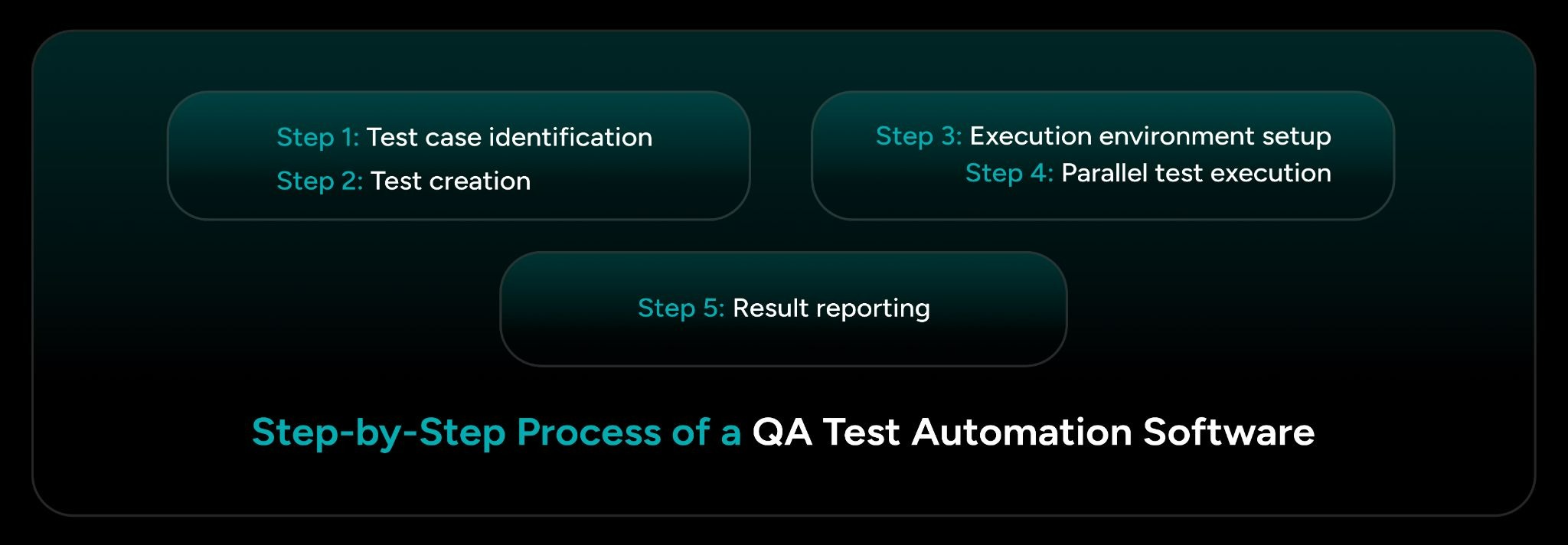
Step 1: Test Case Identification
Engineering teams prioritize which tests to automate first, typically focusing on regression tests, critical-path workflows, and high-frequency scenarios that catch the most impactful bugs early.
Step 2: Test Creation
Tests can be scripted manually, recorded with record-and-playback tools, or generated directly from requirements and Jira tickets using AI, eliminating human error and ensuring alignment with product specifications.
Step 3: Execution Environment Setup
Automated tests are integrated with CI/CD pipelines, ensuring that every commit or merge triggers the appropriate tests without slowing down releases.
Step 4: Parallel Test Execution
Modern QA automation testing tools enable UI, API, and mobile tests to run in parallel, drastically reducing test cycle times while maintaining broad platform coverage.
Step 5: Result Reporting
Test outcomes are automatically logged and analyzed, providing pass/fail results, defect tracing, and coverage mapping. Teams gain real-time visibility into quality and actionable insights for faster remediation.
QA automation software boosts productivity and improves engineering outcomes:

While traditional QA software tools offer generic script execution, engineering leaders frequently find themselves managing fragmented open-source toolchains and fragile scripts.
As an integrated component of SoftSpell’s AI-driven SDLC intelligence platform, TestSpell uniquely unifies fragmented open-source workflows into a single, intelligent testing environment. Its direct requirement-to-test generation, parallel execution across UI, API, and mobile, and traceable reporting set it apart from traditional tools.
Here is exactly how TestSpell bridges the gaps that legacy testing leaves behind:
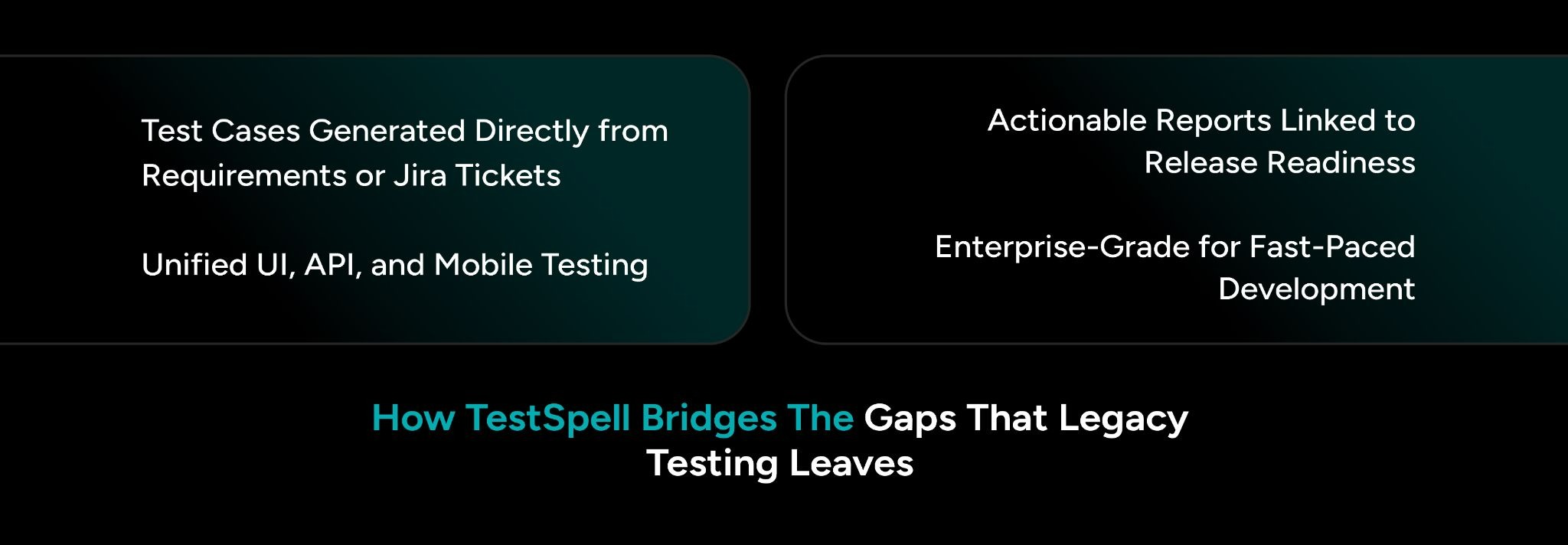
1. Test Cases Generated Directly from Requirements or Jira Tickets
By linking to ReqSpell, TestSpell generates automated tests straight from structured requirements or Jira tickets.
2. Unified UI, API, and Mobile Testing
Instead of juggling multiple tools such as Selenium, Postman, and Appium, TestSpell runs UI, API, and mobile tests in a single parallel workflow.
3. Actionable Reports Linked to Release Readiness
TestSpell reports are organized by module, sprint, or full suite, providing actionable intelligence rather than just pass/fail counts.
4. Enterprise-Grade for Fast-Paced Development
Designed for distributed teams and frequent releases, TestSpell scales QA without adding overhead.
The outcome: Your team delivers releases faster and more reliably, expands test coverage, and achieves end-to-end traceability, all while reducing manual QA toil and complexity. With TestSpell, QA automation benefits becomes your competitive advantage, not just a routine box to check.

The future of high-velocity software delivery isn’t about faster coding alone—it’s about integrating quality into every step. Teams that succeed are those where testing is built into development, not treated as an afterthought.
TestSpell by SoftSpell makes this possible through requirement-driven, AI-generated test cases; parallel execution across UI, API, and mobile, and full traceability. QA, DevOps, and engineering teams can now catch bugs early, maintain consistent coverage, and release with confidence.
For organizations seeking to accelerate delivery, minimize risk, and ensure every release meets business goals, TestSpell stands out as the premier choice for QA test automation software.
Experience smarter QA → Book a TestSpell Demo today.




July 1, 2026
Don’t Miss Out
We share cool stuff about coding, AI, and making dev life easier.
Hop on the list - we’ll keep it chill.

© 2026, SoftSpell. All Rights Reserved


