Flaky tests are slowing enterprise releases, increasing engineering costs, and reducing trust in automation, even with modern automated QA testing tools.
The core issue is not just unstable test scripts. Most flaky failures come from fragmented CI/CD pipelines, poor synchronization, weak requirements traceability, and rapidly changing applications.
TestSpell helps enterprises reduce flaky automation with AI-driven test generation, unified UI/API/mobile testing, and requirement-driven QA workflows that improve release stability and testing visibility.
In this blog, you’ll learn:
Why flaky tests still happen in enterprise QA
The hidden business cost of unstable automation
What causes unreliable automated testing pipelines
How AI-powered QA automation tools improve test stability and release confidence
Your automation pipeline passes in one build and fails in the next, without a single code change. That is the reality of flaky testing for many enterprise engineering teams.
Even with modern QA automation tools, flaky tests continue to slow releases, increase debugging effort, and reduce trust in automated testing.
The problem is often deeper than just unstable scripts. In many cases, flaky tests stem from fragmented workflows, inconsistent environments, poor traceability, and increasing automation complexity across the SDLC.
TestSpell helps enterprises reduce this instability with AI-powered test automation, requirement-driven testing, and unified visibility across QA workflows.
This blog explores why flaky tests persist, the hidden costs they impose, and how modern engineering teams can build more stable and reliable automation pipelines.
Why Do Automated QA Testing Tools Still Produce Flaky Tests?
Most flaky tests are symptoms of fragmented engineering systems rather than poor testing scripts alone.
Automated QA testing tools still produce flaky tests due to the following reasons:
1. Poor Synchronization Handling in UI Automation
2. Unstable Test Environments Across CI/CD Pipelines
3. Weak Requirements-to-Test Traceability
4. Fragile Locators and Frequent UI Changes
5. Test Suites Scaling Faster Than Teams Can Maintain Them
1. Poor Synchronization Handling in UI Automation
Many flaky failures originate from synchronization gaps between application behavior and the automation framework. Even advanced QA automation tools can struggle when applications render asynchronously or depend heavily on dynamic frontend behavior.
Common causes include:
Timing delays between user actions and application responses
DOM rendering issues in modern JavaScript frameworks
API latency is affecting page states and test execution order
Hardcoded waits that fail under varying runtime conditions
In large-scale automated QA testing environments, static synchronization strategies often produce inconsistent results across browsers, devices, and execution pipelines. Instead of reliably validating application behavior, tests become dependent on timing assumptions that break down under real-world conditions.
2. Unstable Test Environments Across CI/CD Pipelines
Flaky tests are often caused by inconsistent environments rather than defective automation logic. Modern automated QA testing software typically runs across distributed CI/CD pipelines, cloud environments, containers, and parallel execution frameworks, where even small infrastructure variations can introduce instability.
Key contributors include:
Environment drift between staging, QA, and production-like systems
Infrastructure inconsistencies across containers or virtual machines
Shared test data conflicts during parallel execution
Cloud scaling instability affecting execution timing and resource allocation
Without strong CI/CD reliability practices, teams experience unpredictable failures that are difficult to reproduce locally, making root-cause analysis significantly harder.
3. Weak Requirements-to-Test Traceability
Flaky automation frequently begins long before execution, during requirement definition and test planning. When requirements lack clarity or proper traceability, automated tests become misaligned with actual business workflows.
This often results in:
Incomplete acceptance criteria
Poorly defined functional expectations
Missing mapping between requirements and test cases
Frequent rework as features evolve
Platforms like TestSpell help reduce these gaps through AI-driven traceability, enabling teams to connect requirements, user stories, and automated test coverage more effectively. Better traceability improves test stability because automation reflects validated workflows rather than assumptions.
4. Fragile Locators and Frequent UI Changes
Modern frontend applications evolve rapidly, and even minor UI updates can break large numbers of automated tests. Flaky behavior often emerges when locators are tightly coupled to unstable interface elements.
Common issues include:
Frontend redesigns changing page structures
Selector instability caused by dynamic IDs or generated classes
Component reuse patterns creating ambiguous element targeting
As applications scale, maintaining resilient locators becomes increasingly difficult, especially when automation frameworks rely heavily on brittle XPath or CSS selector strategies.
5. Test Suites Scaling Faster Than Teams Can Maintain Them
As organizations expand automation coverage, test suites often grow faster than engineering teams can maintain them. Over time, this creates automation debt that directly contributes to flaky behavior.
Typical scaling problems include:
Rising maintenance overhead across large regression suites
Duplicated scripts with inconsistent logic
Regression suite bloat slowing execution and increasing failure noise
Legacy automation frameworks that are difficult to modernize
Without governance, standardization, and intelligent automation management, teams spend more time maintaining unstable tests than improving software quality.
Recent industry reports show how serious the problem has become:
Google engineering research found that nearly 14% of all test executions experience flaky failures in large-scale CI environments.
Microsoft reported that developers can spend up to 30 minutes investigating a single flaky failure before confirming it is not a real defect.
Industry benchmarks estimate that flaky tests consume 15–30% of total CI/CD execution time because of repeated reruns and failed validations.
Bitrise’s 2025 testing report found flaky test occurrences increased from 10% in 2022 to 26% in 2025 across enterprise mobile testing environments.
How Do Flaky Tests Impact Enterprise Engineering Teams?
Flaky tests don't just slow down pipelines; they quietly erode trust in automation and create a compounding cost that spreads across QA, DevOps, and delivery teams.
Reduced Trust in Automation - When tests pass and fail without a consistent reason, engineers stop relying on them. Teams begin ignoring failures, which defeats the entire purpose of automated QA.
Slower Releases - Every unexplained failure triggers an investigation cycle. What should be a straight path to deployment becomes a loop of re-runs, manual checks, and delayed sign-offs.
Increased Debugging Costs - Chasing intermittent failures is among the most expensive and least productive work in engineering. Senior developers get pulled into debugging test infrastructure instead of shipping features.
Delayed Deployments - Flaky tests create uncertainty at the worst possible moment: release day. Teams either delay deployments for investigation or ship with unresolved failures, both of which carry real business risk.
Burnout Across QA and DevOps Teams - Repeatedly triaging the same unstable tests with no clear resolution path erodes morale quickly. It signals a broken process that tooling and process improvements alone often cannot fix.
Additional Operational Impacts
Infrastructure Rerun Costs — Repeated pipeline executions consume unnecessary cloud resources, increase CI/CD expenses, and slow down shared environments.
Developer Productivity Loss — Engineers spend valuable development time validating false failures instead of building features or fixing real defects.
QA Bottlenecks — QA teams become overloaded with reruns, manual validations, and test maintenance, reducing overall testing efficiency.
Release Rollback Risks — Flaky automation can hide genuine defects or trigger incorrect deployment decisions, increasing the likelihood of failed releases and rollbacks.
Impact Area
How Flaky Tests Affect Teams
Business Consequences
Automation Reliability
Engineers stop trusting automated results
Reduced adoption of automation practices
Release Velocity
Frequent reruns and investigations delay deployments
Slower time-to-market
Engineering Productivity
Developers spend time debugging unstable tests
Lower feature delivery output
QA Efficiency
QA teams focus on test maintenance instead of validation
Testing bottlenecks and delayed sign-offs
Infrastructure Usage
Repeated CI/CD reruns consume compute resources
Increased operational costs
Deployment Confidence
Unclear test results create release uncertainty
Higher rollback and production risk
Team Morale
Constant false failures frustrate teams
Burnout across QA and DevOps functions
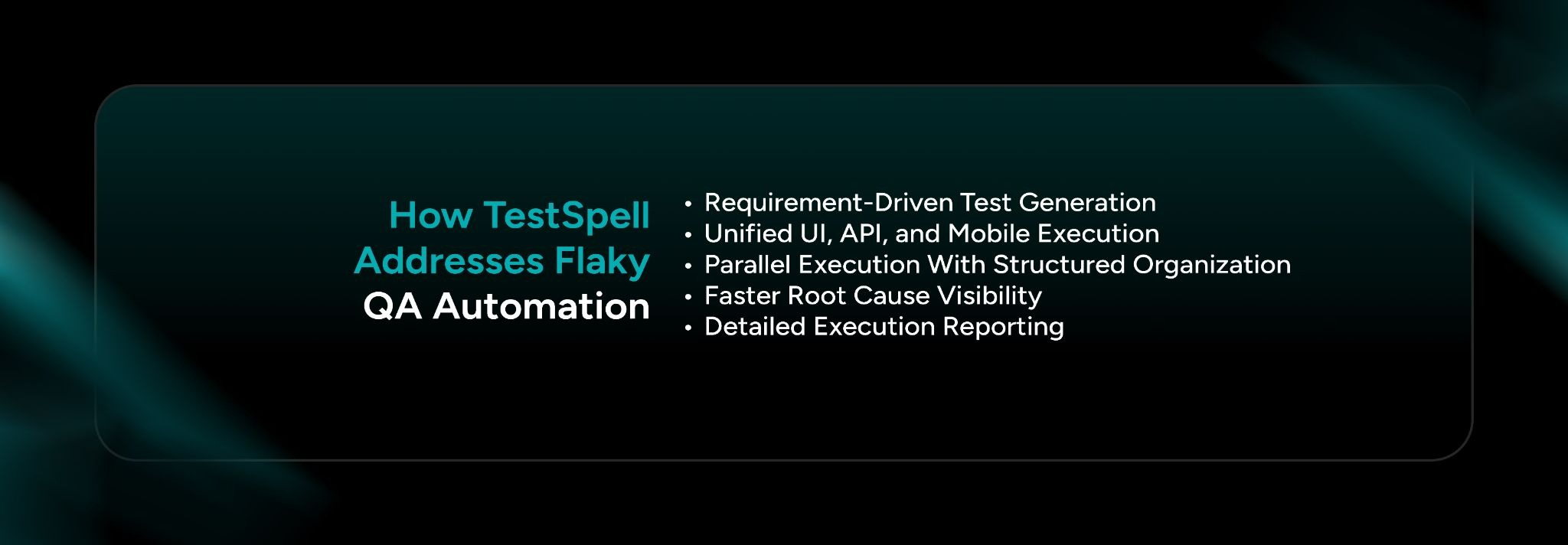
How TestSpell Addresses Flaky QA Automation?
TestSpell tackles flaky automation at the root cause level, not by re-running unstable tests, but by connecting test creation directly to requirements, workflows, and the broader SDLC pipeline from the start.
Requirement-Driven Test Generation - TestSpell generates test cases directly from requirements and JIRA inputs, so every test traces back to a verified business workflow. Tests built on defined requirements are inherently more stable than manually written scripts built on assumptions.
Unified UI, API, and Mobile Execution - Running UI, API, and mobile tests in a single coordinated flow eliminates failures caused by disconnected test logic across separate tools. Coverage is consistent and end-to-end, not fragmented across toolchains.
Parallel Execution With Structured Organization - Tests organized by modules, sprints, or full suites execute in parallel with clear isolation between them. This reduces dependency-related instability and makes it significantly easier to identify the true source of a failure.
Faster Root Cause Visibility - When a test fails, TestSpell surfaces the likely cause immediately and links the failure to the responsible requirement, code change, or environment. Engineering teams spend less time chasing intermittent failures and more time resolving genuine defects.
Detailed Execution Reporting - Rich execution reports give QA, engineering, and product teams clear visibility into failure trends, coverage gaps, and unstable test behavior — so teams can distinguish between real defects and flaky automation without manual investigation. As part of the broader SoftSpell ecosystem, TestSpell also works alongside other AI-powered SDLC products that help teams accelerate development and improve software quality end to end:
ReqSpell - ReqSpell transforms unstructured inputs like PDFs, emails, legacy codebases, product documents, and test plans into structured, traceable requirements. It helps product, engineering, and QA teams align faster through AI-powered requirement extraction, reverse engineering, test coverage validation, and natural language querying across requirements, code, and test artifacts.
CodeSpell - CodeSpell accelerates software development with AI-assisted coding, code generation, optimization, documentation, unit testing, and intelligent code suggestions. It also includes Design Studio capabilities that convert Figma designs into production-ready React, Angular, or React Native applications while simplifying API development, test script generation, and infrastructure setup.
Together, ReqSpell, CodeSpell, and TestSpell provide an integrated AI-powered SDLC intelligence platform that connects requirements, development, testing, and delivery workflows for modern engineering teams.
Conclusion
Flaky tests are no longer just a testing issue; they are a reliability challenge that impacts release velocity, engineering productivity, infrastructure costs, and deployment confidence across the SDLC.
As enterprise applications become more complex, traditional QA automation tools alone are no longer enough. Organizations need intelligent, connected, automated QA testing software that improves traceability, reduces false failures, and stabilizes automation workflows across CI/CD environments.
Stop wasting engineering hours on flaky automation. TestSpell helps enterprises eliminate unstable testing workflows with AI-powered automated QA testing tools built for modern CI/CD pipelines.
Book a demo and see how smarter automation can accelerate releases, reduce false failures, and restore confidence in every deployment.
Automated QA testing tools help engineering teams automate software validation across web, mobile, and API applications. These tools reduce manual testing effort, improve release speed, and increase test coverage across CI/CD pipelines.
2. Why do flaky tests happen in QA automated testing?
Flaky tests usually occur because of unstable environments, synchronization issues, fragile UI locators, inconsistent test data, or weak requirements traceability. Even advanced QA automated testing tools can produce unreliable results if testing workflows are not properly aligned with the SDLC.
3. How does a QA automation tool improve release quality?
A modern QA automation tool helps teams identify defects earlier, reduce repetitive manual work, and improve deployment confidence through continuous testing and automated execution workflows.
4. What should enterprises look for in automated QA testing software?
Enterprises should look for automated QA testing software that supports AI-driven automation, requirement traceability, CI/CD integration, unified reporting, and scalable cross-platform testing capabilities.
5. How does automated QA software reduce flaky testing?
Modern automated QA software reduces flaky testing by improving test stability, synchronization, and CI/CD reliability. AI-driven platforms like TestSpell help teams reduce false failures with requirement-driven testing, unified execution workflows, and better visibility across QA pipelines.


.svg)
.jpg)