


Changelog
July 1, 2026
.svg)

Your releases are slipping. QA is overwhelmed. A common debate arises: automate more, or add manual testers?
Wrong question.
The test automation vs. manual testing debate has been framed as a competition for decades, and that framing is costing engineering teams time, money, and production stability. The truth is, neither approach alone can carry the weight of modern software quality.
The best QA teams deliver value by letting automation handle repetitive, predictable tests at scale, while human testers focus their expertise on the nuanced, creative challenges automation can't address.
By the end of this blog post, you'll have actionable steps to build that crucial QA balance, and you'll know exactly what to do next to move your team from nervous releases to confident launches. Ready to level up your QA? Read on.
Before you can build a smarter testing strategy, you need to understand what each approach actually does, and more importantly, what it was designed to do.
Manual testing is the process of validating software through direct human interaction without relying on automated scripts. A tester executes workflows, observes system behavior, identifies inconsistencies, and evaluates whether the application behaves as expected from a real user’s perspective.
Teams commonly use manual testing during:
Automation cannot fully replace human judgment. Manual testing still delivers critical value in areas where context, intuition, and user experience matter more than scripted validation.
Automated testing uses scripts, frameworks, and tools to execute predefined test cases. Instead of manually repeating workflows, teams automate software testing to continuously validate functionality across environments, browsers, devices, and releases.
Modern automated software testing solutions integrate directly into CI/CD pipelines, allowing teams to detect failures before code reaches production.
Automation is commonly used for:
Automation becomes essential when speed, scale, and repeatability are the priority.

Reasons why treating test automation vs manual testing as a binary choice can harm your business:
Most discussions about test automation vs. manual testing frame the decision the wrong way: either automate everything or rely entirely on manual QA. In reality, modern engineering teams rarely succeed with either extreme.
Both approaches solve different quality problems, and relying too heavily on one creates operational risks that eventually affect release speed, software stability, and customer trust.
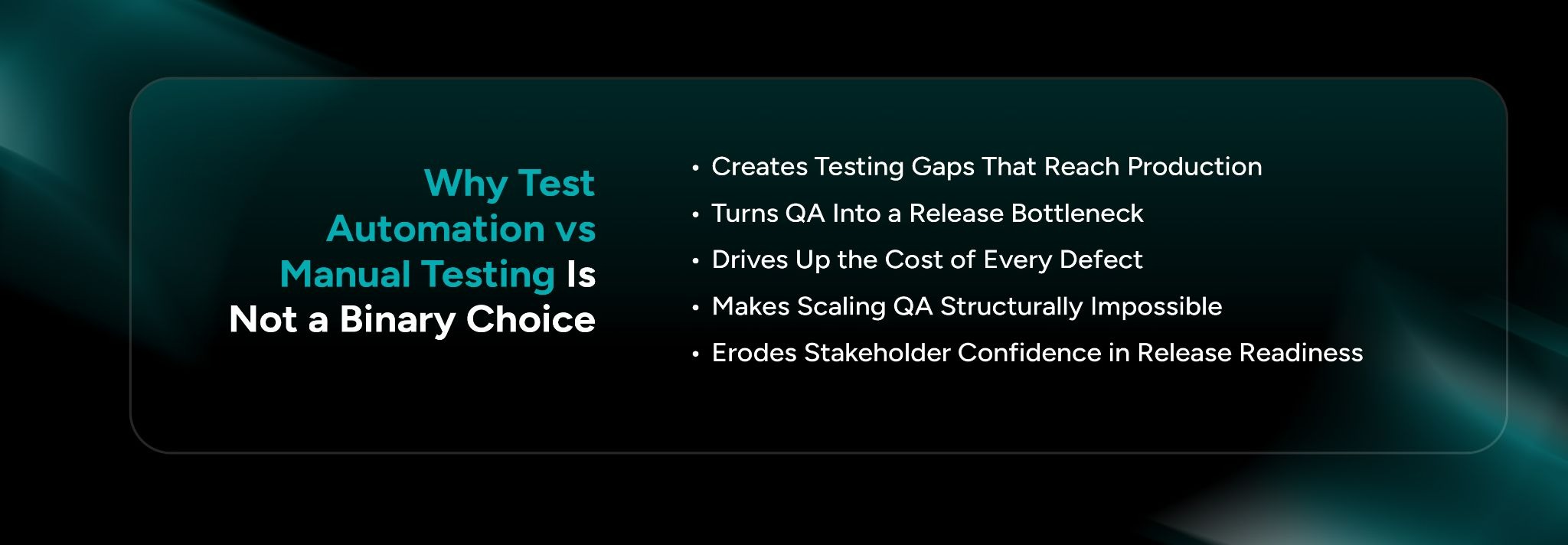
1. It Creates Testing Gaps That Reach Production
Every testing strategy has blind spots. Automation excels at repetition and scale but struggles with context, usability, and unexpected user behavior. Manual testing catches many of these issues through human exploration, but it cannot realistically validate every regression scenario in fast-moving release cycles.
When teams lean too far in either direction, coverage gaps appear quickly.
2. It Turns QA Into a Release Bottleneck
QA should accelerate release confidence, not delay delivery pipelines. But teams operating at either extreme often create bottlenecks that slow engineering velocity.
Manual-heavy teams usually tie release schedules to tester availability. As sprint cycles shorten, QA teams struggle to complete validation before deployment deadlines.
At the other end, over-automated teams often spend more time fixing broken scripts than testing new functionality. Test maintenance becomes a hidden engineering workload that quietly grows every sprint.
In both cases:
3. It Drives Up the Cost of Every Defect
The later a defect is discovered, the more expensive it becomes to fix. That cost increases even further when bugs reach production environments.
Teams that overtrust automation often ignore flaky tests because the suite becomes unreliable over time. Once confidence in automation drops, critical failures begin slipping through unnoticed.
Teams relying mostly on manual testing face a different problem. Limited regression coverage means testers prioritize only high-risk flows, leaving smaller but still costly defects undiscovered.
This creates three major problems:
4. It Makes Scaling QA Structurally Impossible
As products grow, testing complexity grows with them. The wrong QA strategy makes scaling almost impossible.
Manual-only environments scale by adding more testers. Over time, QA costs increase linearly with product complexity, release frequency, and platform coverage requirements.
Automation-only environments face a different issue: script debt. Poorly maintained automation frameworks become fragmented, unstable, and difficult to update as applications evolve.
Neither model scales efficiently on its own.
High-performing engineering organizations solve this differently. They combine automated software testing solutions for repetitive validation with manual expertise for exploratory and experience-driven testing. That balance allows coverage to grow without increasing costs at the same pace.
5. It Erodes Stakeholder Confidence in Release Readiness
One of the biggest hidden risks in a poor QA strategy is uncertainty. When teams cannot fully trust either their automation coverage or their manual validation process, release decisions become guesswork.
Product managers, engineering leaders, and DevOps teams lose visibility into actual release readiness.
That usually leads to one of two outcomes:
The balance between manual and automated testing becomes even more critical in industries where speed, accuracy, compliance, and customer experience directly affect business outcomes.
1. Fintech
Financial platforms depend heavily on automated software testing solutions for compliance reporting, API validation, transaction consistency, and audit-ready documentation. Automation provides the repeatability that regulators expect.
But transaction edge cases, fraud scenarios, and workflow anomalies often surface only through manual exploration. Missing either side creates serious financial and regulatory risk.
2. eCommerce
eCommerce platforms use automation to validate thousands of SKUs, pricing rules, payment flows, and cross-device checkout scenarios during high-traffic periods. But automation alone cannot fully validate customer behavior.
Checkout friction, broken personalization logic, and confusing user experiences still require human testing because scripts cannot measure why customers abandon carts.
3. Healthcare
Healthcare applications require far more than simple pass/fail validation. Clinical workflows, patient interactions, and decision-support systems often need manual verification to ensure outcomes make sense in real-world use.
In regulated healthcare environments, teams automate repetitive functional testing while manually validating clinical logic, compliance-sensitive flows, and patient-impact scenarios. This balance is not optional. It is often required for audit and risk management purposes.
Most testing tools force teams to choose between automation and manual QA. TestSpell by SoftSpell is built for hybrid testing, where both approaches work together within a single workflow.

TestSpell uses AI to simplify test case creation, execution, reporting, and maintenance. It helps teams automate software testing without losing the human validation modern applications still need.
Key capabilities include:
1. AI Decides What to Automate
TestSpell identifies repeatable, automation-ready scenarios, reducing the constant sprint-by-sprint debate over what to automate.
This allows QA teams to:
2. Requirement-Driven Automation
TestSpell generates tests directly from requirements and Jira tickets, automating only clearly defined workflows.
This leaves:
for manual QA, where human judgment matters most.
3. One Platform for Both Testing Modes
Instead of managing separate manual and automated tools, TestSpell unifies the following:
inside a single platform.
This eliminates reporting gaps and provides QA leaders with complete visibility into release coverage.
4. AI Maintenance Reduces Script Debt
Automation often fails because teams spend too much time fixing broken scripts.
TestSpell uses AI to automatically adapt tests as applications change, helping teams:
5. Unified Reporting Across QA
TestSpell combines automated runs, manual validation results, and coverage insights into one dashboard.
This gives:
What makes TestSpell more effective is that it operates within the broader SoftSpell AI-powered SDLC platform. Instead of treating testing as an isolated stage, SoftSpell integrates requirements, development, and QA into a single continuous workflow.
ReqSpell converts documents, Jira tickets, spreadsheets, and feedback into structured requirements, helping QA teams avoid gaps caused by unclear specifications.
This helps teams:
As engineering teams ship faster, QA often struggles to keep coverage aligned with rapid code changes. CodeSpell helps reduce that gap by accelerating code generation and repetitive development work.
Combined with TestSpell, teams get:
Together, CodeSpell and TestSpell create a more connected and scalable SDLC workflow.

The test automation vs. manual testing debate was never meant to have a winner. The teams shipping confidently without sacrificing speed or quality aren't choosing sides. They're combining automation's consistency and scale with human judgment's depth and adaptability.
That balance is exactly what TestSpell is built for. TestSpell's intelligent test automation doesn't replace your QA team's expertise; it amplifies it. From automated test case generation and parallel execution to end-to-end UI, API, and mobile coverage, TestSpell gives your team the infrastructure to automate what should be automated and the bandwidth to focus human effort where it genuinely matters.
The result: faster releases, stronger coverage, and a QA strategy that actually scales.
Schedule a demo or explore TestSpell to get started today.




July 1, 2026
Don’t Miss Out
We share cool stuff about coding, AI, and making dev life easier.
Hop on the list - we’ll keep it chill.

© 2026, SoftSpell. All Rights Reserved


