


Changelog
July 1, 2026
.svg)
.jpg)
Most teams adopt QA automation expecting one thing: speed. What they get, when done right, is something far more transformative. The problem is that many organizations treat automation as a scripting exercise: automate a few regression flows, plug them into a pipeline, and call it done.
That approach works until it doesn't. Scripts break, suites bloat, and confidence erodes. The real qa automation benefits only surface when teams stop thinking in scripts and start thinking in systems.
This blog explores that shift, from isolated test scripts to interconnected, intelligent quality pipelines. You'll learn where script-based automation breaks down, what systems thinking actually means for QA, and how modern platforms that help teams make that transition at enterprise scale.
At first glance, QA automation looks like a technical activity: write a script, run it, check the result. But the teams consistently getting value from automation aren't just writing better scripts; they're building better systems. Understanding the difference between these two approaches is the foundation for unlocking the true depth of test automation benefits.
Most teams adopt automation, expecting speed. What they actually gain is a fundamental shift in how quality is owned across the entire delivery pipeline.
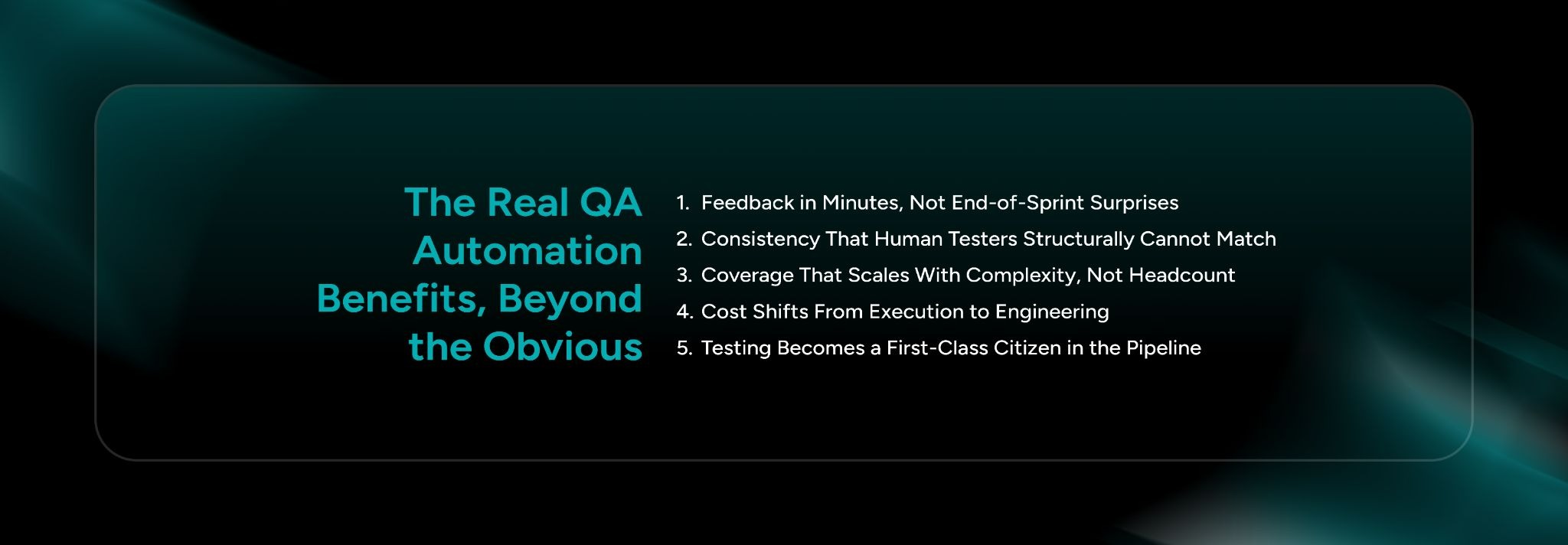
1. Feedback in Minutes, Not End-of-Sprint Surprises
Manual regression cycles take 3–5 days per sprint. Automation compresses that to a parallel run completed before the next standup. The speed benefit is real, but the more important gain is timing. A broken API contract caught at commit time takes minutes to fix. The same issue caught in UAT derails a release and costs days of engineering time.
When automated QA testing software is integrated directly into CI/CD pipelines, every code change automatically triggers a test run. Teams don't wait for a QA handoff; they get immediate, actionable signals. That shift from reactive to proactive quality is where automation starts paying for itself in ways that go far beyond raw execution speed.
2. Consistency That Human Testers Structurally Cannot Match
A manual tester running the same scenario across 12 browser-OS combinations will miss steps, vary inputs, and fatigue. Automation doesn't. Every run is identical, same data, same sequence, same assertions across all environments. There is no cognitive load, no end-of-day fatigue, and no variation in how edge cases are handled.
This matters most during regression, where subtle differences in execution hide real defects. A flicker in a dropdown, a timing issue in a form submission, a missed assertion in a multi-step workflow- these are the defects that slip through manual testing and surface in production. Automated qa testing tools eliminate that variability structurally, not by trying harder, but by being incapable of inconsistency.
3. Coverage That Scales With Complexity, Not Headcount
Manual QA scales linearly with people. If you double your test surface, you need roughly twice as many testers. Automation scales with compute. Parallel execution lets a small team validate hundreds of scenarios simultaneously, across devices, browsers, configurations, and data sets, coverage that's physically impossible to maintain manually as products grow.
This is one of the most significant test automation benefits for fast-scaling teams. You don't need to grow your QA team proportionally to your product. You invest in a smarter, broader testing system, and that system grows its coverage capacity alongside your product without a matching increase in headcount or cost.
4. Cost Shifts From Execution to Engineering
The recurring cost of manually retesting the same flows every sprint compounds into significant waste over 12–18 months. Running the same 200 test cases by hand every two weeks across multiple environments adds up to hundreds of engineering hours that never yield a new insight. It produces a status report.
Automation redirects that time. Once a suite is in place, execution is free. The recurring cost shifts from running tests to improving them. QA engineers move from test execution to exploratory testing, test strategy, and edge-case discovery, work that requires human judgment and yields higher defect discovery rates. That's a structural improvement in how quality engineering time is spent.
5. Testing Becomes a First-Class Citizen in the Pipeline
Every commit triggers a test run. Every pull request is validated before being merged. Release gates are enforced without waiting for manual sign-off. Teams that integrate testing this way don't just release faster, they release with measurably higher confidence.
This is the core of what qa automation requirements look like in a modern DevOps environment. Testing isn't a phase that happens after development. It's a continuous signal that runs alongside development, surfacing issues as they're introduced rather than weeks later. That integration makes quality a shared responsibility across the entire team, not a final checkpoint owned by one department.
When automation is treated as a system rather than isolated scripts, testing becomes smarter, more predictive, and better aligned with business priorities. It reduces wasted test runs and increases confidence in quality across releases.
Reduced Redundancy and Smarter Execution
Not every test needs to run on every commit. A change to the payment module doesn't require running the full marketing flow suite. Systems thinking introduces test impact analysis, the ability to run tests that matter most based on which code actually changed.
This reduces pipeline time, lowers infrastructure cost, and surfaces critical failures faster by eliminating noise from unrelated tests. Teams that operate this way run smarter suites, not just bigger ones.
Stronger Developer-QA Collaboration
One of the most undervalued test automation benefits is what it does to team dynamics. When QA and development share the same tooling, dashboards, and quality metrics, defect conversations change. Instead of "QA found a bug in testing," the conversation becomes "our pipeline flagged a regression at commit X, here's the trace."
Shared metrics create shared ownership. Better defect insights mean faster resolution. And when developers can see test results in their own workflows, without waiting for a QA report, feedback loops tighten dramatically.
Greater Scalability Across Platforms
Modern products don't run on one browser on one device. They run on Chrome and Safari, iOS and Android, desktop and tablet, in six regions with different network conditions. Automated QA testing software enables multi-device, multi-platform test execution with resilience by running the same suite across every relevant configuration in parallel, without a proportional increase in time or effort.
Systems thinking ensures that as the product expands into new platforms, the testing architecture expands with it, not by rewriting everything, but by extending a modular, well-designed foundation.

TestSpell is SoftSpell's AI-powered test automation platform built for enterprises that need speed, coverage, and confidence across every release. It doesn't just automate tests; it builds the kind of intelligent testing system that the systems-thinking approach demands.
1. Requirement-Driven Test Case Generation
TestSpell generates test cases directly from requirements or JIRA inputs, eliminating the need to start scripting from scratch. Testing begins early in the SDLC, thereby reducing the cost of late-stage defect discovery. Clear traceability is maintained between what was planned, what was specified, and what was actually tested, giving teams full visibility into coverage gaps before a release goes out.
2. Unified API, UI, and Mobile Testing in One Flow
Rather than managing separate tools for UI, API, and mobile testing, TestSpell runs all three within a single unified workflow. Tests can be organized by modules, sprints, or full suites to match your development structure. This unification reduces context-switching, eliminates tool sprawl, and ensures that cross-layer defects, the kind that only appear when UI, API, and mobile interact, are caught within a single execution environment.
3. Parallel Execution for Maximum Coverage
TestSpell executes multiple test scenarios simultaneously across environments and configurations. What used to be days-long QA cycles compress to hours or minutes. Coverage scales with the product without a proportional increase in manual effort, delivering the compute-driven scalability that defines mature automated qa testing tools.
4. Detailed Reports and Quality Visibility
Every run produces execution reports with clear defect insights that go beyond basic pass/fail results. Shared metrics bridge the gap between QA and development, enabling faster and more informed defect resolution. Teams don't just know what failed; they understand why, where, and the impact on the broader release.
5. SDLC-Integrated Testing That Moves With Development
TestSpell plugs directly into CI/CD pipelines, enabling continuous testing without disrupting release velocity. It scales to enterprise compliance and delivery goals across large, distributed teams, ensuring that testing doesn't become a bottleneck as complexity grows but instead becomes a competitive advantage embedded at every stage of delivery.

Explore TestSpell and see how SoftSpell helps enterprises build testing infrastructure that keeps pace with modern software delivery.
QA automation benefits are not realized the moment you write your first automated test. They compound, over sprints, over releases, over the lifetime of a product, when automation is designed as a system rather than a collection of scripts.
The shift from script-based thinking to systems thinking is what separates teams that struggle with brittle suites and maintenance debt from teams that release with speed and confidence.
By embracing that shift, organizations unlock faster feedback, consistent coverage, scalable execution, and a quality culture where testing is built into the pipeline rather than bolted on at the end. Platforms like TestSpell by SoftSpell make that transition practical, turning QA automation from a tactical tool into a strategic, enterprise-grade capability.
Explore TestSpell and book a demo now!




July 1, 2026
Don’t Miss Out
We share cool stuff about coding, AI, and making dev life easier.
Hop on the list - we’ll keep it chill.

© 2026, SoftSpell. All Rights Reserved


