


Changelog
July 1, 2026
.svg)

Featured Snippet
The best enterprise testing software in 2026 replaces legacy QA tools by automating test creation, running tests in parallel across UI, API, and mobile, and integrating natively with CI/CD pipelines. The top five platforms are TestSpell, Testsigma, TestComplete, Katalon Studio, and testRigor. TestSpell leads for enterprises that need requirement-to-test automation, real-time reporting, and full traceability without adding QA overhead.
TL;DR: The 30-Second Takeaway
Legacy QA tools slow modern release cycles with manual scripting, flaky automation, and disconnected workflows. In 2026, teams need AI-powered QA platforms that automate test generation, accelerate regression testing, and integrate directly into CI/CD pipelines. This guide compares five leading QA testing tools, including TestSpell.
A release is ready to ship, but the QA cycle is still running. Developers wait for regression results, product teams delay deployments, and critical fixes pile up while legacy testing tools struggle to keep pace with modern delivery cycles.
Many traditional QA platforms were built for a slower era of software development. They rely on manual configuration, fragmented workflows, sequential execution, and disconnected reporting systems that create delays across Agile and CI/CD environments.
Modern enterprises need testing platforms that can support continuous delivery, distributed teams, and large-scale automation without slowing releases down.
This is why many organizations are moving toward AI-powered enterprise testing software that combines automation, real-time visibility, and integrated workflows in a single platform.
In this blog, we compare five of the best enterprise testing software solutions helping teams replace outdated QA processes, improve testing efficiency, and accelerate software delivery.
We also explore how SoftSpell’s TestSpell is helping enterprises modernize testing with AI-driven automation and CI/CD-native workflows.
Before comparing tools, it is worth being specific about what legacy QA tooling actually costs.
The numbers make the case. Legacy tools do not just slow teams down. They create compounding costs that grow with every sprint.
Comparing the 5 Top Enterprise Testing Software Programs
Choosing the right testing platform depends on your team’s automation needs, scalability requirements, and development workflows. The table below compares five leading enterprise testing solutions for modern enterprises.
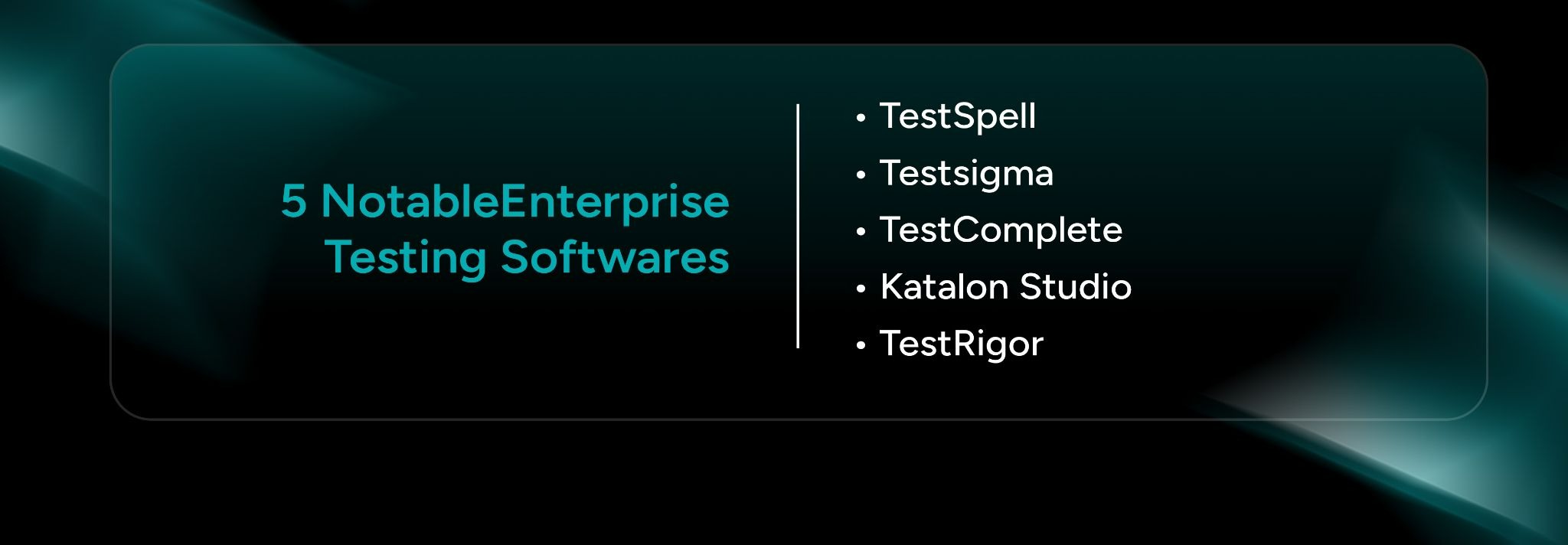
The 5 best enterprise testing software are:
1. TestSpell
2. Testsigma
3. TestComplete
4. Katalon Studio
5. testRigor
1. TestSpell
Legacy QA tools were built for a different era, one where testing happened at the end of development, release cycles moved slowly, and teams could afford long regression windows. Modern engineering teams operate very differently. Continuous delivery, Agile sprints, distributed teams, and CI/CD pipelines require testing to keep pace with development.

TestSpell is designed specifically for enterprises that have outgrown those limitations. Built as an AI-powered enterprise testing platform, it helps teams automate the entire testing lifecycle — from requirement analysis to execution reporting — while integrating directly into existing SDLC workflows.
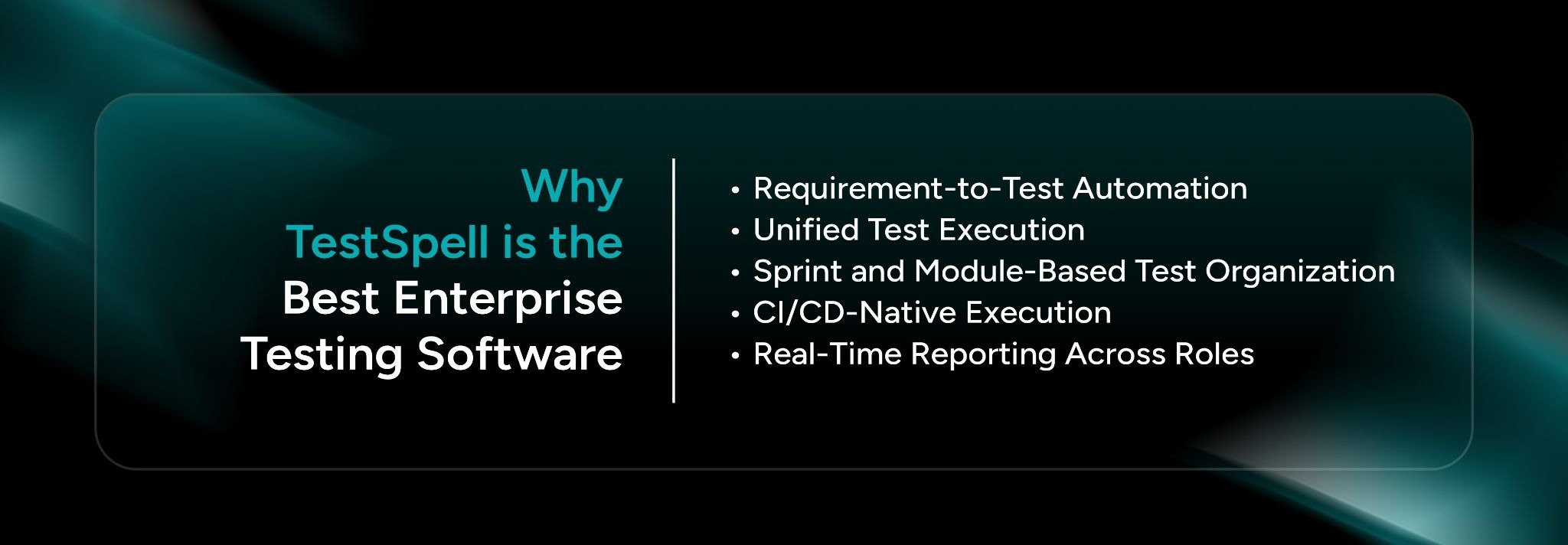
Requirement-to-Test Automation
Automatically generate test cases from requirements, JIRA stories, OpenAPI files, and plain-English inputs to reduce manual QA effort and improve traceability.
Unified Test Execution
Run UI, API, and mobile tests from a single platform with parallel execution support, eliminating fragmented QA workflows and tool sprawl.
Agile Test Organization
Organize testing by sprints, modules, features, regression suites, and release cycles for better visibility and scalable test management.
CI/CD-Native Workflows
Integrate testing directly into CI/CD pipelines to enable continuous validation, faster feedback, and reduced release bottlenecks.
Real-Time Reporting
Access live dashboards, HTML reports, video playback, root cause analysis, and release readiness insights across QA, engineering, and product teams.
Why Choose TestSpell
TestSpell addresses these challenges through AI-powered automation, unified testing workflows, and continuous execution integrated directly into the SDLC.
Instead of simply automating existing manual processes, the platform modernizes enterprise testing end-to-end.
By combining requirement-driven automation, scalable execution, real-time reporting, and CI/CD-native workflows, TestSpell helps enterprises reduce operational overhead while improving software quality and release speed.

2. Testsigma
Testsigma is built around Behavior Driven Development, making it a strong fit for teams that want QA and development working from the same specification language. Test cases are written in plain English using a Gherkin syntax, which reduces the communication gap between business stakeholders and engineering.
The platform supports web, API, and mobile testing with cloud execution built in. Setup is faster than most legacy tools, and the collaboration features work well for distributed Agile teams.
Key Features
• Full BDD support with Gherkin-based test authoring in plain English
• Cloud-based parallel test execution across browsers and devices
• Visual testing and accessibility testing modules
3. TestComplete
TestComplete from SmartBear is one of the most established names in enterprise test automation. It covers web, desktop, and mobile testing with strong support for a wide range of technologies, including legacy desktop applications that many newer tools simply cannot handle.
The low-code interface makes test creation accessible to QA engineers who are not developers, while the underlying scripting engine gives technical teams full flexibility when they need it.
Key Features
• Broad technology support: web, desktop (Win32, WPF, .NET), and mobile
• Low-code test creation with optional scripting in Python, JavaScript, or VBScript
• Integrations with Jenkins, Azure DevOps, JIRA, and other enterprise toolchains
4. Katalon Studio
Katalon Studio positions itself as an all-in-one testing platform with a free tier that gives smaller teams access to enterprise-level automation capabilities. It covers web, API, mobile, and desktop testing from a single interface, with a built-in IDE, reporting dashboard, and CI/CD integration.
The platform has grown significantly since its initial release and now includes AI-assisted test maintenance, self-healing scripts, and visual testing. The free tier is genuinely functional, not a limited trial.
Key Features
• Free tier with full automation capabilities for web, API, and mobile
• Self-healing test scripts that adapt to minor UI changes without breaking
• Katalon TestOps for centralized test management and analytics across projects
5. testRigor
testRigor takes a different approach to enterprise test automation. Instead of scripting languages or low-code builders, testers write test cases in plain English, and the platform interprets and executes them. There is no test maintenance burden from selector changes, no brittle XPath dependencies, and no requirement for QA engineers to have coding skills.
The platform is cloud-based, execution is fast, and setup time is measured in hours rather than weeks. For enterprises where QA is handled by non-technical team members or where speed of setup is the primary constraint, testRigor removes most of the barriers.
Key Features
• Plain English test authoring with no coding or scripting required
• Cloud-based execution with no infrastructure to manage
• Automatic handling of dynamic elements, reducing test maintenance significantly

Legacy QA tools struggle because modern software delivery moves faster than traditional testing workflows were designed to handle.
Today’s enterprises need testing platforms that support Agile development, CI/CD pipelines, and continuous delivery without creating release bottlenecks.
While each platform covered in this blog offers valuable capabilities, TestSpell stands out for enterprises looking to modernize QA with AI-powered automation, unified UI/API/mobile testing, CI/CD-native execution, and real-time reporting.
For teams managing large-scale releases and distributed engineering workflows, TestSpell provides a faster, more scalable, and enterprise-ready alternative to legacy QA tools.
Ready to replace your legacy QA tooling?
Book a demo and see how TestSpell fits into your existing CI/CD workflow, from JIRA story to test execution to real-time reporting, without adding QA overhead.




July 1, 2026
Don’t Miss Out
We share cool stuff about coding, AI, and making dev life easier.
Hop on the list - we’ll keep it chill.

© 2026, SoftSpell. All Rights Reserved


