


Changelog
July 1, 2026
.svg)
.png)
AI-powered requirements analysis converts unstructured inputs into structured, traceable specifications, reduces ambiguity, and accelerates delivery. SoftSpell’s ReqSpell automates extraction, validation, and end-to-end traceability throughout the SDLC to ensure reliable outcomes.
Here's something most CTOs and engineering leaders already know but rarely admit out loud: software projects don't fail because of bad code. They fail because of bad requirements.
The Standish Group found that 80% of software project failures trace back to requirements-related issues, not bugs, infrastructure, or team size. And yet, for most teams, software development requirements analysis is still a manual, inconsistent, and painfully slow process, one where critical details get lost in email threads and stakeholder meetings produce conflicting specs, and developers start building the wrong thing before anyone notices.
The good news? AI-driven software development doesn't just speed up requirements analysis; it introduces capabilities that manual processes can't match, such as consistently identifying hidden ambiguities and automatically surfacing key requirements.
According to statistics, as of 2026, around 53% of software teams rely on AI to guide early-stage planning and requirements analysis, and the teams doing it right are seeing fewer defects, faster delivery, and far less downstream rework.
This post breaks down exactly what AI-powered software development requirements analysis means in practice, where traditional approaches break down, and what it looks like when teams get it right.
Software development requirements analysis is the process of identifying, documenting, and validating the needs of a software system before design or development begins. It's where business intent gets translated into technical direction.
Get it right, and everything downstream, including architecture decisions, sprint planning, QA coverage, and release timelines, moves faster and with far fewer surprises. Get it wrong, and you're paying for that mistake in rework cycles for months.
Most teams understand this in theory. In practice, they're still doing it the hard way. This brings us to why the traditional process often falls short.
Please read: AI Requirements Gathering
AI transforms the SDLC requirements gathering process through the following:
If traditional software development requirements gathering is like trying to assemble a puzzle with half the pieces in different rooms, AI brings all the pieces to the table, tells you which are missing, and flags the ones that don't fit before anyone starts building.
This isn't about replacing business analysts or product managers. AI uniquely eliminates manual, error-prone steps by automatically standardizing requirements, revealing subtle inconsistencies, and maintaining accuracy at a scale that manual methods cannot match, thereby reducing project risk.
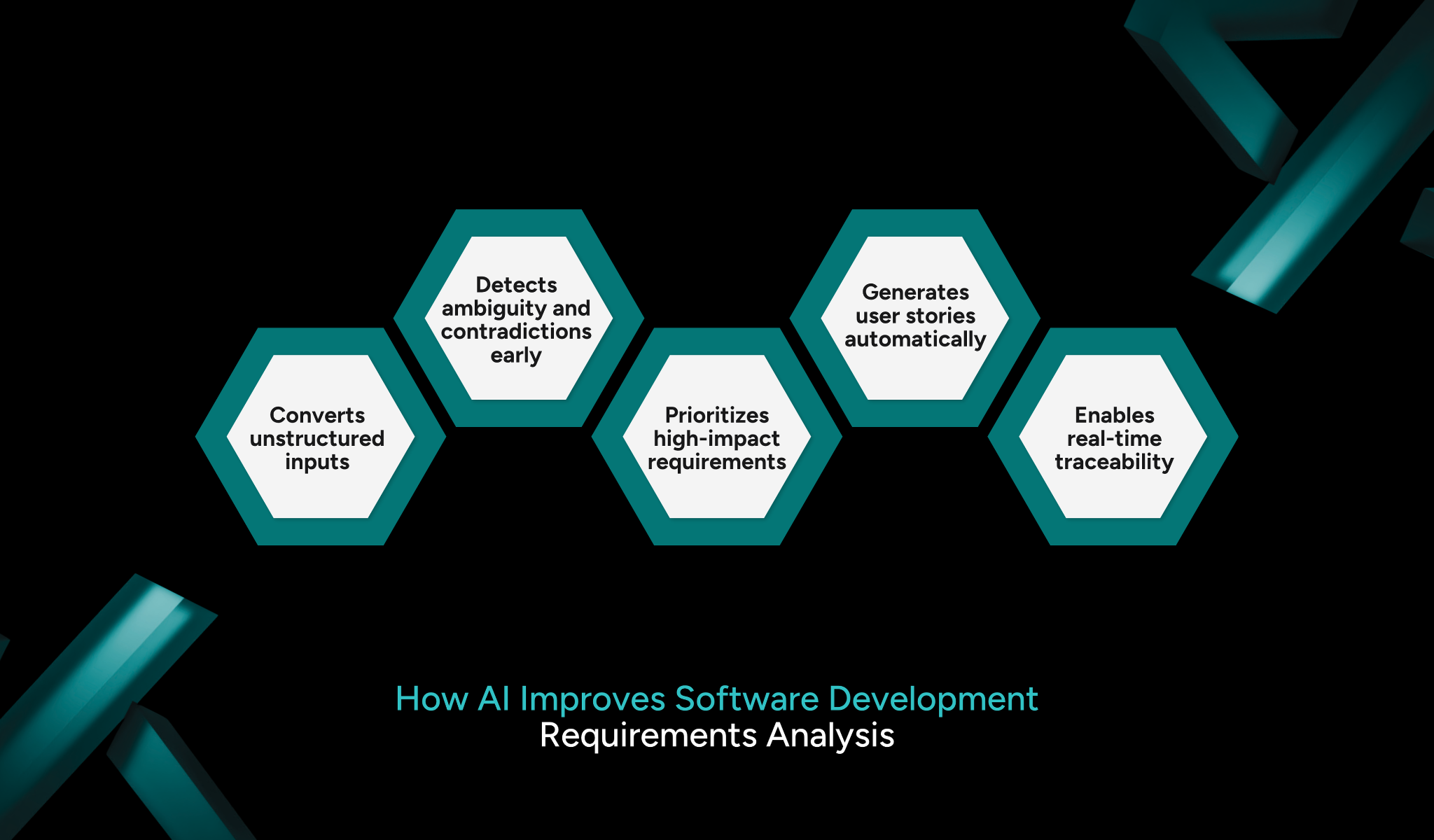
Here's what actually changes when AI enters the requirements process:
Further read: ReqSpell Knowledge Graph

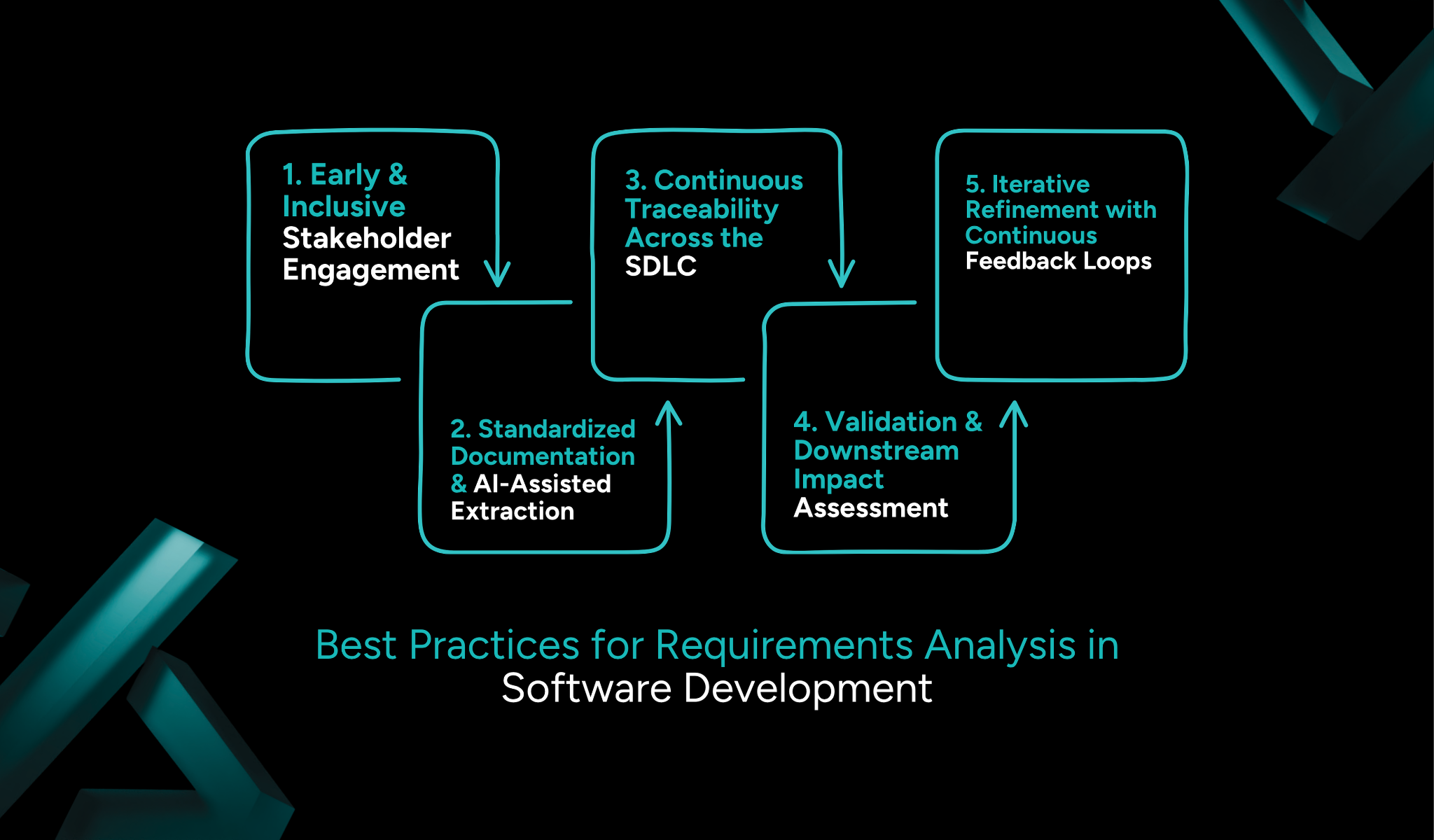
The best practices for requirements analysis in the AI software development lifecycle are:
1. Early & Inclusive Stakeholder Engagement
2. Standardized Documentation & AI-Assisted Extraction
3. Continuous Traceability Across the SDLC
4. Validation & Downstream Impact Assessment
5. Iterative Refinement with Continuous Feedback Loops
Adopting AI for SDLC requirements gathering isn't just a tooling decision; it's a process shift.
Here are five practices that separate teams doing this well from those still struggling with the same old problems.
1. Early and Inclusive Stakeholder Engagement
Requirements fail when the right people aren't in the room early enough. Before any AI tool can do its job, you need structured inputs from every stakeholder who shapes what the product must do.
AI amplifies the quality of your inputs; it doesn't fix their absence. Prioritize:
2. Standardized Documentation and AI-Assisted Extraction
Inconsistency is one of the highest hidden costs in traditional software development requirements gathering: different BAs, different formats, and different interpretations. Standardized templates fix the structure. AI-assisted extraction fixes the human error. Together they ensure:
3. Continuous Traceability Across the SDLC
Without traceability, a scope change at the product level creates invisible downstream chaos. AI-powered traceability keeps every link live throughout the software development life cycle requirements analysis process.
4. Validation and Downstream Impact Assessment
Writing requirements is one thing; knowing they're complete, conflict-free, and safe to build against is another. AI-powered validation simulates downstream consequences before developers pick up a ticket:
This is where requirements-gathering software tools deliver some of their clearest, most measurable ROI.
5. Iterative Refinement with Continuous Feedback Loops
Requirements are rarely perfect on the first pass. High-performing teams treat them as living documents, not frozen handoffs. AI makes iterative refinement practical:
Also read: Requirements Gathering Questions
ReqSpell fits into the broader SoftSpell SDLC platform in the following ways:
1. Requirement Grooming
2. Legacy Code Reverse Engineering
3. Test Coverage Validation
4. Cross-Team Alignment via Natural Language
5. Built-In Traceability
6. Secure by Design
Most SDLC tools assume your requirements are already clean, structured, and agreed upon before you start. ReqSpell doesn't make that assumption because in the real world, they never are.
ReqSpell transforms scattered, unstructured inputs into structured, traceable, production-ready specifications, a capability most SDLC tools skip entirely.
And because it sits within the broader SoftSpell platform, every requirement it produces connects directly to design, AI code generation, testing, and deployment. It does not exist as a separate artifact but as a live thread running through the entire delivery lifecycle.
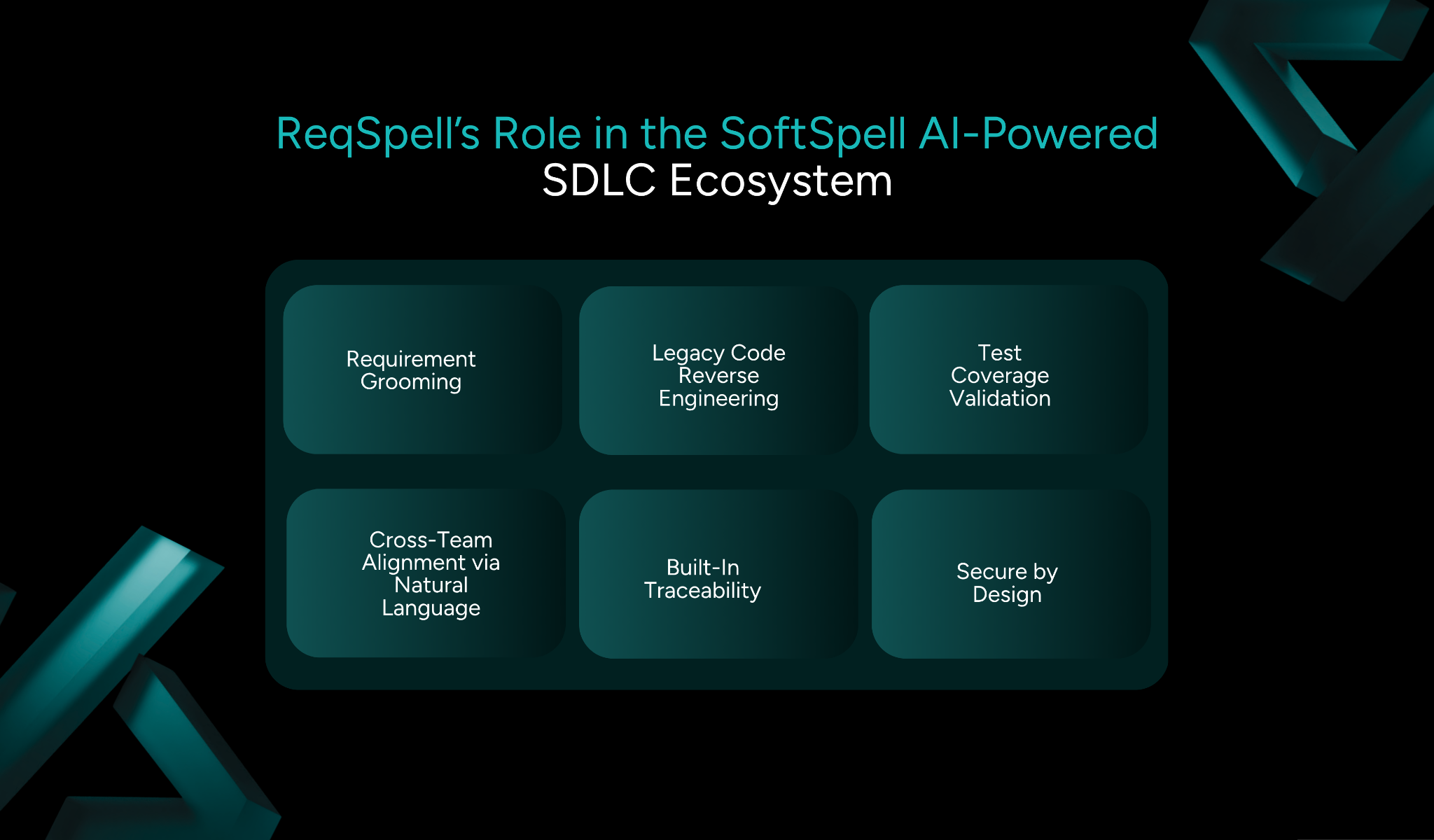
Here's what that looks like across each capability:
1. Requirement Grooming
Most teams spend more time organizing requirements than actually analyzing them. ReqSpell eliminates that overhead:
2. Legacy Code Reverse Engineering
Undocumented legacy systems are among the biggest blockers to enterprise modernization. ReqSpell surfaces what's actually there:
3. Test Coverage Validation
In traditional software development requirements analysis, the gap between what was specified and what was tested only becomes visible during QA, or worse, post-release. ReqSpell closes that gap earlier:
4. Cross-Team Alignment via Natural Language
Alignment meetings exist largely because stakeholders can't easily query across the systems that hold project knowledge. ReqSpell changes that dynamic:
5. Built-In Traceability
This is where ReqSpell's integration with the broader SoftSpell platform becomes genuinely powerful. Rather than traceability being a reporting exercise done after the fact:
6. Secure by Design
For enterprise teams operating in regulated industries or distributed environments, security and access control aren't optional; they're baseline requirements:
Further read: Choosing the Right Requirement Management Tool for Enterprise
Every defect caught in QA, every sprint derailed by conflicting specs, and every rework cycle that blows a release deadline almost always trace back to the same root cause: requirements that were vague, incomplete, or never properly validated.
Software development requirements analysis isn't a preliminary step you get through before the real work starts. It is the real work. Get it right, and every stage downstream: design, development, testing, deployment moves faster and with fewer surprises. Get it wrong, and you're paying for it repeatedly, at every stage.
AI shifts this from reactive to proactive. Problems caught at the requirements stage cost a fraction of what they cost in QA or production.
ReqSpell is purpose-built for exactly this, not a feature bolted onto a code assistant, but a dedicated requirements intelligence layer designed to make everything built after it more accurate, more traceable, and faster to deliver.



July 1, 2026
Don’t Miss Out
We share cool stuff about coding, AI, and making dev life easier.
Hop on the list - we’ll keep it chill.

© 2026, SoftSpell. All Rights Reserved


