


Changelog
July 1, 2026
.svg)
.png)
Unclear requirements are behind nearly 70% of software project failures — yet most teams still treat gathering them as an afterthought. This guide covers the key stages, common pitfalls, and best practices for requirements gathering in the SDLC, as well as how AI-powered tools like ReqSpell turn ambiguous inputs into structured, traceable specifications that accelerate delivery.
A surprising number of software failures begin long before a single line of code is written, and most teams never see it coming.
The numbers are hard to ignore: according to a study, requirements-related issues account for nearly 70% of project failures, and unclear specifications alone drive 30–50% of all development rework. Despite this, most engineering teams still treat SDLC requirements gathering as a documentation formality rather than the strategic foundation it is.
That disconnect has a real cost. When inputs from business teams, architects, developers, and QA engineers remain scattered across emails, spreadsheets, and undocumented meetings, misalignment becomes inevitable.
By the time those gaps surface, Globalbit revealed that fixing a requirements defect costs 5–10x more than catching it up front, a compounding liability that quietly erodes with every sprint and every deadline.
The good news? It's entirely preventable.
This guide walks you through the key SDLC stages, practical techniques, and proven strategies to reduce rework, sharpen traceability, and help your team ship predictably.
Requirement gathering in SDLC is the structured process of identifying, documenting, and validating what a software system needs to do before development begins. It bridges the gap between business intent and technical execution by capturing everything stakeholders expect the system to deliver: features, constraints, performance standards, and integration needs.
Think of it as the blueprint phase. Just as no architect breaks ground without a detailed plan, no engineering team should write production code without a validated, agreed-upon set of requirements.
In practice, requirements gathering and analysis in the SDLC draw from multiple sources. This includes product managers, business analysts, end users, architects, and operations leads, and synthesises them into clear, traceable, and testable specifications that guide every subsequent phase of the lifecycle.
Most project failures aren't engineering failures; they're alignment failures. And requirement gathering is precisely where that alignment either gets established or quietly falls apart.
Strong SDLC requirement gathering helps organizations:
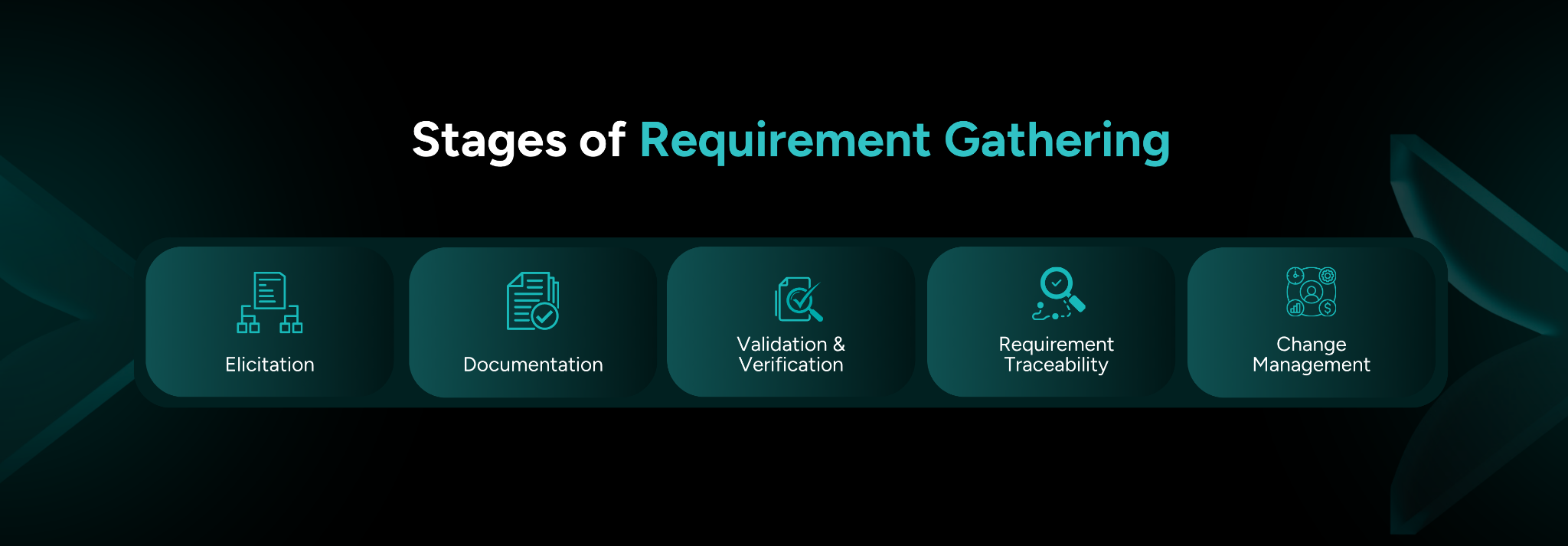
The key stages of requirement gathering are:
1. Elicitation
2. Documentation
3. Validation & Verification
4. Requirement Traceability
5. Change Management
AI Requirements gathering isn't a single meeting or a one-time document; it's a multi-stage discipline that runs in parallel with your entire SDLC. Each stage builds on the previous one, and skipping or rushing any of them is where most teams quietly accumulate technical and delivery debt.
Here's how each stage works in practice.
1. Elicitation
Requirement elicitation is the process of discovering what stakeholders actually need. This stage focuses on gathering information from users, business leaders, product owners, technical teams, and other stakeholders who influence the project.
The challenge is that stakeholders often describe solutions rather than underlying problems. Effective elicitation helps uncover both.
Common elicitation techniques include:
During this stage, teams should identify:
2. Documentation
Once requirements are collected, they need to be documented in a format that is clear, consistent, and understandable for all stakeholders.
Poor documentation leads to multiple interpretations of the same requirement, causing confusion during development and testing.
A well-structured requirements document typically includes:
Best practices include:
3. Validation and Verification
Collecting requirements is only half the job. Teams must also verify that requirements are accurate and validate that they truly reflect stakeholder expectations.
The AI requirement validation stage helps identify gaps, contradictions, and unrealistic expectations before development begins.
Key validation activities include:
Teams should evaluate whether requirements are:
4. Requirement Traceability
One of the biggest challenges in modern software development is maintaining visibility as projects evolve. Requirement traceability ensures that every requirement can be tracked throughout the SDLC.
Without traceability, teams struggle to understand the impact of changes, identify missing functionality, or prove compliance during audits.
A strong traceability process links requirements to:
Many organizations use a Requirement Traceability Matrix (RTM) to map these relationships and simplify impact analysis.
Traceability becomes especially important for enterprise projects, regulated industries, and large-scale software initiatives where requirements frequently change.
5. Change Management
Requirements rarely remain static throughout a project. Market conditions change, business priorities evolve, and new stakeholder needs emerge.
Without a structured change management process, projects can quickly suffer from scope creep, missed deadlines, and budget overruns.
An effective change management process includes:
Before approving a change, teams should evaluate its impact on:

The common challenges in requirement gathering are:
Even teams with experienced engineers and structured processes struggle with requirement gathering, not because the concept is complex, but because the execution involves multiple stakeholders, competing priorities, and tools that were never designed to work together. Understanding where the process breaks down is the first step to building one that holds up.
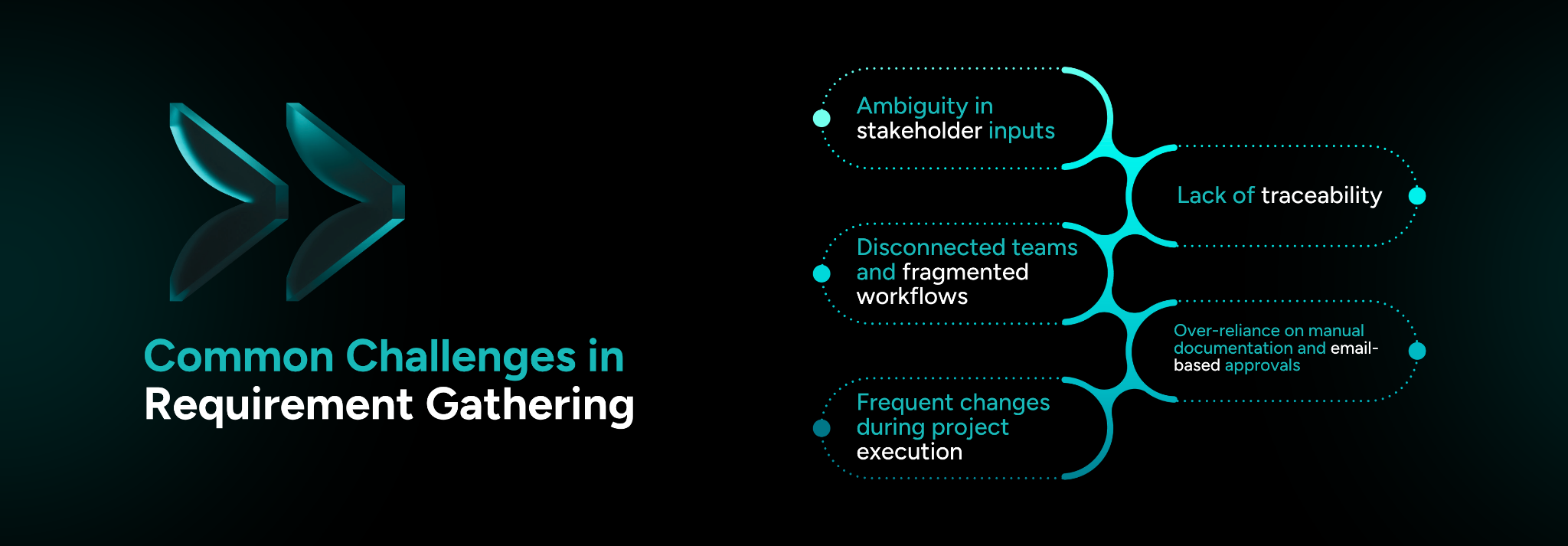
Here are the five most common challenges engineering teams face during requirements gathering in the SDLC, and why they're more costly than organizations realize.
1. Ambiguity in Stakeholder Inputs
Stakeholders often describe what they want in different ways, and sometimes they are not fully aligned on priorities themselves. Business users may focus on outcomes, while technical teams need detailed specifications.
Common issues include:
2. Disconnected Teams and Fragmented Workflows
Requirement gathering for software development typically involves multiple departments, including business teams, product managers, architects, developers, QA engineers, and operations teams.
When information is spread across meetings, emails, spreadsheets, chat platforms, and ticketing systems, teams often work from different versions of the truth.
This can result in:
3. Frequent Requirement Changes During Project Execution
Business needs evolve, customer expectations shift, and regulatory requirements change. While change is inevitable, unmanaged changes to requirements can create significant disruption.
Without a structured process, teams may face:
4. Lack of Traceability Between Requirements, Code, and Tests
Many organisations struggle to track how requirements are implemented throughout the SDLC. Once development begins, requirements often become disconnected from design documents, code repositories, and testing workflows.
This creates several risks:
5. Over-Reliance on Manual Documentation and Email-Based Approvals
Many requirement management software processes still depend heavily on documents, spreadsheets, and long email threads. As projects become more complex, these manual methods become difficult to maintain and scale.
Common consequences include:
The best practices to improve requirement gathering in SDLC are:
Knowing where requirement gathering breaks down is only half the battle. The other half is building a process that's structured enough to prevent those failures and flexible enough to adapt when project realities change.
These best practices aren't theoretical ideals. They're the operational habits that separate engineering teams who ship predictably from those who are constantly recovering from avoidable misalignments.
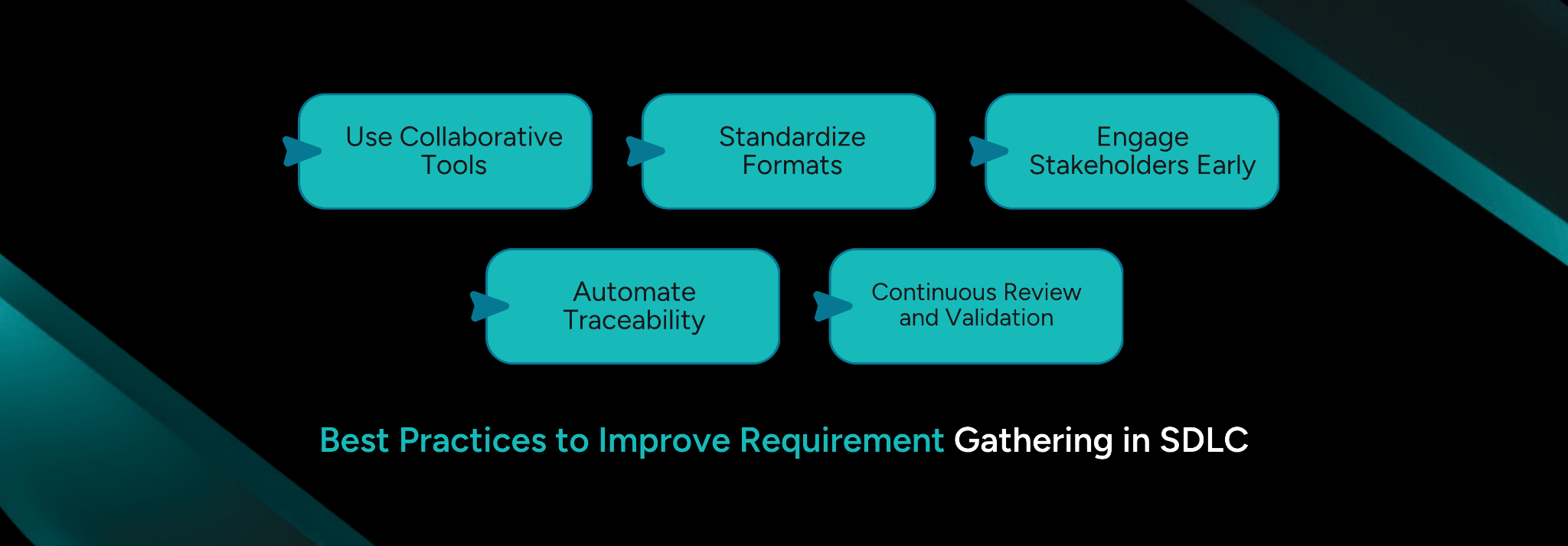
1. Use Collaborative Tools
One of the most common reasons requirements become inconsistent is that information is spread across multiple systems and documents. Teams need a centralized environment where everyone can access the latest version of requirements.
Best practices include:
To improve visibility across the SDLC, requirements should also integrate with tools such as:
2. Standardize Formats
Bad requirements are one of the leading causes of misunderstandings between stakeholders and development teams. Standardization helps ensure every requirement is documented with the same level of clarity and detail.
A standardized approach should include:
Benefits of standardization include:
3. Engage Stakeholders Early
Requirements gathering and analysis in the SDLC should never be isolated to a single department. The earlier teams involve stakeholders, the fewer surprises emerge during development and testing.
Effective stakeholder engagement includes:
Key participants should include:
4. Automate Traceability
As projects grow, manually maintaining relationships between requirements, code, tests, and releases becomes increasingly difficult.
An AI-powered requirement management tool can automate much of this process by creating traceable links throughout the SDLC.
Organizations should look for tools that can:
5. Continuous Review and Validation
Requirements are rarely static. Business goals evolve, customer expectations change, and technical realities emerge during development. Waiting until the testing phase to validate requirements often leads to unnecessary delays and rework.
Instead, teams should establish continuous review processes that include:
Also read: From Requirements to Release: How AI is Rewriting the SDLC
Understanding the stages and best practices of requirement gathering in SDLC is one thing.
Having the infrastructure to execute them consistently across distributed teams, complex codebases, and fast-moving sprints is another challenge entirely.
This is exactly the gap that ReqSpell, SoftSpell's AI-powered requirements intelligence module, is built to close.
ReqSpell isn't a documentation tool with an AI label attached. It's a purpose-built capability that transforms how engineering organizations capture, structure, trace, and govern requirements from the first stakeholder conversation to the final deployment artifact.
With clearer requirements and stronger traceability, organizations can:
ReqSpell is built around six capabilities that directly address the most common and most costly failure points in requirement gathering for software development:
1. AI-Powered Extraction
Most requirement inputs don't arrive in structured formats. They live in product documents, email threads, release notes, spreadsheets, and code comments scattered across systems.
ReqSpell's AI engine ingests all of these unstructured sources and converts them into structured, traceable, and queryable specifications, eliminating the manual effort of translating raw stakeholder inputs into actionable engineering requirements.
2. Built-In Traceability
ReqSpell automatically maps the full requirement chain:
features → requirements → user stories → test cases.
This end-to-end traceability means that when a requirement changes, every connected artifact from design specs to QA test plans is immediately visible and updatable. No manual RTM maintenance. No traceability gaps that only surface during audits or post-release retrospectives.
3. Reverse Engineering Insight
For teams working with legacy codebases where documentation is outdated, incomplete, or nonexistent, ReqSpell analyses existing code to identify modules, dependencies, and functional scope.
This gives engineering leads a structured understanding of what the legacy system actually does before modernization work begins, dramatically reducing the risk of undocumented dependencies breaking new development.
4. Test Coverage Validation
ReqSpell maps requirements directly to test plans and highlights paths without test coverage before QA begins execution. This means your QA team isn't discovering coverage gaps during test runs or, worse, after release.
It means those gaps are surfaced and addressed during planning, where fixing them costs a fraction of what it would cost post-deployment.
5. Natural Language Query
Instead of manually searching across documents and tickets, teams can query their entire requirements knowledge base in plain English.
Ask requirements gathering questions like:
Then get instant, contextual answers, dramatically reducing the time engineers and QA leads spend hunting for context mid-sprint.
6. Secure Collaboration
Enterprise requirement management involves multiple stakeholders, internal product teams, external clients, compliance reviewers, and contracted vendors.
ReqSpell's role-based access controls ensure the right people see the right requirements at the right time. This supports both internal governance standards and external collaboration without compromising data integrity or security compliance.

Requirement gathering isn't where software projects begin; it's where they succeed or fail. When requirements are structured, validated, and traceable, every downstream phase of your SDLC moves faster, with fewer defects, fewer surprises, and stronger alignment across every team involved in delivery.
The difference between engineering teams that ship predictably and those that rarely come down to talent. It comes down to process and the tools that enforce it.
That's exactly what SoftSpell’s ReqSpell delivers. Purpose-built for modern SDLC environments, ReqSpell stands out as the most capable AI-powered requirements gathering tool available today, transforming scattered, ambiguous inputs into structured, traceable, and actionable specifications that your entire delivery pipeline can confidently build from.
Stop letting requirements gaps silently erode your sprints, timelines, and stakeholder trust.
Book a Demo with SoftSpell and see how ReqSpell turns requirement chaos into delivery confidence, starting today.



July 1, 2026
Don’t Miss Out
We share cool stuff about coding, AI, and making dev life easier.
Hop on the list - we’ll keep it chill.

© 2026, SoftSpell. All Rights Reserved


