Optimizing Your Software Development Planning for Faster Delivery & QC

ReqSpell

March 25, 2026

TL;DR

Poor software development planning, not poor execution, causes most missed deadlines.

Requirement drift between kickoff and delivery slowly breaks alignment across product, dev, and QA.

Structured planning connects your roadmap, releases, sprints, and test cycles into one clear chain.

Shifting quality left means you involve QA during planning, not after development ends.

The right software development planning software gives your teams shared visibility, traceable requirements, and forecasts you can trust.

What if your delivery problems come from planning, not execution?

Nearly half of all C-suite executives report that more than 30% of their technology development projects face delays. This comes from a BCG survey across 25 industries. The issue is rarely talent. Weak software development planning causes it most of the time.

  • Poor planning creates a ripple effect that impacts every team:
  • Deadlines slip because no one flags dependency conflicts during planning
  • QA scrambles to test features built on requirements that changed three times
  • Stakeholders lose confidence in timelines that never had real data behind them

This is a structural problem. You can fix the structure.

The Hidden Gaps in How Most Teams Plan

Most teams do not have a discipline problem. They have a visibility problem. Gaps in their software development planning process sit in plain sight.

Here are the three breakdowns that quietly derail delivery cycles:

  • Requirements that change between kickoff and development: Features shift in scope, but no one tracks the change or reviews the timeline again
  • Tools that do not connect: Planning stays in one platform, execution in another, and QA in a third, so no one sees the full picture
  • Timelines built on assumptions, not clarity: Developers commit to estimates without real input, and the schedule breaks when reality hits

Sound familiar? If your teams keep firefighting instead of building, at least one of these gaps is in play.
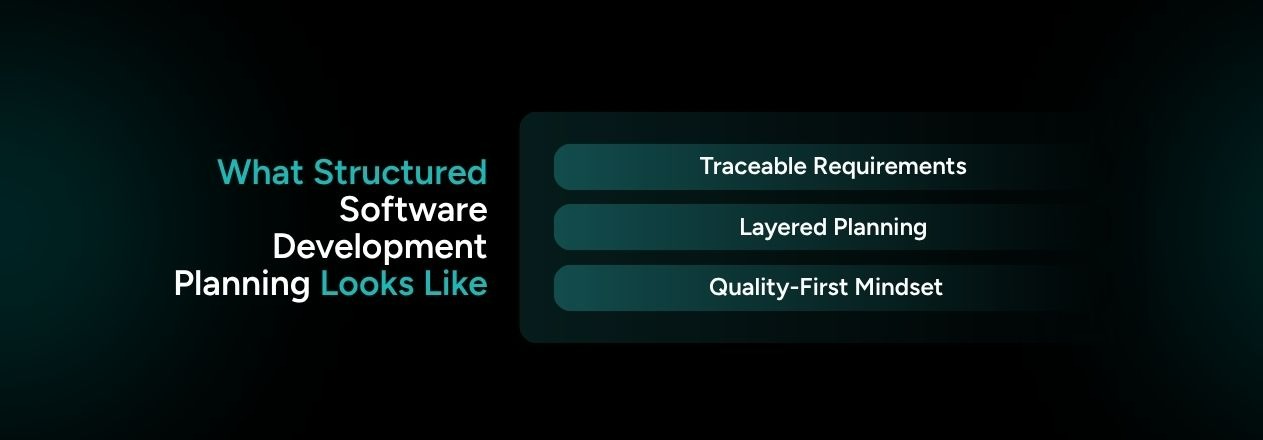
What Structured Software Development Planning Looks Like

Structured software development planning with traceable requirements, layered planning, and a focus on building quality from the start.

1. Traceable Requirements From Day One

Every feature your team builds should connect directly to a business requirement. When that connection breaks, and without a system, it will, product, dev, and QA start working from different versions of the truth.

Requirement traceability is not extra documentation work. It is the single thread that keeps your entire delivery chain clear and honest. When a requirement changes, traceability makes sure every team sees it, adjusts to it, and plans for it.

  • Trace every feature back to a business objective
  • Flag requirement changes in real time, not during retrospectives
  • Give QA and dev equal visibility into what you build and why

2. Planning in Layers, Not Silos

Your roadmap, release plan, sprint plan, and test plan should work as one connected system. When they exist as four separate documents owned by four separate teams, you are not planning. You are just hoping.

The software development life cycle planning phase works only when each layer informs the next. A change at the roadmap level should flow into your sprint plan automatically. It should not show up as a surprise two weeks before a release.

  • Roadmap sets direction
  • The release plan defines the scope and dates
  • Sprint plan assigns work
  • Test plan checks outcomes

When these layers connect, your teams stop reacting and start delivering.

3. Quality Starts at Planning, Not Testing

Most teams treat quality as a final checkpoint. By the time QA gets involved, the requirement has already changed, the build is already done, and fixing anything means restarting something. That is expensive.

When you involve QA during the software development life cycle planning phase, everything changes. Acceptance criteria get defined before you write a single line of code. Test cases get built alongside development, not after it.

  • QA reviews requirements before the sprint kickoff
  • Acceptance criteria are fixed during planning, not discussed at sign-off
  • Defects caught in planning cost much less than defects caught in production

How Better Planning Speeds Up Delivery

Structured planning does not slow your teams down. It removes the friction that already slows them down. You get less rework, fewer status meetings, and fewer last-minute scope surprises. All of this leads to faster and more predictable delivery cycles.

When your software development planning process connects requirements to sprints to test cases, your teams can work side by side instead of one after another. Dev builds while QA prepares. Product improves the next sprint while engineering delivers the current one.

You see how this changes your workflow in a simple way. The result is not just speed. It is the speed your stakeholders can plan around:

  • Forecasts based on real capacity, not optimism
  • Release dates that hold because teams mapped dependencies early
  • Confidence that what you ship matches what you promised

Suggested Read: If Only ReqSpell Existed Before I Wrote 200 Pages of Specs 

5 Signs Your Planning Process Is Holding You Back

You do not need a full audit to spot gaps in your planning process. These five signals show up long before a major delivery failure happens.

  • Deadlines slip, but no one can point to where the plan broke. The work gets done, but something earlier went wrong, and no one catches it
  • QA sees a different requirement than what dev builds. The feature changes along the way, and no one updates the test plan
  • High speed, low delivery confidence. Your team ships stories, but stakeholders still do not trust the release date
  • Product and engineering stay out of sync. Priorities change, but the sprint plan does not reflect it until it is too late
  • Retrospectives repeat the same root causes. When the same planning issues keep coming up, the process causes the problem, not the people

How ReqSpell by SoftSpell Brings This All Together

SoftSpell accelerating SDLC by about 40 percent while reducing defects by 70 percent through AI-driven development automation.

Every gap this blog highlights, like changing requirements, tools that do not connect, late QA involvement, and unreliable forecasts, ReqSpell helps you close them.

ReqSpell is an AI-powered requirement management tool from SoftSpell. It turns unstructured inputs like legacy codebases, PDFs, emails, product documents, and test plans into clear and traceable specifications your whole team can use.

Here is what ReqSpell does across your planning chain:

  • Requirement Grooming: Extracts and organizes business needs from scattered documents so nothing gets lost between kickoff and development
  • Reverse Engineering: Analyzes legacy codebases to show modules, dependencies, and functional scope without manual effort
  • Test Coverage Validation: Connects clear requirements directly to test plans and flags untested paths before they reach production
  • Cross Team Alignment: Let's product, dev, and QA search across documents, code, and test artifacts using simple language

ReqSpell fits the way modern teams work. Product teams turn scattered notes into structured specs. Engineering teams understand legacy systems without getting lost in code. QA teams map test cases to requirements and find coverage gaps early.

You can already see how this brings your teams onto the same page.

Two capabilities make ReqSpell especially useful for teams handling complex software delivery:

  • AI-powered extraction converts product documents, release notes, and spreadsheets into clean and structured specifications automatically
  • Traceability built In connects features to requirements, requirements to user stories, and stories to test cases across your full software development planning process

ReqSpell also keeps your data secure at scale. It uses role-based access so the right people see the right content, whether they work inside your team or outside as collaborators.

Conclusion

What separates teams that deliver consistently from those that keep catching up?

This blog walks you through the real cost of poor planning, the hidden gaps in how most teams plan their work, and what a connected software development planning process looks like in practice. The answer never comes from working harder. It always comes from planning smarter.

Every sprint that starts with weak requirements ends in rework. Every reliable release is built on tools that do not connect ships late or ship the wrong thing. The cost of delay grows faster than most teams expect.

You can see how this plays out in your own workflow.

ReqSpell by SoftSpell gives your teams the structure, traceability, and visibility to change this, starting with your next planning cycle.

Table of Contents

    FAQs

    1. What is software development planning, and why does it matter?
    Software development planning is the process of defining, connecting, and managing everything that needs to happen before and during a development cycle. This includes requirements through to release. It matters because every delivery failure, like missed deadlines, poor quality, and misaligned teams, comes from how well you plan the work at the start.
    2. How does the software development life cycle planning phase affect delivery speed?
    The planning phase sets the base for every sprint, release, and test cycle that follows. When you keep it structured and traceable, your teams move faster. They spend less time clarifying, reworking, and realigning. When planning stays weak, every step that follows carries the extra load.
    3. When should QA get involved in the planning process?
    QA should join during the planning phase, not after development ends. When you involve QA early, you define acceptance criteria before you write any code. Teams build test cases alongside development. Teams also catch defects early before they reach production.
    4. How do we get product, dev, and QA aligned around the same plan?
    You can align teams best with a shared planning layer where requirements, sprints, and test plans connect. When a requirement changes, every team sees it. When the sprint scope shifts, the test plan updates with it. You can see how this keeps everyone on the same page. Alignment comes from visibility, not meetings.
    5. What should we look for in software development planning software?
    Look for a solution that connects your full planning chain, from business requirements to test cases, with real-time traceability. It should show planning gaps early. It should support teams working side by side across product, dev, and QA. It should also give leadership clear forecast visibility so they can make confident decisions.
    Blog Author Image
    Gautham

    AI-Native Product Strategist

    LinkedInBlog Social IconBlog Social IconBlog Share Link

    Don’t Miss Out
    We share cool stuff about coding, AI, and making dev life easier.
    Hop on the list - we’ll keep it chill.