


Changelog
July 1, 2026
.svg)
.png)
The modern enterprise is currently caught in a Digital Paradox. On one hand, leadership is demanding an aggressive AI roadmap to stay competitive in an era of generative intelligence. On the other, the technical reality is anchored by decades-old legacy systems. These are monolithic structures that hold the organization’s most critical business logic hostage.
The truth that many consultants will not tell you is this: You cannot build a 2026 AI strategy on a 1996 code foundation. If your core business rules are buried in undocumented source files, your AI will not have the context it needs to be effective. This is where SoftSpell, incorporating ReqSpell transformation, changes the game.
Most legacy systems are black boxes. They work, but nobody truly knows how anymore. The original architects have retired, and the documentation, if it ever existed, is woefully out of date. When you try to layer AI or cloud-native microservices on top of this foundation, you encounter three primary blockers:
SoftSpell provides the Rosetta Stone for these systems. It translates archaic code into actionable requirement intelligence.
Modernizing a legacy stack is usually seen as a high-risk, multi-year manual endeavor. SoftSpell automates the heavy lifting by following a structured transformation path that prioritizes understanding before execution.
1. Source File Ingestion and Deep Analysis
The journey begins at the atomic level: the source file. Whether it is COBOL, Java, or legacy C++, SoftSpell ingests these raw text files and performs a deep structural analysis. Unlike standard compilers that just look for syntax, our AI-powered engine looks for intent. It identifies how data flows through the system and where the gravity of the application lies.
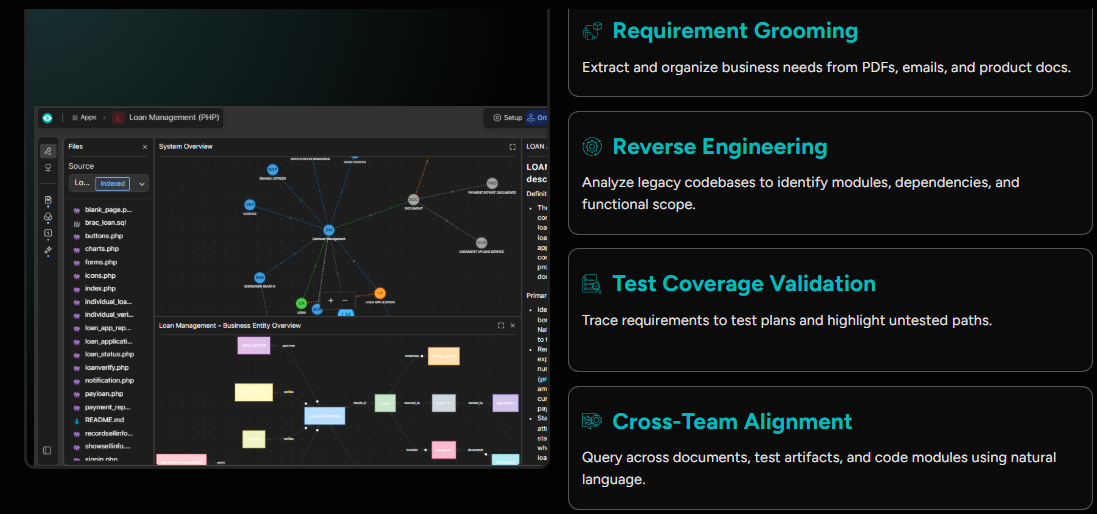
2. System and Business Entity Overview
Once the code is ingested, SoftSpell generates a comprehensive System Overview. This is not just a folder tree; it is a map of the application's DNA.
3. Interactive Information Retrieval via Chat Mode
This is the breakthrough moment for modernization teams. SoftSpell features a Chat Mode that allows architects and developers to talk to their legacy codebase. For example, instead of spending three weeks auditing code to find how a specific interest rate is calculated, a developer can simply ask: "What are the business rules governing interest calculations in the 1998 module?". This retrieval capability transforms the modernization process from a blind migration into a surgical transition.
By using SoftSpell to extract business rules and map dependencies, enterprises can finally execute their AI roadmap with confidence. You move from a state of Technical Debt to technical wealth by:
Legacy systems do not have to be the graveyard of your AI ambitions. The challenge has never been the age of the code, but the lack of visibility into the logic it contains. By shifting the focus from simple code migration to deep requirement intelligence, SoftSpell enables enterprises to bridge the gap between their heritage systems and their digital future.
Through automated legacy code analysis, business rule extraction, and a dedicated chat-based retrieval system, you can finally unlock decades of hidden value. Stop guessing what your code does and start building a future-ready architecture that is cloud-native, scalable, and fully optimized for the generative era.



July 1, 2026
Don’t Miss Out
We share cool stuff about coding, AI, and making dev life easier.
Hop on the list - we’ll keep it chill.

© 2026, SoftSpell. All Rights Reserved


