


Changelog
July 1, 2026
.svg)
.png)
Key Takeaways
Legacy systems are the backbone of most enterprises, but they are also quietly becoming their biggest liability.
According to Gartner, enterprises spend up to 80% of their IT budgets just maintaining legacy systems, leaving little room for innovation. As customer expectations rise and competition intensifies, the question is no longer whether to modernize. It is how fast you can do it without breaking everything in the process.
Legacy modernization is no longer a back-office IT conversation. It is a boardroom priority.
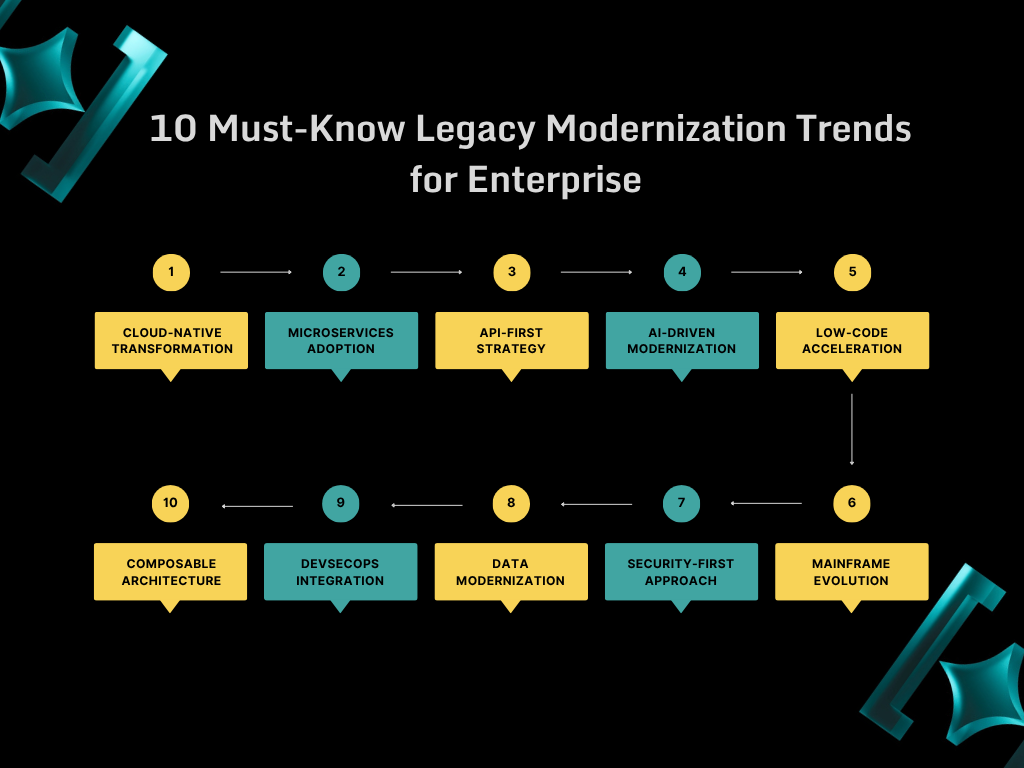
In this guide, we break down the 10 most important legacy modernization trends every enterprise CTO, IT director, and digital transformation leader needs to understand in 2025.
Legacy modernization refers to the process of updating, replacing, or re-architecting outdated IT systems, applications, and infrastructure to meet modern business and technology demands. This includes migrating from monolithic architectures to cloud-native environments, replacing end-of-life software, adopting APIs, and integrating AI and automation into core systems.
Why does it matter?
Moving workloads to the cloud is no longer a trend. It is table stakes. But in 2025, enterprises are moving beyond basic lift and shift migrations toward true cloud-native transformation.
Cloud-native modernization involves rebuilding or re-platforming applications to leverage containerization (Docker, Kubernetes), serverless functions, and managed cloud services from AWS, Azure, or Google Cloud.
The key shift here is intentionality. Enterprises that simply move old systems to the cloud without re-architecting them end up with the same technical debt, just hosted elsewhere. The real ROI comes from redesigning systems to take advantage of auto-scaling, resilience, and cloud economics.
What enterprises are doing:
If your legacy modernization roadmap does not account for cloud-native principles, you are modernizing in the wrong direction.
One of the most transformative shifts in enterprise IT is the move from tightly coupled monolithic applications to modular microservices architectures.
In a monolithic system, all components including user interface, business logic, and data access are bundled together. This makes scaling, updating, and maintaining systems increasingly difficult as the application grows.
Microservices decompose these systems into small, independently deployable services that communicate via APIs. Each service handles a specific business function and can be developed, deployed, and scaled independently.
Benefits for enterprises:
Companies like Netflix, Amazon, and Uber built their competitive edge on microservices. Enterprise modernization programs are now applying the same principles to banking, healthcare, logistics, and manufacturing systems.
APIs (Application Programming Interfaces) have become the connective tissue of modern enterprise IT. An API-first strategy means designing and exposing core business capabilities as APIs before building any front-end or integration layer.
For legacy modernization, this approach is a game-changer. Rather than ripping out an entire legacy system at once, which is risky and expensive, enterprises can wrap legacy systems with APIs to make their data and functions accessible to modern applications. This is often called the strangler fig pattern, where new functionality gradually replaces the old system without a big-bang migration.
Why API-first modernization works:
In 2025, enterprises with a mature API strategy are moving faster, integrating better, and building more resilient digital ecosystems.
Here is a trend that is changing the economics of modernization: AI is now being used to modernize legacy systems themselves.
Traditionally, migrating legacy COBOL code, analyzing monolithic codebases, or documenting undocumented systems required enormous manual effort. AI-powered tools can now scan legacy code, generate documentation, identify dependencies, suggest refactoring strategies, and even translate code from one language to another.
Tools like GitHub Copilot, AWS Mainframe Modernization, and various AI-assisted code analysis platforms are dramatically reducing the time and cost of legacy migration projects.
Practical applications:
For enterprises sitting on decades-old codebases, AI-driven modernization is not just faster. It is often the only practical path forward.
Low-code and no-code platforms have matured significantly, and enterprises are now using them to rapidly replace legacy workflows, forms-based applications, and departmental tools without heavy custom development.
Platforms like Microsoft Power Platform, Salesforce, OutSystems, and Mendix allow business users and developers to build modern applications through visual interfaces, dramatically reducing development time and dependency on scarce engineering talent.
This is particularly powerful for:
Low-code does not replace deep engineering for complex core systems, but it fills a critical gap, allowing enterprises to modernize large categories of applications quickly and cost-effectively while freeing developers to focus on strategic work.
Mainframes process trillions of dollars in transactions every day. Despite predictions of their death for decades, mainframes are still running the core operations of the world's largest banks, insurers, and retailers.
But the talent pool for mainframe expertise is shrinking fast. As COBOL developers retire, the risk of running on aging mainframe systems is growing.
In 2025, mainframe modernization is one of the most active areas in enterprise IT. The approach varies:
The key challenge is preserving decades of embedded business logic during migration. Enterprises that approach this thoughtfully using AI-assisted code analysis and incremental migration are achieving modernization without disrupting mission-critical operations.
Legacy systems are disproportionately vulnerable to cyberattacks. They often run on unsupported operating systems, lack encryption, and cannot be easily patched. In an era of ransomware, supply chain attacks, and tightening data privacy regulations, security is no longer an afterthought in modernization. It is a primary driver.
Enterprises are increasingly approaching legacy modernization through a security lens, prioritizing systems that pose the highest compliance and vulnerability risk.
Security-first modernization involves:
Regulations like GDPR, HIPAA, PCI-DSS, and India's DPDP Act are also forcing enterprises to modernize legacy systems that cannot meet current compliance requirements.

Legacy modernization is not just about applications. It is about data. Many enterprises are sitting on valuable data trapped in legacy databases, data warehouses, and siloed systems that cannot support modern analytics or AI workloads.
Data modernization involves migrating to cloud data platforms such as Snowflake, Databricks, and Google BigQuery, building real-time data pipelines, and making data accessible across the organization through modern data mesh or data lakehouse architectures.
Why this matters now:
Enterprises that modernize their data infrastructure alongside their applications gain a compounding advantage. Better data enables better AI, which enables better business decisions.
Legacy enterprises often operate with waterfall development processes, infrequent releases, and siloed development and operations teams. Modernization is not just a technology change. It requires an operational transformation.
DevSecOps brings together development, security, and IT operations into a unified, automated workflow. Combined with CI/CD (Continuous Integration and Continuous Delivery) pipelines, it allows enterprises to release software faster, with higher quality and better security.
What this looks like in practice:
For enterprises modernizing legacy systems, adopting DevSecOps culture is often the difference between a modernization program that delivers ongoing value and one that creates a new generation of technical debt.
The most forward-looking trend in legacy modernization is the move toward composable enterprise architecture. Rather than building or buying monolithic platforms, enterprises are assembling modular, interchangeable business capabilities from best-of-breed components.
The MACH architecture framework, which stands for Microservices, API-first, Cloud-native, and Headless, is the technical expression of this philosophy. It enables enterprises to swap out individual components such as a payment service, a recommendation engine, or a content management system without rebuilding the entire system.
Why composable architecture matters:
Composability is particularly powerful for retail, financial services, and healthcare enterprises that need to move quickly in response to regulatory changes, competitive pressures, and evolving customer expectations.
Legacy modernization is one of the most consequential decisions an enterprise will make this decade. Get it right, and you unlock agility, cost efficiency, innovation capacity, and competitive differentiation. Get it wrong, and you inherit a new generation of technical debt while your competitors move faster.
The ten trends covered in this post, from cloud-native migration, microservices, and API-first strategy, to AI-driven modernization, low-code platforms, mainframe renewal, security-first thinking, data modernization, DevSecOps, and composable architecture, are not isolated initiatives. The most successful enterprises weave them together into a coherent modernization strategy aligned with business goals.
At Softspell, we help enterprises design and execute legacy modernization programs that deliver real business outcomes, not just technology upgrades. Whether you are just starting to assess your legacy landscape or deep into a multi-year transformation, we bring the expertise to help you move faster and smarter.
Ready to modernize your legacy systems? Get in touch with Softspell today.




July 1, 2026
Don’t Miss Out
We share cool stuff about coding, AI, and making dev life easier.
Hop on the list - we’ll keep it chill.

© 2026, SoftSpell. All Rights Reserved


