


Changelog
July 1, 2026
.svg)
.jpg)
What if the biggest risk to your business in 2026 is not a competitor, but the system you have run for the last 15 years?
Legacy systems quietly create three major problems for enterprise leaders. They increase maintenance costs. They reduce the number of engineers who want to work on outdated code. They also widen the gap between what your business needs and what your system can deliver.
Legacy application modernization is no longer just a strategic choice. It is an operational need. The risks are real. Every approach carries some risk. Every wrong move can disrupt the business you want to improve.
This guide breaks down the best legacy system modernization approaches for 2026.
Here is where things usually break down.
There is no single right answer. The best legacy modernization approach depends on your risk tolerance, timeline, technical debt level, and long-term architecture goals. Here are the six most proven options, explained clearly.
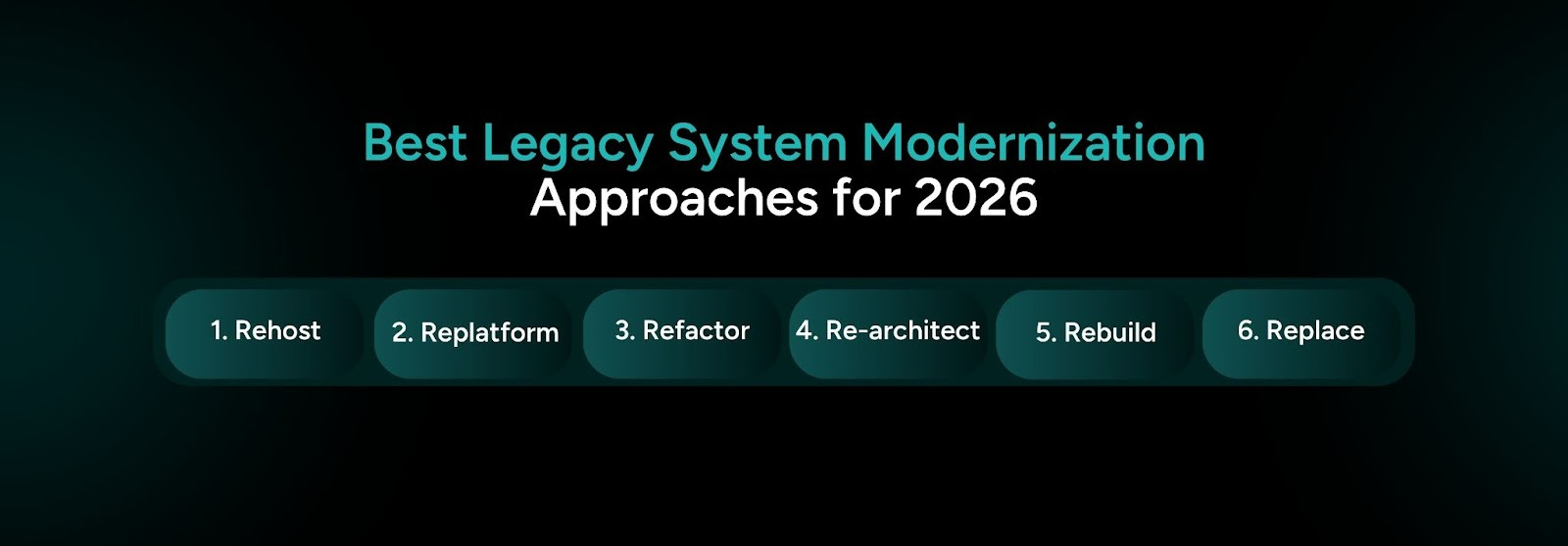
1. Rehost: Lift and Shift
You move your entire application to a new infrastructure, usually the cloud, without changing the code. The application runs the same way as before, but now on modern hardware with cloud benefits.
Think of it as changing the building, not the business inside it.
2. Replatform: Optimize for the New Environment
You move the application to a new platform and make focused updates. You do not rewrite it, but you improve it enough to use cloud features like auto scaling, managed databases, or containers.
The core application logic stays the same, but you improve the setup around it.
3. Refactor: Clean the Code, Keep the Logic
You improve the internal code. You make it easier to read, reduce repetition, and remove unused code. You do not change what the application does. The behavior stays the same, but the structure improves.
This is a common starting point for legacy code modernization in active enterprise systems.
4. Re-architect: Break the Monolith
You redesign the system architecture. You often split a large system into smaller services, modules, or event-driven parts. You keep the business logic, but you change how the system is built.
This approach supports true long-term scaling and allows teams to deploy services on their own.
5. Rebuild: Start From a Clean Slate
You build the application again from scratch using modern tools, languages, and architecture patterns. You keep the business needs, not the old code. Nothing from the legacy system moves forward except what the business truly needs.
6. Replace: Buy What Already Exists
You retire the legacy application and switch to a ready-made commercial or SaaS solution that serves the same purpose. You do not rewrite or refactor. You set it up and move your data.
The right legacy application modernization strategy is not only about budget and timeline. It starts with an honest look at four key factors.
Assess Your Documentation and Requirements Clarity
Can your team clearly explain what every module in your legacy system does?
If the answer is no or even partial, approaches like Re-architect and Rebuild bring much higher risk than they seem. Clear documentation decides how safely you can make changes.
Evaluate Your Current Test Coverage and QA Maturity
Do you have automated regression coverage for your legacy codebase?
If not, do not start Refactor or Re-architect yet. First, set a test baseline. Without it, you have no safety net. You also cannot confirm that your changes did not break critical features.
Define Your Risk Tolerance and Business Continuity Needs
Can your business handle any downtime or loss of function during modernization?
For systems that process transactions, manage compliance, or serve external customers, gradual approaches like Rehost, Replatform, and Refactor bring much lower risk than Rebuild or Replace.
Map Your Timeline Against Organizational Change Capacity
Does your team have the capacity to handle a multi-year transformation?
The most powerful approach has no value if your organization cannot sustain it. Gradual legacy application modernization strategies perform better than big bang approaches in enterprise environments. They work better not because they aim higher, but because teams can actually complete them.
Which Approach Fits Which Situation
Choosing the right legacy modernization approach is a strategic decision. Executing it safely is a different challenge. This challenge sits at the SDLC layer. This is where SoftSpell works.
ReqSpell solves the documentation gap directly. It turns discussions, scattered specs, and team knowledge into structured and traceable requirement documents and user stories. It does this before you change a single line of code.
This gives your team a clear understanding so you can move forward with confidence. It also gives stakeholders a clear trail to review and approve changes with confidence.
CodeSpell helps you with legacy code modernization by creating structured execution plans before you make any changes. It improves legacy code into cleaner and easier-to-maintain structures. It also converts legacy modules into modern frameworks.
TestSpell creates test scripts for existing legacy codebases. It also automates regression coverage during the entire modernization process. It removes the no safety net problem. This allows Refactor, Re-architect, or Rebuild cycles to move forward without fear of hidden issues.
Together, ReqSpell, Codespell, and Testspell turn legacy modernization services into a controlled and AI-assisted process. They help you move from a high-risk overhaul to a steady and manageable evolution.
Think about what it would mean for your business if your next modernization effort actually finished on time, ran without any production issues, and kept your team confident.
Choosing the right legacy modernization approach matters. The teams that succeed in 2026 will not just choose the right strategy. They will execute it with the right guardrails. They set clear requirements before they write the first line of code.
This is the difference between modernization as a risk and modernization as a competitive advantage. If you are reviewing legacy application modernization strategies and want to see how AI-assisted execution works in real scenarios, a SoftSpell demo is a useful next step.



July 1, 2026
Don’t Miss Out
We share cool stuff about coding, AI, and making dev life easier.
Hop on the list - we’ll keep it chill.

© 2026, SoftSpell. All Rights Reserved


