


Changelog
July 1, 2026
.svg)
.jpg)
Is your business still relying on outdated legacy systems?
You are not alone. In fact, 75% of organizations have already completed small-scale modernization projects to stay competitive. Many companies now focus on modernizing legacy systems to keep up with changing technology and business demands.
Legacy modernization is no longer a luxury. It has become a necessity in today’s fast-moving digital world. When you update outdated systems, you improve efficiency, strengthen agility, and support long-term business growth.
In this section, you will learn why legacy modernization matters. You will also see why businesses need a clear strategy to manage modernizing legacy systems smoothly.
Legacy systems support many businesses. They form the backbone of daily operations. As technology changes, these older systems become less efficient and harder to manage.
Outdated legacy systems slow down business agility. They make it harder for you to respond to changing market demands. They also limit innovation because new technologies often do not connect well with older infrastructure.
Businesses that continue to rely on these systems risk falling behind in a fast-moving digital environment. Have you noticed how quickly technology expectations shift in the market?
Running legacy systems creates several risks:
Modernizing legacy systems gives your business several advantages:
Suggested Read: How Legacy SDLC Processes Are Holding Back Your AI Initiatives
You need clear legacy system modernization strategies to begin the process smoothly. A careful and gradual approach helps you continue daily operations without disruption.
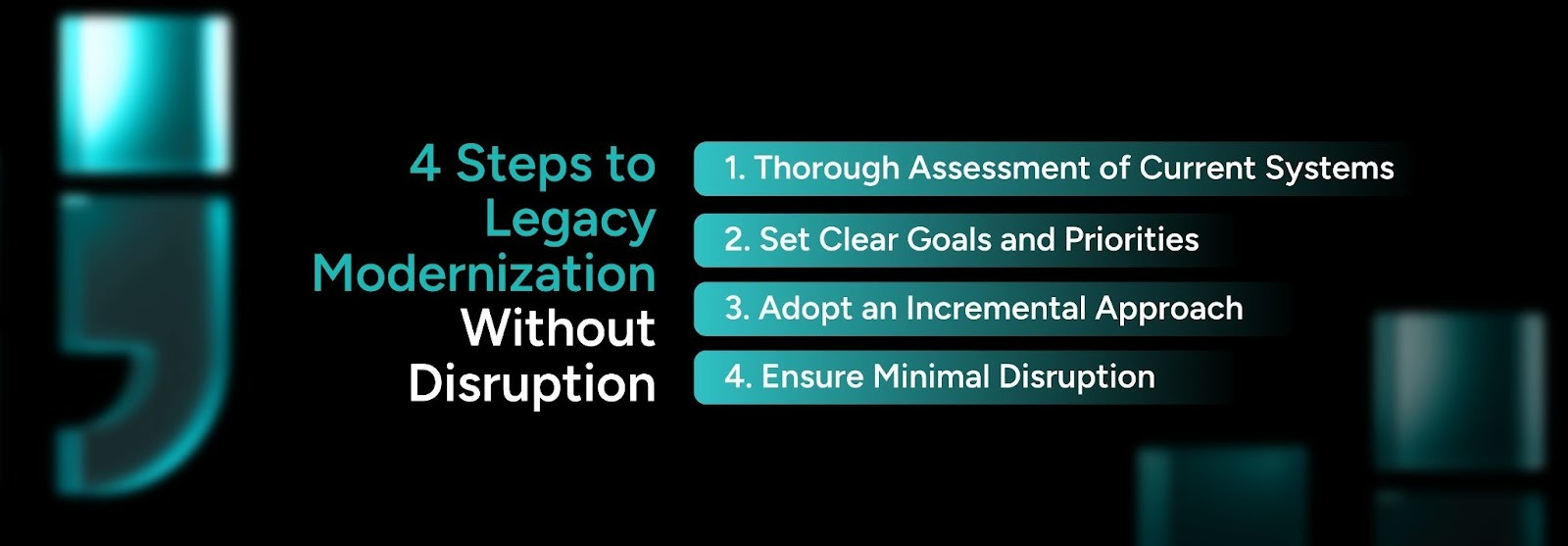
1. Conduct a Thorough Assessment of Current Systems
2. Set Clear Goals and Priorities
3. Adopt an Incremental Approach to Modernization
4. Ensure Minimal Disruption to Business Operations
Modernizing legacy applications is a complex process. You need careful planning to avoid disruption and achieve success. A clear strategy helps you move from older systems to more efficient and scalable solutions. Several important factors can guide this transition.
Stakeholder Engagement
Start by involving stakeholders early in the process. This includes department heads, IT teams, and business leaders. When everyone joins the discussion early, teams align better on goals and expectations.
This alignment also clarifies the impact of modernization across the organization. As a result, you gain stronger support for the project, which helps the effort succeed.
Data Integrity and Migration
Data migration also requires careful attention. Moving data from older systems to new platforms demands accuracy at every step. To prevent data loss or corruption, you should follow a clear process.
Security and Compliance
Along with data management, security must remain a top priority. During legacy system modernization, you must protect sensitive information and follow industry regulations. Strong security practices help maintain trust and reduce risks.
Scalability and Flexibility
Beyond security, you should also think about long-term growth. Choose tools and strategies that support scalability. Your system should adapt to changing business needs over time. This includes handling larger data volumes or connecting with new technologies.
To achieve successful legacy system modernization, you need a structured and thoughtful approach. Clear steps help reduce risks and keep the process organized.
1. Map Out the Entire Modernization Roadmap
First, create a detailed roadmap before you begin the modernization effort. Include every stage of the process. This should cover system assessment, modernization steps, and reviews after implementation. When you define the full journey early, your team stays focused and aligned with business goals.
2. Ensure Proper Resource Allocation
Next, make sure you allocate the right resources. Legacy system modernization requires skilled talent and a sufficient budget. Involve the right experts and confirm that your organization supports the process from planning to execution.
3. Continuous Testing and Monitoring
At the same time, maintain regular testing throughout the modernization effort. Continuous monitoring helps you confirm that updated components work correctly. It also ensures that the system meets performance expectations.
When issues appear, you can address them early before they affect business operations.
4. Seek External Expertise if Needed
Finally, recognize when additional support can help. Modernizing legacy applications can become complex, especially when systems include heavy customization or deep connections with other business tools.
If your internal team reaches its limits, bring in external consultants or industry experts who specialize in legacy system modernization. Their experience can help guide the transition and keep the process smooth.
Legacy modernization plays an important role when you want your business to stay competitive and efficient. At SoftSpell, we approach legacy system modernization with a complete and connected strategy. We combine AI-driven tools that support every stage of the AI SDLC.
ReqSpell
ReqSpell removes confusion and helps you maintain clear documentation governance before you begin technical changes.
CodeSpell
CodeSpell helps you move from monolithic systems to modular and scalable architectures with lower risk. Have you seen how quickly legacy code becomes hard to maintain without the right structure?
Suggested Read: How Top Dev Teams Modernize Legacy Code with Codespell’s AI-Powered SDLC Automation
TestSpell
TestSpell helps you modernize systems without introducing regressions. It reduces manual QA work and helps you apply gradual system updates safely.

Are you ready to future-proof your business by modernizing legacy systems?
When you focus on updating legacy systems, you need a clear and careful strategy. You should assess your current systems, define clear goals, follow a gradual approach, and protect daily operations from disruption.
These steps help your business modernize systems while keeping work running smoothly. Have you thought about how much easier modernization becomes with the right approach?
SoftSpell provides a complete AI-driven ecosystem that helps you manage this transformation. Its connected approach supports every stage of the process. Try SoftSpell today and move toward modern systems that support long-term business success.





July 1, 2026
Don’t Miss Out
We share cool stuff about coding, AI, and making dev life easier.
Hop on the list - we’ll keep it chill.

© 2026, SoftSpell. All Rights Reserved


