


Changelog
July 1, 2026
.svg)
%20(1).jpg)
Your requirements doc is 47 pages long. Your developers have read 3 of them.
Before a single line of code gets written, most software projects are already set up to fail, not because of bad developers, but because requirements are buried in PDFs nobody opens, email threads nobody tracks, and spreadsheets nobody agrees on.
The result? Developers build the wrong thing. QA catches it late. Teams spend sprints firefighting instead of shipping.
Traditional requirements gathering is broken by design, manual, slow, and dangerously dependent on one person's interpretation of another person's vague brief. Getting software development requirements right is no longer optional; it's the difference between a product that ships and one that stalls.
In this blog, we will explore a tool that transforms the way teams capture, structure, and track requirements, eliminating ambiguity and aligning all stakeholders from kickoff to release.
Let's get going!
The SDLC requirements process has traditionally been one of the most labor-intensive and error-prone phases of software development. Business analysts manually translate stakeholder inputs into requirement documents.
SDLC requirements gathering is one of the most critical and most broken phases in traditional development pipelines. AI-driven workflows address the core pain points with measurable results.
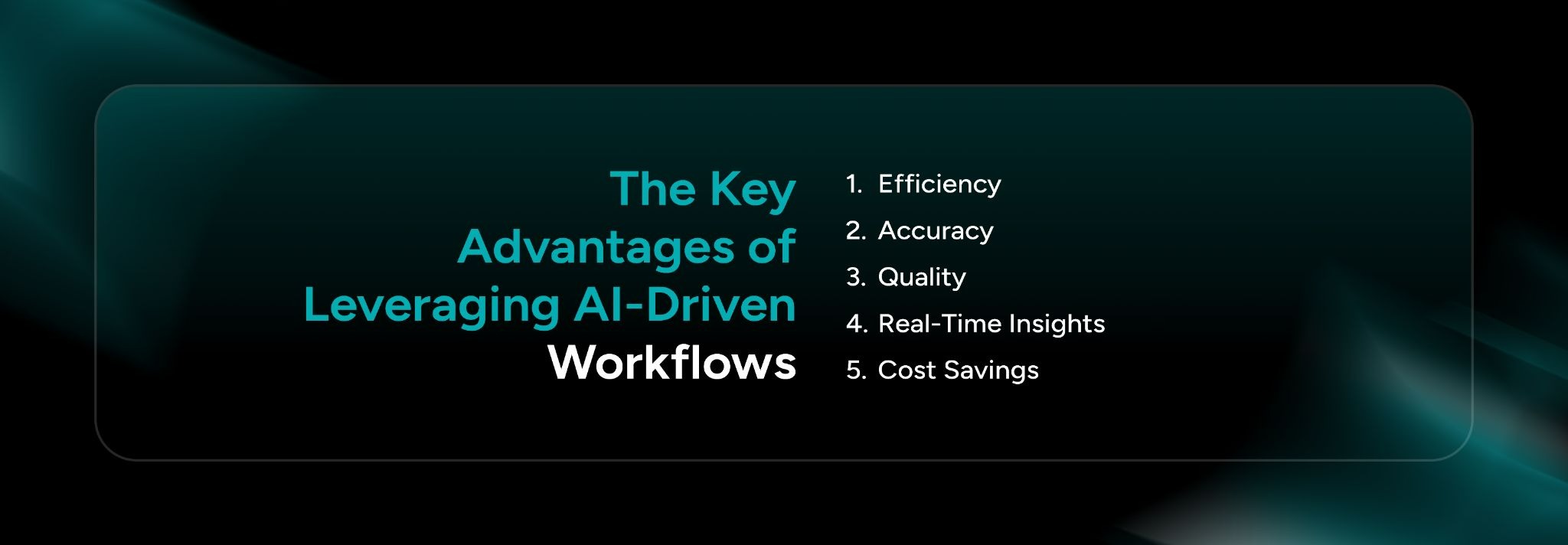
1) Efficiency
AI dramatically compresses the time required for requirements gathering in SDLC. What previously took weeks of workshops, interviews, and documentation cycles can now happen in hours.
2) Accuracy
Human interpretation introduces bias, assumptions, and inconsistency. AI tools cross-reference inputs across multiple sources simultaneously, ensuring that requirements are logically consistent, aligned with stated business objectives, and technically feasible before a single line of code is written. This reduces the risk of building the wrong thing entirely.
3) Quality
Ambiguity is the enemy of quality software. AI-driven software development requirements analysis eliminates vague language by converting open-ended inputs into precise, structured specifications. Every requirement becomes testable, traceable, and clearly scoped, which directly improves the quality of the final product.
4) Real-Time Insights
AI tools maintain a live, continuously updated view of requirement status. Teams can instantly see what has been approved, what is in progress, what is blocked, and what is at risk, without waiting for a status meeting or a manually updated tracker. This also boosts the security and productivity of your team.
5) Cost Savings
Rework is the silent budget killer in software development. By catching gaps, conflicts, and misalignments at the requirements stage, AI tools prevent the far more expensive process of correcting problems discovered in testing or, worse, in production. The result is faster time-to-market and significantly lower development costs.
Adopting AI-driven tools for SDLC requirements gathering requires thoughtful planning. Here are the key factors organizations should evaluate before and during implementation.
Selecting the Right AI Tools
Not every AI tool is built for enterprise-grade requirements management. When evaluating options, teams should look for capabilities like multi-format ingestion, natural language querying, dependency mapping, and traceability, not just document generation. The right tool should match the complexity and scale of your development environment.
Integration with Existing Tools and Workflows
AI tools deliver the most value when they integrate seamlessly into the workflows teams already use. SoftSpell is designed to work alongside popular development tools, including Jira, GitHub, and IDEs such as VS Code. This means teams don't need to abandon their existing infrastructure; ReqSpell plugs in and enhances it.
Scalability
As organizations grow, their requirement complexity grows with them. An AI tool that works well for a 10-person startup must also handle the thousands of interconnected requirements, modules, and dependencies that define enterprise systems.
Security and Compliance
For any tool embedded in the SDLC, security is non-negotiable. SoftSpell adheres to SOC 2 compliance standards, ensuring that sensitive project data, business logic, system architecture, and stakeholder inputs remain protected. Role-based access controls ensure that only the right people see the right information, whether they're internal engineers or external collaborators.
ReqSpell automates the extraction and structuring of software requirements, ensuring clarity, accuracy, and alignment across all teams for faster, cost-efficient development.
Here's how its core capabilities translate into real-world impact.
Turns Unstructured Inputs Into Actionable Specifications
Most organizations are sitting on a mountain of unstructured information, legacy documents, email threads, release notes, old codebases, and no clean way to turn them into actionable development requirements. ReqSpell changes this.
It ingests PDFs, emails, spreadsheets, legacy codebases, and release notes, converting them into clean, structured, and queryable specifications that development teams can act on immediately.
Knowledge Graph, Requirement Intelligence, Not Just Storage
Traditional requirement management tools are essentially fancy filing cabinets. ReqSpell is fundamentally different. It builds a real-time, interactive knowledge graph that maps every module, entity, and dependency across your entire system.
Teams can immediately see how a proposed change to a requirement will impact downstream components before development begins. Product managers can explore system logic independently, dramatically reducing the engineering bottleneck caused by constant clarification requests. For organizations inheriting legacy systems, this capability alone can compress months of analysis into hours of structured, navigable visibility.
Natural Language Querying, No More Requirement Back-and-Forth
One of the most persistent inefficiencies in SDLC requirements gathering is the constant back-and-forth among team members as they try to locate context buried in documents, codebases, or test files. ReqSpell solves this with natural language querying. AI-powered SDLC for enterprises can deliver more efficient results.
Any team member can ask plain-English questions across the entire project, "Which requirements don't have test coverage?" or "What are the payment module dependencies?", and receive immediate, accurate answers drawn simultaneously from documents, code modules, and test artifacts. No more waiting on subject-matter experts. No more digging through folders. The right context is always one question away.
Agent Mode, Requirement to Execution Without Manual Handoffs
The gap between requirements sign-off and development kickoff is where projects lose momentum. Decisions made during requirements analysis get lost in translation. Context evaporates between teams. ReqSpell's Agent Mode closes this gap entirely.
Once requirements are finalized, ReqSpell converts them into AI-generated execution plans with clearly defined development steps. Teams review and approve these plans, and execution flows through automated Git-based workflows, pull requests are created, changes are tracked, and governance is maintained throughout. The result is a seamless, documented handoff from requirement to code, with no manual translation required.
End-to-End Traceability That Governs the Entire SDLC
Traceability is the backbone of compliant, auditable software development, and it's the feature most traditional tools fail to deliver consistently. ReqSpell automatically maps features to requirements, requirements to user stories, and user stories to test cases, creating one connected chain across the entire SDLC.
QA teams can identify coverage gaps before release, not after. Engineers see the exact requirement behind every task, eliminating scope ambiguity mid-sprint. Role-based access controls ensure that governance applies consistently to internal teams and external collaborators alike. Every decision, change, and approval is captured in a traceable, auditable record.

Schedule a demo with SoftSpell today and see how ReqSpell can accelerate your SDLC from day one.
The challenges of traditional software development requirements management are well-documented: ambiguity, misalignment, manual inefficiency, and costly rework that compounds at every stage of the SDLC.
AI-driven workflows offer a fundamentally better path, one where requirements are automatically extracted, intelligently organized, continuously tracked, and seamlessly translated into execution.
SoftSpell's ReqSpell delivers precisely this, combining multi-format ingestion, knowledge graph intelligence, natural language querying, agent-driven execution, and end-to-end traceability in a single platform built for enterprise scale.
For organizations ready to eliminate the inefficiencies that slow development and undermine product quality, SoftSpell is not just an improvement over the status quo; it's a competitive advantage.
Connect with us today!




July 1, 2026
Don’t Miss Out
We share cool stuff about coding, AI, and making dev life easier.
Hop on the list - we’ll keep it chill.

© 2026, SoftSpell. All Rights Reserved


