


Changelog
July 1, 2026
.svg)
.jpg)
The way software is built is changing fast. AI is no longer just a supporting tool; it's becoming an active participant in the development lifecycle. But not all AI is created equal. Understanding agentic AI vs traditional AI is critical for enterprise leaders navigating digital transformation today.
Traditional AI follows fixed instructions, executes defined tasks, and waits for human direction. Agentic AI, on the other hand, thinks, plans, and acts autonomously, driving outcomes across the software development lifecycle.
As enterprises face mounting pressure to deliver faster, reduce costs, and scale efficiently, choosing the right AI approach can be the difference between leading the market and falling behind.
This blog breaks down exactly what sets these two paradigms apart and why it matters for your business.
1. Autonomy and Decision-Making
One of the most defining differences between the two lies in autonomy. Traditional AI systems are built on predefined rules and models. They execute tasks within narrow, well-defined boundaries and require human oversight to handle anything outside their programming. They are reactive by design; they do what they're told, nothing more.
Agentic AI, in contrast, can set goals, form multi-step plans, and execute decisions independently. It doesn't wait for human input at every stage. In agentic software development, this means an agentic system can analyze a codebase, identify what needs to be done, prioritize tasks, and act, all without constant developer intervention. This level of autonomous decision-making fundamentally changes what's possible in a development workflow.
2. Adaptability to Changing Requirements
Software projects are rarely static. Requirements evolve, priorities shift, and unforeseen challenges emerge. Traditional AI struggles here because it's trained on fixed datasets and optimized for specific, stable tasks. When the environment changes, traditional AI often needs retraining or reconfiguration, a slow and resource-intensive process.
Agentic AI is built for change. It can learn and adapt in real-time, recalibrating its approach as new information becomes available. For enterprises managing complex, rapidly evolving software projects, this real-time adaptability is a game-changer. It means your AI layer keeps pace with your business, not the other way around.
3. Handling Complex and Unstructured Data
Most enterprise software environments are messy. Data is unstructured, inconsistent, and spread across multiple systems. Traditional AI performs well with structured, clean datasets but often breaks down when faced with complexity and ambiguity. It requires significant preprocessing and human curation to function effectively.
Agentic AI excels at processing unstructured data, parsing logs, interpreting natural-language requirements, analyzing legacy codebases, and deriving meaningful insights from noisy inputs. This makes it significantly better equipped to handle the real-world complexity of enterprise software development.
4. Integration with Legacy Systems
For most enterprises, modernization doesn't mean starting from scratch; it means evolving what already exists. Traditional AI tools often struggle with legacy infrastructure. Integrating them typically requires substantial rework, API overhauls, or even full system replacements, all of which are costly and disruptive.
Agentic AI is designed with flexibility in mind. It can interact with existing systems, understand their logic, and work alongside legacy infrastructure without forcing a complete overhaul. This makes legacy system integration far smoother, allowing enterprises to modernize incrementally while keeping business operations uninterrupted.
5. Proactive Problem Solving
Traditional AI is reactive. It identifies an issue after it has surfaced and responds based on its training. In a software development context, this means bugs, bottlenecks, and failures are often caught late, after they've already caused delays or damage.
Agentic AI flips this dynamic. It continuously monitors the development environment, anticipates potential failures, and intervenes before problems escalate. This proactive problem-solving capability reduces defect costs, shortens debugging cycles, and keeps development timelines on track.
6. Efficiency and Speed
Speed is currency in software development. Traditional AI can automate isolated tasks, but it still requires significant manual intervention. Code reviews, test case generation, documentation, and deployment often remain largely human-driven.
Agentic AI automates across the entire workflow. From code generation to testing to documentation, it handles repetitive, time-consuming tasks end-to-end. The result is a dramatically faster development cycle, with engineers freed up to focus on higher-value, creative work rather than routine execution.
Suggested Read: AI SDLC: How the Smartest Enterprises Will Innovate in 2026
Enterprises are under constant pressure to ship faster, spend less, and scale more. Traditional AI tools have helped, but they've also introduced new bottlenecks. Agentic AI addresses these gaps at their root, transforming the SDLC from a linear, manual-heavy process into a dynamic, intelligent pipeline.
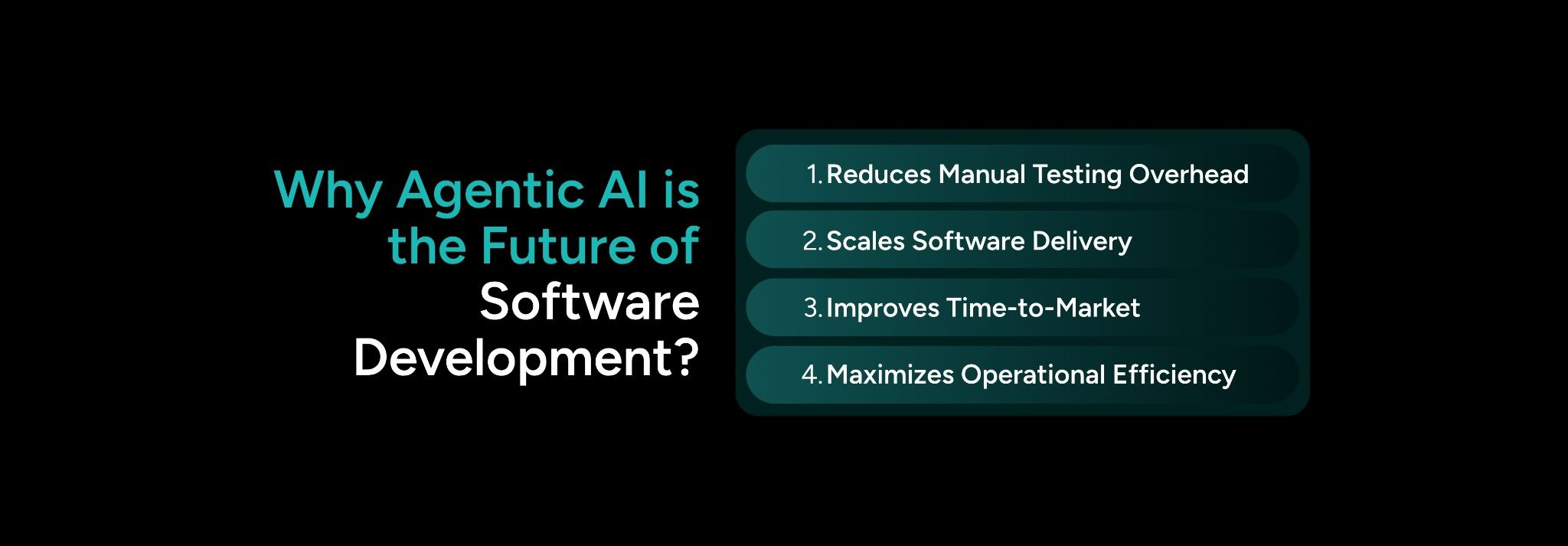
1) Reduces Manual Testing Overhead
Manual testing is one of the biggest drains on development teams. It's slow, repetitive, and prone to human error. Agentic AI takes over the heavy lifting, autonomously generating test cases, executing them, identifying failures, and suggesting fixes. This enables continuous integration at speed, dramatically reducing the time and cost associated with QA cycles.
2) Scales Software Delivery
As product complexity grows, so do the demands on code reviews, bug tracking, and release management. Agentic AI automates these redundant but necessary tasks, allowing development teams to scale output without proportionally scaling headcount. Engineers spend less time on routine work and more time building features that drive real business value.
3) Improves Time-to-Market
Faster time-to-market is one of the most cited priorities for enterprise technology leaders. Agentic AI accelerates this by identifying bottlenecks in real-time, predicting issues before they delay releases, and streamlining every phase of the development cycle. What once took weeks can now take days.
4) Maximizes Operational Efficiency
Beyond speed, agentic AI helps enterprises do more with less. Automating across the SDLC, planning, coding, testing, and deployment, it increases throughput without increasing costs. Teams become leaner and more productive, and operational efficiency becomes a competitive advantage rather than a constant struggle.
Adopting agentic AI is not without its challenges. Enterprises must go in with a clear understanding of the risks involved.
Integration with Legacy Systems
While agentic AI handles legacy environments better than traditional AI, its integration remains complex. Enterprises must carefully map existing infrastructure, identify compatibility gaps, and plan for phased rollouts to avoid disrupting live business operations. A rushed integration can create more problems than it solves.
Change Management and Adoption Resistance
Technology adoption is as much a people challenge as a technical one. Teams unfamiliar with AI-driven workflows may resist change, fear job displacement, or simply lack the skills to work alongside intelligent agents. Successful adoption requires structured change management, clear communication, and ongoing training to build organizational confidence.
Security and Privacy Risks
Agentic AI systems operate with a high degree of autonomy, which introduces new security considerations. An agent with access to codebases, databases, and deployment pipelines represents a significant attack surface. Enterprises must implement robust access controls, audit trails, and compliance frameworks, especially in regulated industries, to effectively manage data privacy and security risks.
Managing AI-Driven Decision-Making Biases
AI systems learn from data, and data carries bias. When agentic AI makes development decisions based on biased training sets, those biases can quietly embed themselves into software systems at scale. Enterprises must invest in bias audits, diverse training data, and human review mechanisms to ensure their AI-driven decisions are fair and reliable.
Scalability and Maintenance Overheads
Deploying agentic AI at enterprise scale is resource-intensive. Models need regular updates, performance monitoring, and maintenance to remain effective as systems evolve. For large organizations with sprawling, complex environments, the operational overhead of maintaining an agentic AI layer requires dedicated planning, tooling, and skilled personnel.
SoftSpell’s Agent Mode does more than write code. It completes development tasks on its own across your entire codebase, just like a senior engineer.
Instead of focusing on one line or file, it studies the full system. It takes action across multiple parts at the same time.
The execution follows a clear loop:
The result is a workflow where AI works with you like a real engineering partner, not just a tool that waits for prompts.

Suggested Read: How Codespell Agent Mode Delivers True End-to-End Code Execution
Agentic AI vs traditional AI is ultimately a question of where you want your development organization to be. Traditional AI has served a purpose, but its limitations are becoming increasingly apparent as enterprise software demands grow more complex and competitive. Agentic AI represents a fundamental evolution, one that brings autonomy, adaptability, and proactive intelligence to every stage of the SDLC.
SoftSpell is at the forefront of this shift. By embedding agentic AI deeply into the development workflow, enterprises can reduce overhead, accelerate delivery, and scale operations without sacrificing quality. For technology leaders serious about future-proofing their software development, the path forward is clear.





July 1, 2026
Don’t Miss Out
We share cool stuff about coding, AI, and making dev life easier.
Hop on the list - we’ll keep it chill.

© 2026, SoftSpell. All Rights Reserved


