Have you noticed how the smartest apps launch faster and run better?
With AI-powered software development, you can overcome common challenges like slow coding, testing errors, and long release cycles. It helps your team work smarter and deliver with confidence.
Here’s how AI-powered software development improves your workflows.
Accelerates coding and reduces errors
Simplifies testing and improves coverage
Optimizes resource use and scaling
Improves code quality and documentation
AI-powered software development changes how you manage your workflow.
In this blog, you will explore 5 steps to build smarter apps, key benefits of AI, and why SoftSpell is the best tool to improve your app development process.
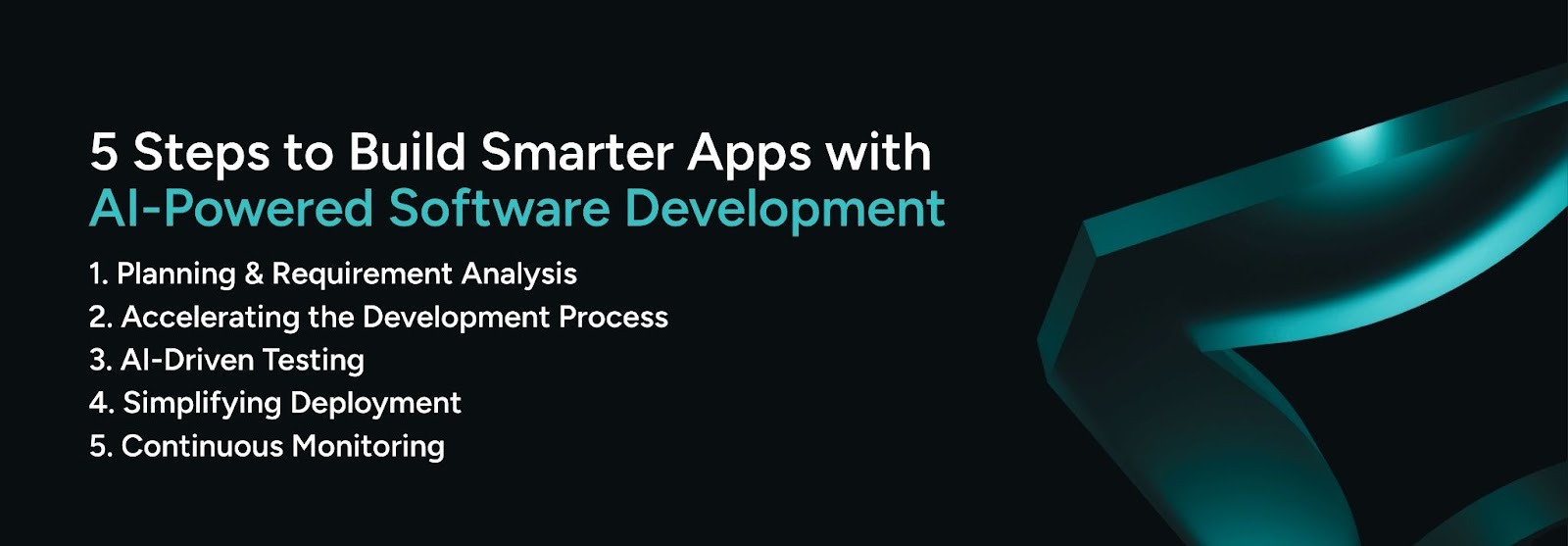
5 Steps to Build Smarter Apps with AI-Powered Software Development
AI-powered software development changes how you build apps. It makes the process faster, smarter, and more efficient. When you use AI tools across the SDLC, you improve features and automate routine work. You also raise overall app quality.
Step 1: AI-Powered Planning and Requirement Analysis
AI simplifies planning and requirement gathering. It removes confusion and gives you a strong data-based foundation.
Automated Requirement Gathering: AI reviews user feedback, market trends, and support tickets. It organizes clear project requirements and reduces confusion.
Feasibility Analysis: AI studies past project data. It estimates timelines and highlights possible risks.
Use Case Identification: AI identifies key use cases based on real-world needs. You can focus on solutions like chatbots or data dashboards.
Step 2: Accelerating the Development Process with AI
AI speeds up development by handling coding support and giving instant suggestions. You can focus on higher-value tasks.
Real-Time Code Suggestions: AI offers instant coding tips and helps you write cleaner code.
Automation of Repetitive Tasks: AI sets up libraries, modules, and basic functions. You spend more time on complex work.
Figma to Code: AI converts design files into working code. It keeps design and development aligned. Imagine how much time you can save here.
Step 3: AI-Driven Testing: Making App Testing Smarter and Faster
AI improves testing by automating test creation and prioritization. You test faster with less manual effort.
Automated Test Case Generation: AI creates detailed test cases, including edge scenarios.
Intelligent Test Prioritization: AI focuses on the most critical areas based on code changes.
Smart Regression Testing: AI reruns tests only where changes occur. It saves time and effort.
Step 4: Simplifying Deployment and Optimizing DevOps with AI
AI improves deployment and continuous integration. You release updates smoothly and scale without delays.
Predictive Scaling: AI predicts resource needs and adjusts capacity based on expected traffic.
Optimized Rollbacks: AI monitors deployments and restores earlier versions if issues appear.
Optimized CI CD Pipelines: AI accelerates builds, tests, and releases for faster delivery.
Step 5: AI in Continuous Monitoring and Maintenance
AI monitors your app performance at all times. It identifies and resolves issues before users feel the impact.
Real-Time Monitoring: AI tracks performance and provides instant insights into issues.
Proactive Issue Resolution: AI predicts and fixes issues early. It keeps your system stable and reliable.
What Are the Benefits of Using AI in Software Development?
When you add AI to your software development workflow, you gain clear advantages. It improves both efficiency and quality. AI for software teams speeds up development processes. As a result, you build apps faster and with greater reliability.
Increased Productivity: AI handles repetitive coding tasks. This lets developers focus on high-value work. It also speeds up overall development.
Improved Code Quality: AI detects bugs and security issues in real time. This keeps your code clean and dependable.
Reduced Costs: AI reduces human error and cuts down manual effort. You lower development costs and use resources better.
Faster Time to Market: AI shortens the release cycle. You launch apps faster while maintaining strong quality standards.
What AI Tools Can You Use to Enhance the App Development Process?
AI changes how you build software. It simplifies tasks, speeds up workflows, and improves productivity. SoftSpell products like ReqSpell, CodeSpell, and TestSpell work together to support your full development journey. They guide you from requirement gathering to testing with a smooth flow.
SoftSpell stands out because it improves every step of the SDLC. It helps your team build high-quality apps faster and with less effort. Imagine managing your entire process with better clarity and speed.
Requirement Analysis: ReqSpell
ReqSpell extracts and organizes requirements from legacy code, test plans, and product documents. It reduces manual analysis and saves time.
Requirement Grooming: Pull business needs from PDFs, emails, and product documents. Keep clarity and consistency across teams.
Reverse Engineering: Study legacy code to identify modules, dependencies, and scope. Support system upgrades and scaling.
Test Coverage Validation: Link requirements to test plans. Spot untested paths and improve coverage.
Cross Team Alignment: Search across documents, test artifacts, and code using natural language. Improve team communication.
AI Code Generation: CodeSpell
CodeSpell improves coding speed and quality. It supports developers at every stage.
AI-Driven Code Optimization: Review code for performance, readability, and scalability. Improve overall app efficiency.
Code Generation: Create foundational code structures and settings automatically. Save time on repetitive setup tasks.
Figma to Production Ready Code: Turn Figma designs into production-ready React or Angular code. Convert user interface components into working code with minimal effort.
Code Documentation: Create clear and complete documentation automatically. Keep your codebase easy to maintain.
Code Explanation: Break down complex logic with clear AI explanations. Reduce debugging time and confusion.
AI-Powered Test Automation: TestSpell
TestSpell simplifies and speeds up your testing process.
Test Case Generation: Create test cases directly from requirements or JIRA inputs. Improve speed and accuracy.
Parallel Testing: Run UI, API, and mobile tests together in one flow. Avoid separate testing cycles.
Early Testing: Start testing early with requirement-based optimization. Detect issues sooner in development.
Detailed Execution Reports: Review clear test reports that highlight improvement areas. Reduce manual testing and release with fewer bugs.
Conclusion
Is your development process ready for the AI-powered future?
You have seen how AI-powered software development improves every stage of the SDLC. It supports planning, coding, testing, and deployment. It also increases productivity, speeds up time to market, and improves code quality.
When you choose the right AI-powered SDLC platform like SoftSpell, you take your app development further. Its tools support requirement analysis, code generation, and testing in one smooth flow. You build faster and work smarter. Imagine the impact on your daily workflow.
Try SoftSpell today and transform your development process.
1. How can AI-powered software development help speed up my app development process?
AI speeds up your work by handling repetitive tasks and giving real-time coding suggestions. It also simplifies testing and keeps everything moving smoothly. You can focus on complex tasks while it reduces overall development time.
2. Can AI tools replace developers in the software development process?
No, AI for software teams supports you by accelerating tech delivery. It handles routine tasks and helps with code generation and testing. It does not replace developers. It improves your productivity and code quality instead.
3. How does AI improve the quality of the code produced during development?
AI finds bugs and security risks in real time. It keeps your code clean and reliable. It also suggests ways to improve performance and make your code easier to maintain.
4. What is the role of AI in the testing phase of software development?
AI creates test cases automatically and sets priorities based on risk. It runs focused regression tests and reduces manual effort. You catch bugs early and save valuable testing time. Are you making the most of this advantage?
5. How can AI-powered software development reduce costs?
AI lowers costs by reducing human errors and cutting down manual tasks. It helps you use resources wisely and speeds up the full development life cycle. You release faster and deal with fewer issues after launch.
Market researcher at SoftSpell, uncovering insights at the intersection of product, users, and market trends. Sharing perspectives on research-driven strategy, SaaS growth, and what’s shaping the future of tech.


.svg)