


Changelog
July 1, 2026
.svg)
.jpg)
Every software project begins with a promise: to deliver the right product on time and within budget. Yet countless projects fail not because of poor coding or weak design, but because of flawed SDLC requirements gathering at the very start. Misunderstood goals, overlooked stakeholders, and vague specifications silently derail timelines and inflate costs before a single line of code is written.
Enterprises today face mounting pressure to move fast without sacrificing clarity. Traditional, manual approaches simply cannot keep up. That is where AI-driven solutions like SoftSpell step in, transforming a historically chaotic process into a structured, accurate, and efficient foundation for software success.
Accurate requirements gathering in SDLC is not a formality, it is the backbone of every successful software delivery. When requirements are clearly defined from the start, development teams build what stakeholders actually need, QA engineers test against measurable outcomes, and project managers can plan realistic timelines.
Consider a real-world scenario: a retail enterprise commissions a customer portal to improve order tracking. Without proper requirements gathering, the development team builds a feature-rich dashboard, only to discover six months later that end-users primarily needed a simple SMS notification system. The result? Budget overrun, delayed launch, and a product that misses the mark entirely.
Challenges in Traditional Methods
Traditional requirements gathering relies heavily on manual processes, email threads, scattered Word documents, and ad hoc interviews. These methods are slow, inconsistent, and prone to human error. Critical details get lost in translation. Conflicting inputs from different departments go unresolved. The outcome is a requirements document full of ambiguities that haunt every subsequent phase of the SDLC.
Stakeholder Involvement
One of the most critical, and most commonly neglected, aspects of requirements of SDLC is ensuring all voices are heard. End-users understand the day-to-day pain points. Software developers know what is technically feasible. QA engineers anticipate edge cases. Third-party vendors bring integration constraints. When any one of these groups is excluded from the requirements gathering process, blind spots emerge that surface as costly rework later.
A structured approach eliminates guesswork and creates a repeatable, auditable path from business need to technical specification. Here is how the process unfolds across six stages.
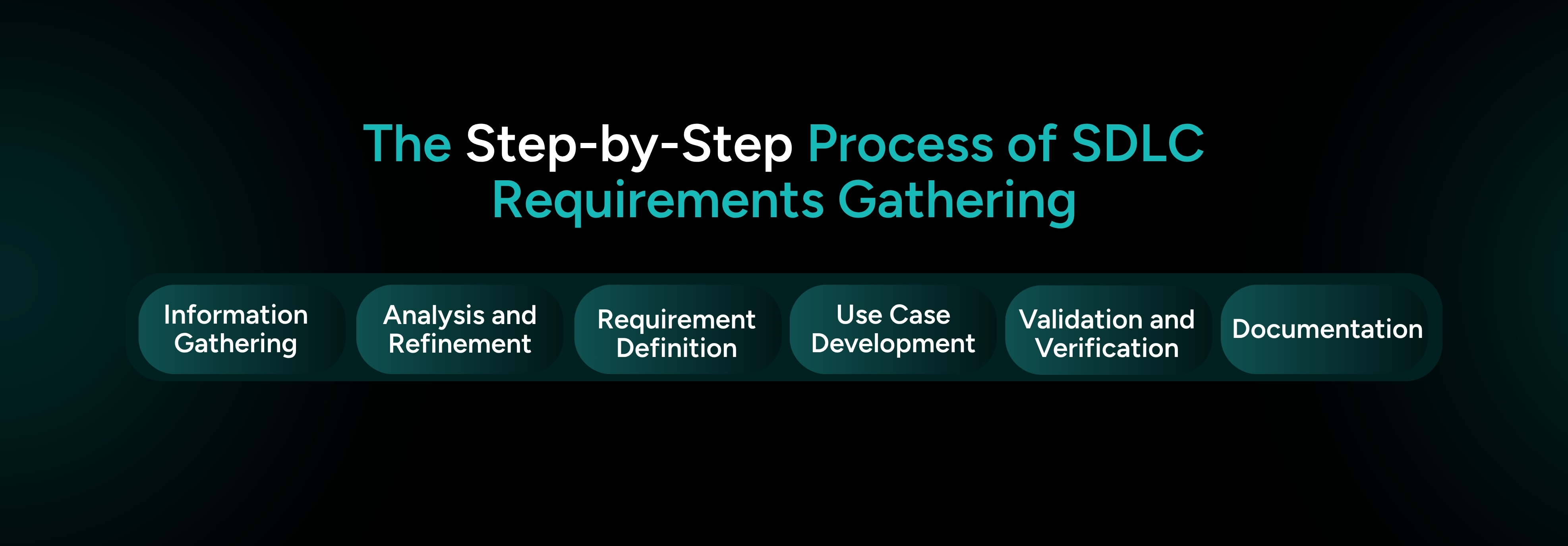
Step 1: Information Gathering
Key activities include stakeholder identification, one-on-one and group interviews, existing document review, and market research. Deliverables at this stage include an initial requirements list, a stakeholder register, and business context documentation. The goal is to cast a wide net, capturing every relevant input before filtering begins.
Step 2: Analysis and Refinement
Once raw inputs are collected, teams categorize requirements by type (functional, non-functional, technical), resolve conflicts between stakeholder groups, assess technical and financial feasibility, and map dependencies between requirements. This is where clarity starts to emerge from noise.
Step 3: Requirement Definition
Each requirement must be specific, measurable, achievable, relevant, and testable. Vague language like "the system should be fast" gets replaced with "the system must return search results within 1.5 seconds for 95% of queries." This precision is what makes downstream development and testing reliable.
Step 4: Use Case Development
Use cases bring requirements to life by describing how real users interact with the system. Each use case includes preconditions (what must be true before the interaction begins), a main flow (the expected path), alternative flows (variations and exceptions), and postconditions (the system state after completion).
Step 5: Validation and Verification
Requirements are reviewed through stakeholder walkthroughs, prototype testing, and peer reviews. This stage catches errors, gaps, and misalignments before they move downstream, where fixing them costs exponentially more time and money.
Step 6: Documentation
The final stage produces the formal artifacts that govern the entire project: the Software Requirement Specification (SRS), use case document, data dictionary, and traceability matrix. These documents serve as the single source of truth throughout the SDLC.
Automation in Information Gathering: SoftSpell's AI scans existing documentation, previous project artifacts, and stakeholder inputs to auto-populate initial requirements lists, ensuring nothing is overlooked.
AI-Driven Analysis: Pattern recognition and natural language processing help the system detect ambiguous language, identify conflicting requirements, and flag feasibility concerns that human analysts might miss.
Faster Requirement Definition: Instead of analysts writing requirements from scratch, ReqSpell suggests well-structured, testable requirement statements based on captured inputs, cutting definition time significantly.
Use Case Development: The AI generates detailed use cases directly from business requirements, saving hours of manual effort while ensuring consistency in format and completeness.
Real-Time Validation: As requirements are entered, SoftSpell continuously checks for gaps, contradictions, and alignment with stated business goals, providing instant feedback rather than catching issues weeks later during a formal review.
Automated Documentation: ReqSpell auto-generates the SRS, traceability matrix, and data dictionary, dramatically reducing the manual documentation burden on business analysts and project managers.
Let us walk through a hypothetical example. A logistics company wants to build an internal shipment tracking system.
In the information gathering phase, the team interviews warehouse managers, dispatchers, delivery drivers, and IT staff. They review legacy tracking spreadsheets and competitor platforms. The output is a stakeholder register and a raw list of 47 potential requirements.
During analysis and refinement, the team discovers a conflict, warehouse managers want real-time GPS updates every 30 seconds, while the IT team flags that the current server infrastructure cannot support that frequency cost-effectively. This dependency is documented and escalated.
In requirement definition, the GPS update requirement is revised: "The system shall update shipment location every 2 minutes, with an option for manual refresh." Measurable, feasible, testable.
Use case development maps out how a dispatcher searches for a delayed shipment, views its last known location, and triggers an automatic customer notification, with alternative flows for when GPS data is unavailable.
Validation involves a working prototype reviewed by all stakeholder groups. Dispatchers identify a missing field for delivery notes. This is caught before development begins.
Documentation produces a complete SRS with 32 finalized requirements, a traceability matrix, and a use case document, all in a standardized format ready for the development team.
Suggested Read: 5 Most Common Requirements Gathering Questions Developers Ask in 2025
ReqSpell helps your team turn scattered requirements into production-ready code by bringing structure to unorganized information. It collects, organizes, and manages requirements from sources like legacy codebases, test plans, and product documents, so your product, engineering, and QA teams can work from one clear source of truth.
The SDLC process in software engineering has always demanded precision. ReqSpell simply makes that precision achievable at scale, without depending on individual analyst expertise or bandwidth.
Effective SDLC requirements gathering is not a nice-to-have, it is the difference between a project that delivers value and one that burns time, budget, and stakeholder trust. The six-step process outlined here provides a proven framework.
AI tools like SoftSpell's ReqSpell make executing that framework faster, more accurate, and more collaborative than anything manual methods can offer. The question is no longer whether AI belongs in requirements gathering. It is how quickly your organization can adopt it before the gap between you and your competitors becomes too wide to close.



July 1, 2026
Don’t Miss Out
We share cool stuff about coding, AI, and making dev life easier.
Hop on the list - we’ll keep it chill.

© 2026, SoftSpell. All Rights Reserved


