


Changelog
July 1, 2026
.svg)
What if your real competitive edge in 2026 comes from redesigning your entire AI SDLC around AI?
Enterprises now embed AI across the software development lifecycle. They reduce delays, improve decisions, and scale innovation with confidence.
Forward-thinking organizations move beyond simple experiments. They adopt structured AI-driven execution.
In this blog, you will see how AI reshapes AI SDLC for leading enterprises in 2026 and why it shapes the next AI investment case.
AI improves decision quality at every stage of the traditional SDLC. It does more than just speed up execution. Instead of reacting to defects and bottlenecks, you can use AI to predict, validate, and optimize continuously.
Imagine preventing issues before they slow you down. You create tighter feedback loops, stronger traceability, less rework, and clear efficiency gains across the lifecycle.
Inefficient requirements gathering and fragmented documentation slow backlog readiness and create misalignment.
How AI Improves:
Manual code creation, inconsistent documentation, and repetitive optimization increase development effort.
How AI Improves:
Lengthy QA cycles, heavy manual effort, and delayed defect detection extend release timelines.
How AI Improves:
Late-stage security reviews create expensive fixes and compliance risks.
How AI Improves:
Rollouts remain risky despite CI/CD maturity, leading to reactive fixes.
How AI Improves:
Suggested Read: From Requirements to Release: How AI is Rewriting the SDLC
AI reduces SDLC cycle time by fixing decision gaps, not just by speeding up tasks. When you embed intelligence across requirements, design, development, testing, and deployment, you stop rework before it starts.
As a result, you achieve predictable delivery, strong alignment, and faster innovation without losing quality or control.
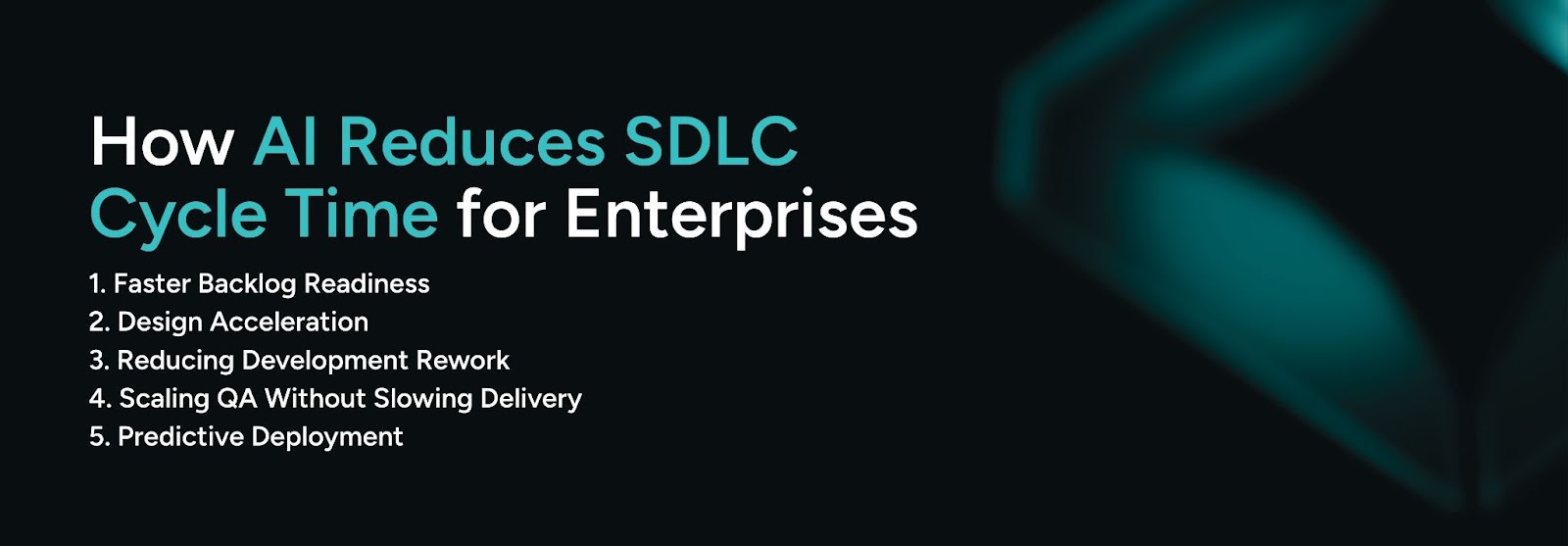
1. Faster Backlog Readiness Through AI-Assisted Requirements
Backlog delays often start with unclear or incomplete requirements. AI removes confusion early. It structures information and improves traceability across teams.
2. Design Acceleration
Design slows down when teams lack visibility into constraints and dependencies. AI adds real-time intelligence to improve both quality and speed.
3. Reducing Development Rework
Rework increases cycle time more than slow coding. AI reduces rework by improving code accuracy during creation. Imagine catching issues as you write code instead of fixing them later.
4. Scaling QA Without Slowing Delivery
QA often becomes the final bottleneck in enterprise SDLC. AI turns testing into a continuous process instead of a last-stage checkpoint.
5. Predictive Deployment Instead of Reactive Fixes
Deployment risks often lead to reactive troubleshooting and rollbacks. AI shifts deployment toward predictive execution and better control.
Transform your software development lifecycle with SoftSpell, an AI-powered tool that simplifies your entire development process. It simplifies complex workflows and helps you move faster with smooth operations. It improves team efficiency and keeps you ahead.
ReqSpell: Seamless Requirement to Code
ReqSpell helps you extract and manage requirements from documents easily. It connects requirements to test plans and keeps your projects aligned from start to finish.
CodeSpell: Ultimate AI Coding Sidekick:
CodeSpell acts as your AI assistant and speeds up software delivery. It creates clean and maintainable code with less effort.
It breaks down complex logic and generates documentation. You save time and reduce errors. Imagine how much faster you can deliver with this support.
TestSpell: AI-Driven Test Automation:
TestSpell manages your testing process from requirement analysis to test reporting. It helps you create tests quickly and automatically generates reports. It keeps quality high while you maintain fast development cycles.
Is your enterprise ready to move beyond AI experiments? It is time to fully optimize your AI SDLC for measurable innovation.
In this blog, you saw how AI improves requirements, development, testing, security, and deployment. It reduces cycle time. It also strengthens decision-making across teams. The smartest enterprises in 2026 will not just automate tasks. They will redesign their SDLC with the right business case for AI tooling. They will build it for resilience.
You need the right AI SDLC partner to turn productivity gains into real business results. SoftSpell embeds intelligence across every stage of the lifecycle. This helps you move from small wins to lasting impact. If you want to accelerate innovation, now is the time to try SoftSpell.


July 1, 2026
Don’t Miss Out
We share cool stuff about coding, AI, and making dev life easier.
Hop on the list - we’ll keep it chill.

© 2026, SoftSpell. All Rights Reserved


