


Changelog
July 1, 2026
.svg)
.jpg)
Your development team just shipped a critical update. Within hours, production is down. The culprit? A regression bug that a faster, smarter testing process would have caught. Sound familiar?
Software testing using AI is no longer a nice-to-have; it's the backbone of modern quality engineering. As enterprise applications grow in complexity and release cycles tighten to days (not months), traditional manual testing simply can't keep up.
AI-powered testing fills that gap by automating repetitive tasks, detecting anomalies in real time, and enabling teams to ship faster without sacrificing quality.
In this post, we'll walk you through 8 proven benefits and 3 QA tools transforming how enterprises approach QA.
Let's be direct: traditional testing is expensive, slow, and fragile.
Manual testing alone consumes a good percentage of a software project's total budget. Regression test suites that once took hours now need to run in minutes to support CI/CD pipelines. And the cost of a single production bug?.
The problem runs deeper than speed. Manual testers miss edge cases, not because they're not skilled, but because the sheer volume of test scenarios in modern enterprise applications is humanly impossible to cover. Automated software testing powered by AI doesn't replace that human judgment. It handles the volume problem so your team can focus on judgment.
There's also a misconception worth addressing head-on: "AI testing is only for big tech companies." That's no longer true. Affordable, enterprise-ready AI testing platforms have democratized access, making these tools as viable for a 50-person engineering team as for a Fortune 500 QA department.
.jpg)
1. Improves Test Coverage and Quality
Manual testing will always have blind spots. Testers are human; they follow known paths, test familiar features, and unconsciously skip edge cases they haven't encountered before.
AI changes the equation entirely. By analyzing historical test data, code changes, and user behavior patterns, AI can identify gaps in manual testing and generate test cases that human testers would never think to write. The result? Dramatically higher coverage with fewer resources.
For enterprise applications with thousands of user flows, this isn't an incremental improvement; it's a structural upgrade to your entire QA process.
2. AI Supports Manual Testing
Here's the narrative that gets it wrong: "AI will replace your testers." It won't. What AI actually does is eliminate the grunt work, the repetitive regression runs, the data entry validation, the browser-compatibility checks, so your experienced testers can focus on what humans do best.
Exploratory testing. Creative edge-case hunting. UX judgment calls. Business logic validation that requires context.
Think of AI as the junior tester who never complains about running the same 500-test regression suite at 2 AM. Manual vs automated software testing is a false choice, the real opportunity is using both in tandem, each doing what it does best.
3. Saves Time with Automation: The Use of AI in Software Testing
AI-powered software testing powered by AI runs around the clock. It doesn't need breaks. It doesn't make keyboard typos. And it can execute thousands of test cases simultaneously, something no human team can replicate.
The use of AI in software testing compresses feedback loops from hours to minutes. A developer pushes code and gets test results before they've finished their next coffee. That speed compounds over sprint cycles, resulting in significantly greater shipping velocity per quarter.
For enterprises running complex microservices architectures, this kind of continuous testing isn't optional; it's existential.
4. Reducing Time-to-Market (TTM)
Speed to market is a competitive advantage, and AI-powered testing is one of the clearest levers to pull.
By enabling parallel testing across browsers, devices, operating systems, and screen sizes simultaneously, AI eliminates the sequential bottlenecks that plague traditional QA pipelines. A test suite that might take 8 hours sequentially can run in under an hour when parallelized.
Enterprises in fast-moving sectors, fintech, e-commerce, and SaaS, can compress product release cycles by weeks. That's real revenue impact.
5. Ensuring Great Accuracy
Human error in software testing is real and costly. A misread test result, a skipped assertion, a misconfigured test environment, small mistakes cascade into big problems, especially in regression testing, where consistency is everything.
AI eliminates this class of errors entirely. Every test case executes with the same precision every time. Complex calculations, data transformations, and multi-step workflows are validated without drift or fatigue.
For compliance-heavy industries, healthcare, finance, and legal tech, that level of precision isn't just a quality perk. It's a regulatory requirement.
6. Real-Time Monitoring and Anomaly Detection
Most testing happens before release. But production environments are unpredictable, with traffic spikes, third-party API failures, and infrastructure hiccups. AI-powered monitoring extends your testing intelligence into production.
By establishing baselines of normal system behavior, AI can detect performance anomalies before they surface as user-facing errors. A response time creeping up by 200ms might not trigger an alert in a rule-based monitoring system. An AI system recognizes it as a deviation from baseline and flags it proactively.
This shift from reactive incident response to proactive anomaly detection is one of the most underrated benefits in enterprise QA.
7. AI in Risk Management
Not all bugs are created equal. Some are cosmetic. Some are catastrophic. AI helps enterprises prioritize by predicting which areas of a codebase carry the highest risk before testing even begins.
By analyzing code changes, historical defect patterns, and application architecture, AI can flag high-risk modules for deeper testing attention. It can simulate real-world stress scenarios, security penetration attempts, load spikes, and dependency failures that manual testing rarely covers.
The upstream benefit? Fewer production incidents, lower remediation costs, and better stakeholder confidence in release quality.
Suggested Read: From Reactive Testing to Predictive QA: How Testspell Enables Continuous Quality at Scale
8. Revolutionizing Test Environment Management
This benefit doesn't get talked about enough. Setting up a test environment manually, provisioning servers, configuring databases, managing dependencies, syncing versions, is slow, error-prone, and deeply frustrating for engineering teams.
AI automates environment provisioning based on real-world conditions. It spins up consistent, reproducible test environments on demand, eliminates "it works on my machine" problems, and ensures that what gets tested actually mirrors production. For enterprises managing dozens of microservices, this alone can reclaim days of engineering time per sprint.
Knowing the benefits is one thing. Knowing which tools to use is where strategy meets execution. Here are three enterprise-ready platforms worth evaluating:
1. TestSpell
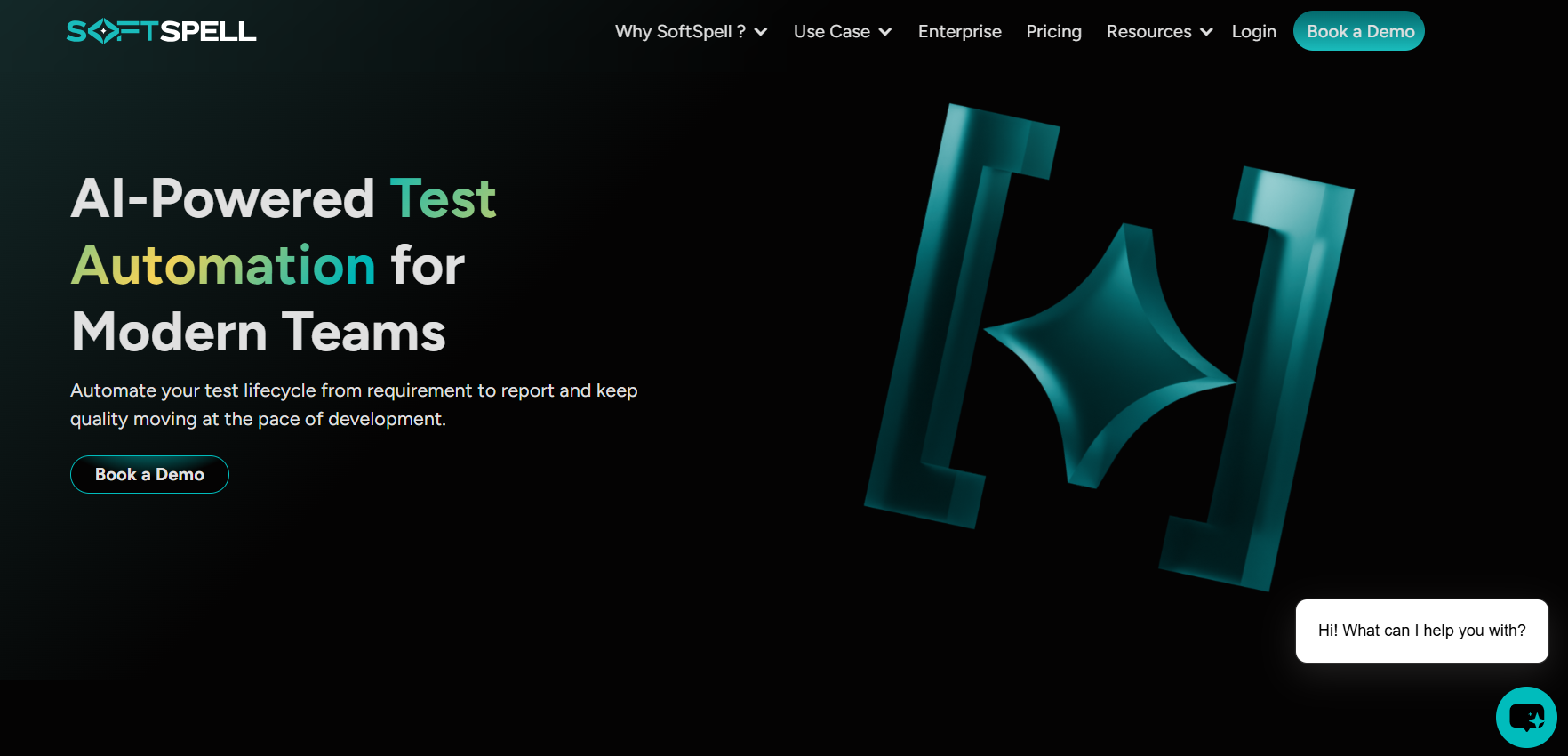
TestSpell from SoftSpell is an AI-powered testing solution built to make software testing faster and easier. It helps QA teams create test cases, find coverage gaps, and improve testing accuracy without adding extra manual work.
By automating repetitive tasks and offering smart suggestions, TestSpell helps teams catch issues early and release software with more confidence. Want to make testing easier and more reliable? TestSpell fits smoothly into modern development workflows, making testing faster, more consistent, and easier to manage across projects.
Key Features
Who is it for?
TestSpell is built for QA teams, testers, and engineering leaders who want to improve software quality, reduce manual testing work, and speed up release cycles with AI-powered automation.

2. TestGrid

TestGrid is built for enterprises that need scalable, codeless test infrastructure without the complexity of managing it themselves. Its AI-driven codeless testing environment allows QA teams to build and execute tests without writing a single line of code, a significant unlock for teams with limited automation expertise.
Cross-browser testing, mobile app testing, and native CI/CD integrations (Jenkins, GitHub Actions, Azure DevOps) make TestGrid a natural fit for enterprises already invested in DevOps workflows. The automated UI testing software capabilities are particularly strong, supporting parallel execution across hundreds of browser/device combinations simultaneously.
Best for: DevOps-mature enterprises seeking codeless automation with deep pipeline integration.
3. TestFort
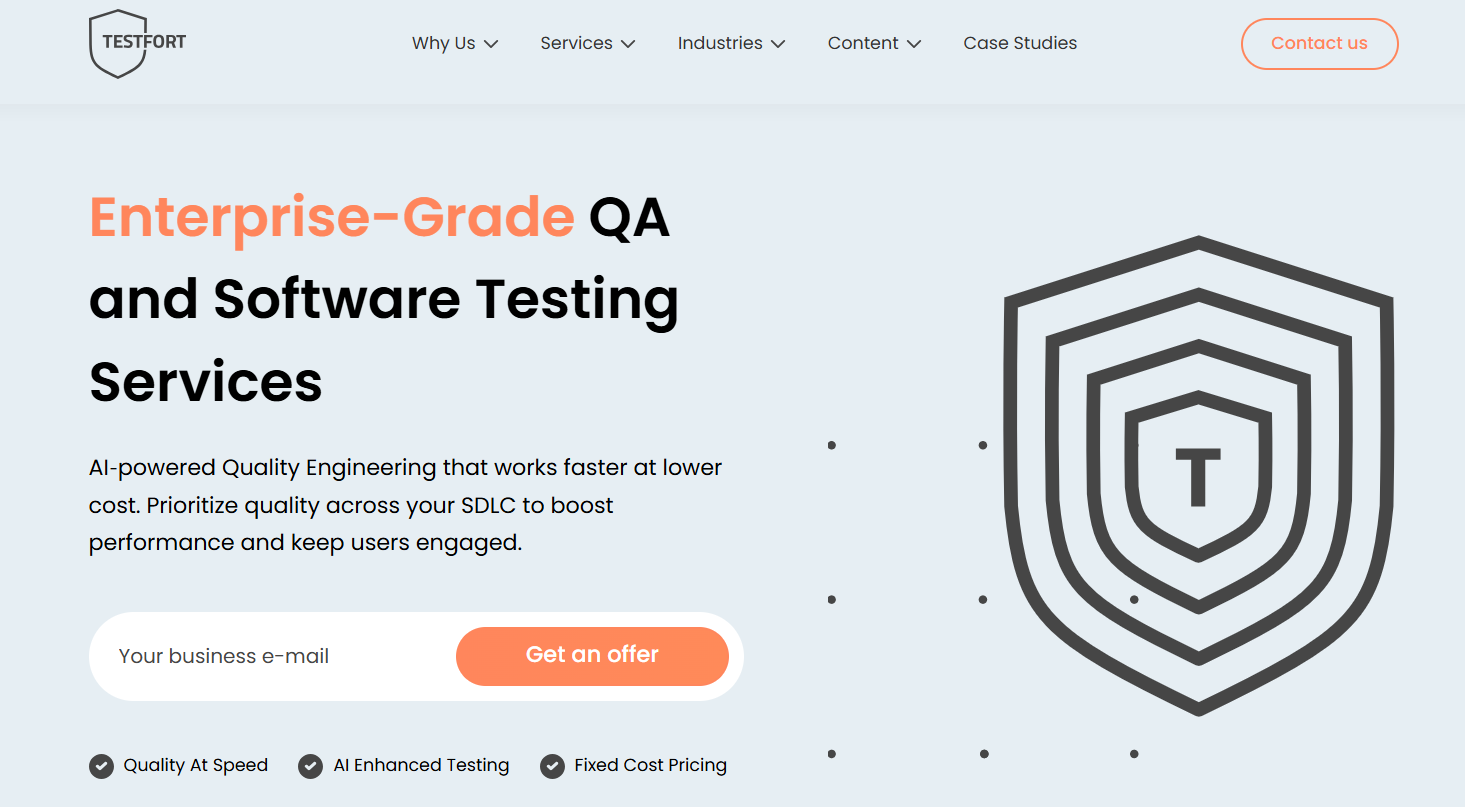
TestFort takes a services-led approach, combining AI-powered quality engineering with dedicated testing expertise. For enterprises that need both technology and talent, TestFort bridges the gap.
Their hybrid model, blending automated and manual testing, is particularly valuable for applications with complex business logic or regulatory requirements where pure automation isn't sufficient. TestFort clients consistently report faster release cycles, reduced defect leakage into production, and measurable improvements in software quality scores.
Best for: Enterprises seeking managed QA services with AI-augmented testing capabilities.
1) AI testing is too complex to implement - Modern platforms like TestSpell and TestGrid are designed for teams without deep automation expertise. Codeless interfaces, plug-and-play CI/CD integrations, and guided onboarding flatten the adoption curve significantly.
2) We can't trust AI to catch what matters - AI doesn't replace judgment, it handles volume. Your human testers still own the test strategy and sign-off decisions. AI just makes sure the mechanical execution layer is exhaustive and consistent.
3) The ROI isn't clear - The numbers are actually quite straightforward. Faster release cycles, fewer production incidents, reduced regression maintenance, and lower defect remediation costs all compound into significant cost savings. Most enterprises see measurable ROI within the first two quarters of adoption.
4) Security and data privacy are concerns - Enterprise-grade AI testing platforms operate under SOC 2, ISO 27001, and GDPR compliance frameworks. Reputable vendors offer on-premise deployment options for highly sensitive environments.
Getting the most from AI testing isn't just about picking the right tool; it's about how you integrate it into your workflow.
Software testing using AI isn't a future trend, it's the present competitive standard. Enterprises that continue relying on purely manual QA processes will find themselves slower to market, more exposed to production incidents, and harder to scale.
The 8 benefits we've covered, from improved coverage and real-time monitoring to risk prediction and environment automation, aren't isolated wins. They compound. Each one reduces friction in your development pipeline, improves product quality, and gives your engineering team more confidence to ship faster.
Tools like TestSpell, TestGrid, and TestFort make enterprise adoption practical and measurable. The question isn't whether to integrate AI into your testing, it's how quickly you can get started.





July 1, 2026
Don’t Miss Out
We share cool stuff about coding, AI, and making dev life easier.
Hop on the list - we’ll keep it chill.

© 2026, SoftSpell. All Rights Reserved


