


Changelog
July 1, 2026
.svg)
.png)
Poor requirements cause 80% of software project failures. It's time to stop guessing and start using AI.
Before your developers write a single line of code, before your QA team opens a test case, and before your DevOps pipeline runs its first build, the damage may already be done.
Bad requirements are the silent killer of software projects. They don't announce themselves. They hide inside vague user stories, ambiguous acceptance criteria, undocumented edge cases, and tribal knowledge locked in the heads of BAs who left the company two sprints ago.
The numbers are brutal. The Standish Group's CHAOS Report found that 80% of software project failures trace back to requirements-related issues. IBM's Systems Sciences Institute showed that fixing a defect at the requirements phase costs $100 — but the same defect costs $10,000 to fix once it reaches production. That's a 100× cost multiplier hiding at the very start of your SDLC.
And the financial scale is staggering: the Consortium for Information & Software Quality (CISQ) estimated that poor software quality costs U.S. businesses $2.41 trillion annually. Not globally — in the U.S. alone.
Traditional requirements management relies on human review. A BA writes requirements in a document; stakeholders comment in silos, and developers interpret the rest using contextual guesswork. This works on small projects. It breaks down catastrophically at an enterprise scale.
AI requirements management replaces this fragile, manual process with intelligent automation that can:
Most legacy requirement tools were built for a simpler era when projects were smaller, timelines were longer, and teams could afford to spend weeks refining specs before development began. That era is over.
Today's enterprise SDLC operates in two-week sprints, ships to production daily, and manages hundreds of microservices with thousands of interdependencies. In this environment, traditional requirement tools fail for four reasons:
ReqSpell, part of the SoftSpell AI SDLC platform, is purpose-built to solve the requirements problem at the enterprise level. It doesn't just help you write better requirements - it transforms the entire requirement lifecycle from a manual, error-prone process into an intelligent, automated workflow.
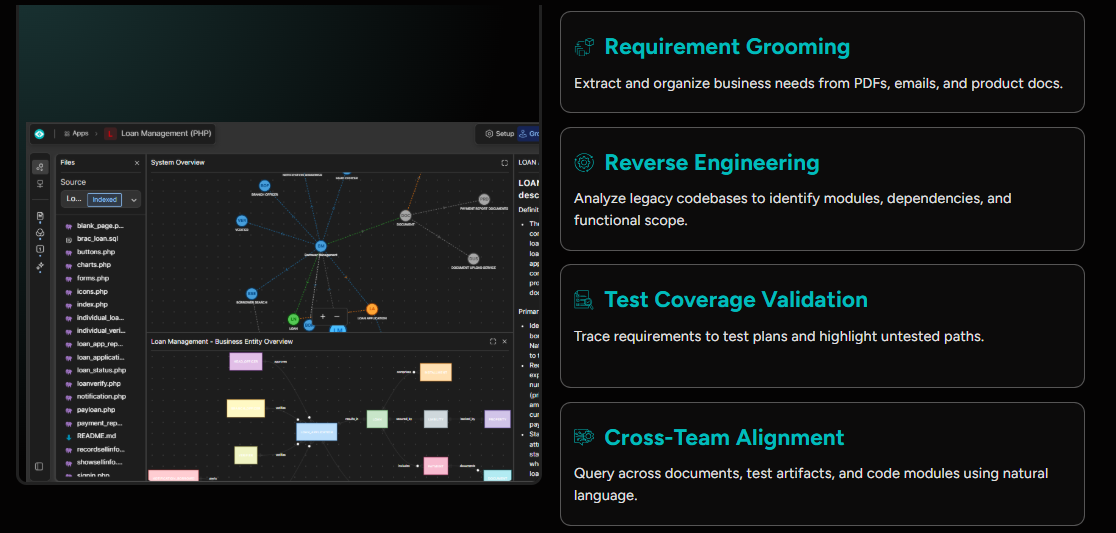
ReqSpell ingests PDFs, emails, meeting notes, release notes, code comments, and legacy documentation and automatically identifies, categorizes, and structures the business requirements buried inside. No more hunting through 200-page PRDs for the three sentences that actually matter.
For modernization projects, ReqSpell analyzes existing codebases to extract functional scope, identify modules and dependencies, and generate structured requirements from code turning legacy systems into documented, traceable specifications without manual archaeology.
ReqSpell evaluates every requirement for completeness, consistency, and technical feasibility. It detects missing parameters, inconsistent logic, unaddressed edge cases, and alignment gaps between business intent and engineering implementation before development begins.
ReqSpell maps requirements to test cases, surfaces coverage gaps, and highlight untested paths. When integrated with TestSpell, this creates an unbroken traceability chain from business requirements to deployed features essential for compliance-driven industries.
5. Natural Language Query Interface
Teams can query their entire requirement ecosystem in plain English. Ask, "What are the functional requirements for the payments module?" or "Which test cases cover the login edge cases?" and get instant, contextually accurate answers without digging through documents.
The benefits of AI requirements management aren't theoretical. Here's what enterprise engineering teams report after implementing ReqSpell:
ReqSpell is designed for engineering organizations that are tired of watching development velocity collapse under the weight of requirement rework. Specifically, it's built for:
Every sprint you run without validated requirements is a sprint where gaps are silently compounding. Every defect that surfaces in QA instead of requirements analysis costs your team 15× more to fix. Every legacy modernization project that starts without structured specs risks months of discovery work that could have been done in days.
The question isn't whether your organization can afford AI requirements management. It's whether you can afford another year without it.



July 1, 2026
Don’t Miss Out
We share cool stuff about coding, AI, and making dev life easier.
Hop on the list - we’ll keep it chill.

© 2026, SoftSpell. All Rights Reserved


