


Changelog
July 1, 2026
.svg)
.png)
TL;DR:
While coding, testing, and deployment are largely automated with AI requirements management, it often slows software projects down. ReqSpell applies AI to convert natural-language requirements into structured, machine-readable data, helping teams improve development efficiency, streamline testing, maintain traceability, strengthen governance, and better connect business goals with software outcomes.
Software leaders today are investing heavily in automation across testing, deployment, and delivery. Yet, one part of the SDLC remains largely untouched - the point where ideas become requirements.
That’s where execution slows down; costs rise, and alignment breaks. The impact is significant. Research frequently cited from IBM shows that defects introduced during the requirements phase can cost up to 100 times more to fix after release than when identified early in development. This highlights how small misunderstandings in requirements can create major downstream consequences.
This is where AI requirements management changes the foundation of software delivery. ReqSpell changes this foundation.
It introduces automation at the requirement level, turning human-written specifications into structured, machine-readable intelligence that can drive development, testing, and DevOps workflows seamlessly.
Even in the most advanced organizations, requirements remain the weakest link in the automation chain.
Teams have automated coding, testing, deployment, and infrastructure management, yet SDLC requirements gathering remains largely manual. Ideas are captured in documents, tickets, spreadsheets, and meeting notes before being passed from one team to another.
They’re written in natural language - ambiguous, unstructured, and open to interpretation.
A simple line like:
“The system should allow admins to manage user permissions.”
can trigger endless follow-up clarifications.
During SDLC requirements analysis, teams immediately start asking questions:
Without clear answers, every team fills in the gaps differently.
Every layer works on interpretation, not data.
This challenge becomes even more significant as organizations scale. More products, more teams, and faster release cycles increase the risk of requirement misunderstandings flowing downstream into development and testing. What starts as a vague requirement can eventually become rework, delays, defects, and missed expectations.
Traditional documentation tools capture text, they don't understand it. They can store requirements, but they cannot identify ambiguity, uncover missing logic, establish traceability, or translate intent into machine-readable workflows.
ReqSpell brings semantic understanding to this process. Instead of treating requirements as static documents, it transforms them into structured intelligence that can power development, testing, and DevOps workflows from the very beginning.
ReqSpell acts as an AI intermediary between business logic and development workflows.
Instead of treating requirements as plain text, it reads natural language specifications, identifies the entities, actions, business rules, and dependencies within them, and converts that information into a structured, queryable model that downstream systems can use.
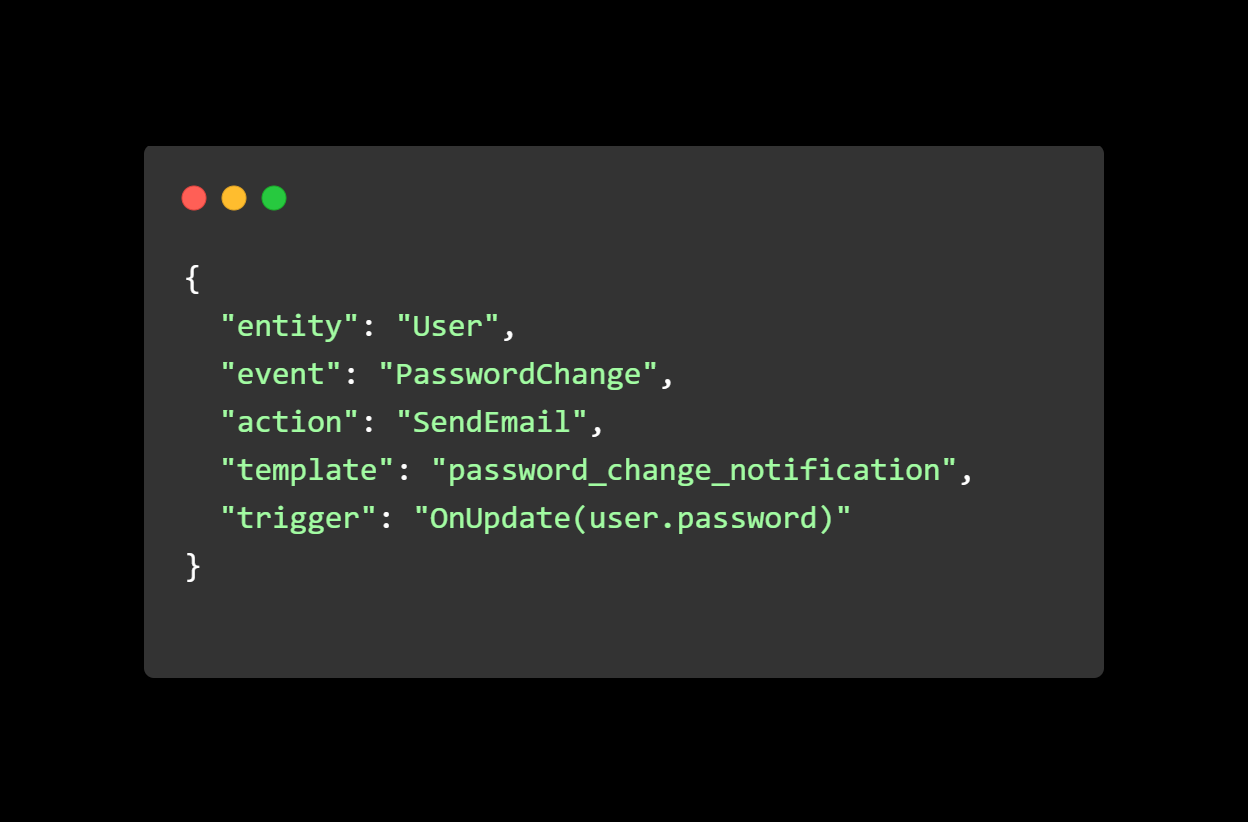
For example, a product manager may write a requirement like:
"The system should send an email to users when their password is changed."
To a human, the requirement seems simple. However, multiple pieces of information are embedded within that single sentence.
ReqSpell automatically extracts and structures them:
Instead of leaving developers and QA teams to interpret the requirement manually, ReqSpell transforms it into machine-readable intelligence that systems can understand and act upon.
This output isn't just documentation. It becomes a structured asset that can:
The result is a direct connection between business intent and software execution, reducing ambiguity while accelerating delivery across the SDLC.
For technology leaders, requirement automation is not just a productivity improvement. It is a strategic capability that improves alignment, reduces execution risk, and enables faster software delivery. Here are some key areas where its impact becomes most visible:
1. Reduce Time-to-Build
With AI requirements management, teams move from idea to implementation within hours. Structured requirements eliminate ambiguity and accelerate development cycles.
2. Enable End-to-End Traceability
ReqSpell auto-links requirements to code, APIs, and test cases - providing continuous visibility across the SDLC.
3. Improve Alignment Across Functions
A single semantic source of truth ensures product, QA, and engineering remain in sync through every sprint.
4. Strengthen Governance and Compliance
With audit-ready traceability, ReqSpell helps enterprises operating in regulated domains maintain full control over requirement changes and validate that SDLC security requirements are consistently captured, tracked, and implemented across teams.
SoftSpell connects requirements, development, and testing in a unified AI-driven workflow, helping teams move from ideas to delivery faster and with greater accuracy. It serves as the entry point to an intelligent, automated software pipeline:
ReqSpell transforms natural-language requirements into structured, machine-readable data, reducing ambiguity and improving requirement clarity.
CodeSpell uses structured requirements to create development-ready code scaffolds, helping teams accelerate implementation and maintain alignment with business needs.
TestSpell generates test scenarios and validation logic directly from requirements, improving test coverage and traceability.
Together, ReqSpell, CodeSpell, and TestSpell create a streamlined AI-first SDLC powered by AI requirements management. This connected flow ensures every stage of software delivery is driven by accurate, context-aware data.
The value extends beyond automation. Continuous traceability is another key advantage of the platform.
SoftSpell maintains a live map between requirement, code, and test. When a requirement changes, the entire dependency chain updates automatically.
For complex or enterprise-scale systems, this transforms maintenance from reactive firefighting into proactive control reducing regression risk and improving delivery predictability.
Unlike tools that store requirements, ReqSpell understands them.
It transforms human intent into structured data that other systems can reason with, making automation possible at the requirement level.
Your stories aren’t just written; they’re connected, queryable, and dynamically linked to real code and test logic.
Key capabilities include:
The result is a shift from documentation management to requirement intelligence. Rather than simply recording requirements, ReqSpell helps organizations operationalize them, making requirements an active part of the AI-first SDLC.
The result is higher velocity, cleaner governance, and a measurable ROI on every sprint.
ReqSpell bridges the final automation gap in modern software delivery, the one between human intent and machine execution.
By structuring natural language requirements into actionable intelligence, it empowers organizations to move from interpretation to automation.
For technology leaders seeking predictability, scalability, and velocity in an AI-first world, Reqspell represents a foundational shift where clarity becomes code.
Every great release starts with a clear requirement. See how ReqSpell turns ideas into structured intelligence that powers the entire SDLC, book your demo today.



July 1, 2026
Don’t Miss Out
We share cool stuff about coding, AI, and making dev life easier.
Hop on the list - we’ll keep it chill.

© 2026, SoftSpell. All Rights Reserved


