


Changelog
July 1, 2026
.svg)
.png)
Software systems don’t fail because teams lack skill - they fail because teams lack clarity.
As systems scale, they accumulate layers of logic, dependencies, and hidden relationships that are rarely documented in a way that reflects reality. What starts as a well-structured architecture gradually becomes a black box. Teams spend more time understanding the system than actually building on top of it.
This is the core problem ReqSpell Knowledge Graph is designed to solve.
Instead of treating system understanding as a manual, time-consuming process, it transforms your entire codebase and requirements into a living, navigable intelligence layer. It doesn’t just show you what exists—it helps you understand why it exists, how it connects, and what happens if you change it.
Most teams assume their biggest constraint is development speed. In reality, the bottleneck appears much earlier—during understanding.
Before writing a single line of code, teams need answers. How is this module connected? What dependencies will this change impact? Where does this business logic originate? These questions often require deep dives into code, multiple stakeholder discussions, and a fair amount of guesswork.
ReqSpell Knowledge Graph eliminates these inefficiencies by making system understanding instant, visual, and contextual.
At its core, the Knowledge Graph reimagines how systems are represented.
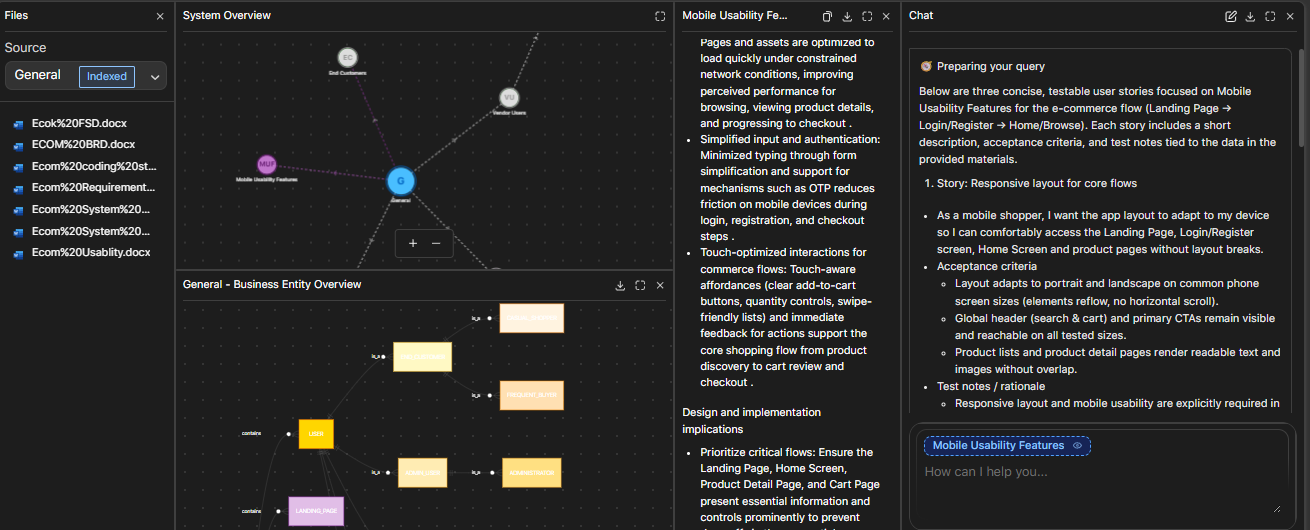
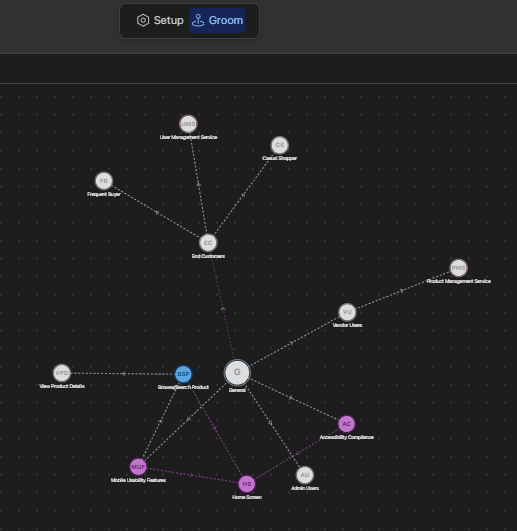
Instead of static diagrams or outdated documentation, it builds a real-time, interactive model of your system. Every module, entity, and dependency is mapped into a connected graph that reflects how your system actually operates.
What You Can Instantly Visualize
This changes how teams interact with architecture. You’re no longer reading about the system - you’re exploring it.
One of the most overlooked challenges in software systems is understanding business logic.
It often lives in fragments - partly in code, partly in documentation, and partly in people’s heads. This fragmentation creates alignment issues between teams.
ReqSpell bridges this gap by making business logic visible and structured.
This shared visibility ensures that product, engineering, and business teams operate with the same understanding.
Understanding a system isn’t just about access to information - it’s about access to the right information at the right time.
ReqSpell introduces context-aware intelligence into every interaction.
Key Capabilities
Instead of generic outputs, teams receive precision-driven insights aligned with actual system context.
Most platforms stop at analysis. ReqSpell goes a step further by enabling execution through Agent Mode.
It transforms insights into structured, actionable workflows, bridging the gap between planning and implementation.
Execution Advantages
This is where true acceleration happens not just faster thinking, but faster execution.
Traditionally, system understanding is concentrated within engineering teams, creating bottlenecks for product and business stakeholders.
ReqSpell changes this dynamic completely.
Cross-Functional Impact
This creates a self-serve system intelligence model, reducing dependency and improving collaboration efficiency.
Legacy systems often represent the highest level of complexity within an organization. They are difficult to analyze, risky to modify, and expensive to maintain.
ReqSpell Knowledge Graph provides immediate clarity by reconstructing system relationships and dependencies.
Legacy Modernization Benefits
What once required months of analysis can now be achieved significantly faster with structured visibility.
ReqSpell Knowledge Graph is not limited to one stage - it delivers value across the entire lifecycle.
This ensures that every phase is connected, efficient, and aligned.
If your teams are spending more time understanding systems than building them, the problem is not capability—it’s visibility.
ReqSpell Knowledge Graph transforms system complexity into a strategic advantage by combining visualization, contextual intelligence, and automated execution.
Key Takeaways
In a landscape where speed and clarity define success, this is not just optimization - it’s transformation.
Call to Action
If your teams are struggling with system complexity, slow requirement analysis, or limited visibility, it’s time to rethink your approach.
Leverage ReqSpell Knowledge Graph to unlock full system intelligence, accelerate workflows, and drive smarter execution across your SDLC.



July 1, 2026
Don’t Miss Out
We share cool stuff about coding, AI, and making dev life easier.
Hop on the list - we’ll keep it chill.

© 2026, SoftSpell. All Rights Reserved


