


Changelog
July 1, 2026
.svg)
%20(1).jpg)
Most AI coding assistants just speed up coding. But software delivery is more complex. SoftSpell is an agentic AI platform that unifies requirements, development, testing, and deployment. By automating the entire SDLC, SoftSpell helps teams reduce manual effort, boost traceability, modernize legacy systems, and deliver quality software faster.
Most AI coding assistants stop at code completion. Your SDLC doesn't — and neither should your tooling.
Right now, your engineers are context-switching between a dozen fragmented tools: one for requirements, another for code generation, a separate suite for QA, and yet another for CI/CD.
Meanwhile, tools like GitHub Copilot, Cursor, and Devin are getting louder in the market, but let's be honest, they're solving one slice of a much bigger problem. They sit inside your IDE and go quiet the moment your sprint moves to testing, deployment, or requirements alignment.
SoftSpell takes a fundamentally different approach. It's not just an AI coding assistant; it's an agentic AI platform that operates across every stage of your SDLC, from unstructured requirements to deployment.
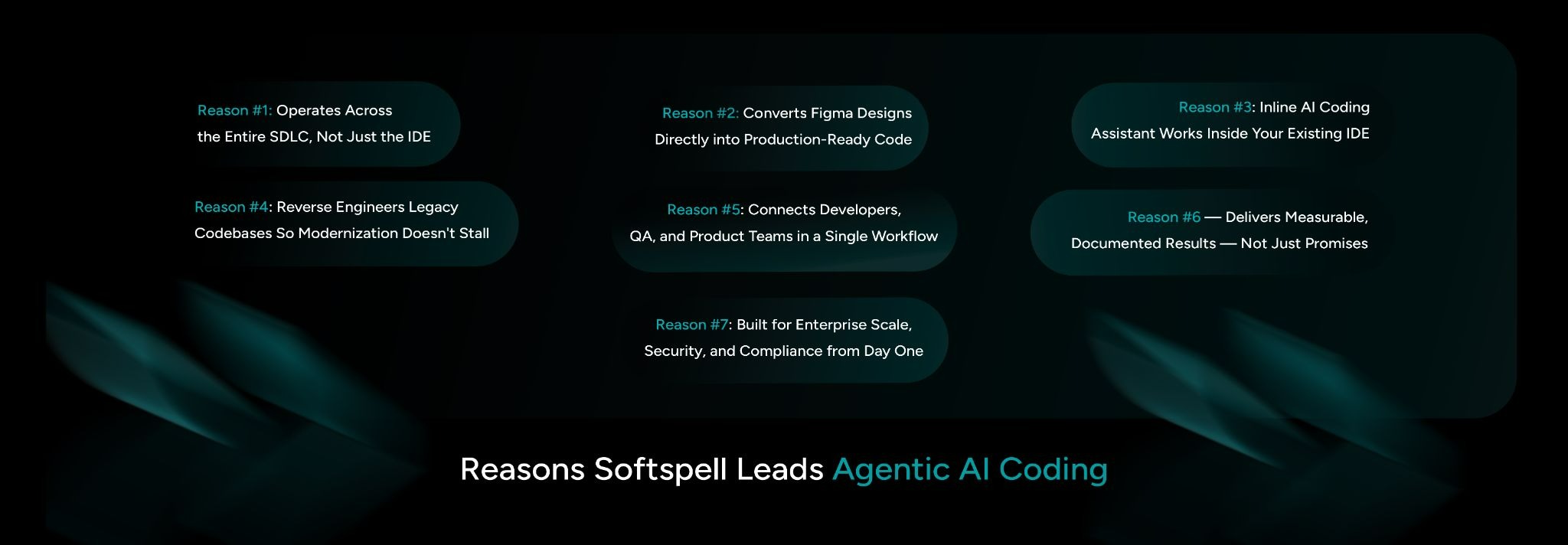
Here are 7 specific, non-generic reasons why SoftSpell is leading the pack as the best agentic AI code generation tools.
SoftSpell is an agentic AI coding assistant and not just another autocomplete tool in the following ways:
An agentic AI coding assistant plans, orchestrates, and acts across the full development lifecycle. This means it pulls context from requirements, generates and validates code, coordinates testing, and feeds outputs downstream, so manual integration isn't required.
SoftSpell's own positioning captures it precisely: "from requirement to deployment, agentic software development." Not IDE to deployment. Requirement for deployment.
That distinction is where everything else flows from.
Here are the 7 unique reasons that matter most.
When your team adopts GitHub Copilot or Cursor, you're adding intelligence to one stage of your workflow; the IDE gets smarter.
But what happens when your product manager is still writing requirements in a Word doc? Or when QA is manually writing test cases from a Jira ticket three sprints later? Those gaps don't shrink with a better autocomplete engine.
SoftSpell is designed so that every stage feeds the next, automatically, with no manual handoffs between them:

Most engineering teams live with a predictable, costly delay between the moment a designer does a Figma handoff file and the moment a developer ships working code from it. That gap is filled with interpretation errors, misaligned components, and last-minute rework that quietly eats sprint capacity every release cycle.
SoftSpell closes that gap directly, and no leading AI coding assistant currently offers this as a governed, integrated workflow. From a single Figma design, CodeSpell generates:
The practical concern that surfaces in every enterprise evaluation is straightforward: "Will this require our developers to change how they work?"
With SoftSpell, the answer is no.
CodeSpell's inline assistant integrates directly into the IDEs your teams are already using, so the AI surfaces exactly where the work is happening, not in a separate chat window. They'll stop opening after week two.
What developers get inside their existing environment:
Most AI coding tools are implicitly designed for greenfield development; they work beautifully with clean, well-documented, modern codebases. Hand them an Oracle Forms application with 15 years of undocumented business logic and no living specification, and they have nothing meaningful to work with.
SoftSpell's primary enterprise positioning is legacy modernization, and it's built specifically for that scenario. Rather than requiring clean inputs, ReqSpell creates them:
One of the most expensive problems in software delivery doesn't appear on a sprint board.
It's the quiet rework that happens when QA discovers a defect that traces back to an ambiguous requirement three weeks after the sprint closed. SoftSpell addresses this structurally by making traceability a built-in property of the workflow rather than something teams try to retrofit manually.
Because requirements flow from ReqSpell into CodeSpell's generation context and then directly into TestSpell's test automation, all three teams work from the same source of truth throughout the delivery cycle.
The platform also integrates with the tools teams already use:
At some point, every evaluation conversation shifts from features to evidence. CTOs and engineering leaders aren't buying potential; they're buying outcomes they can defend to a board or a CFO. SoftSpell has published verifiable results across multiple enterprise deployments in the US:
Refer to the SoftSpell case study for more insights.
For enterprise engineering leaders, security and compliance aren't a checklist item at the end of an evaluation; they're the first filter. Tools that don't meet enterprise governance requirements don't make it past procurement, regardless of their capabilities.
SoftSpell's enterprise architecture was designed with this reality in mind, not retrofitted to meet it:

The market is crowded with AI coding tools making bold promises. But when you strip away the marketing, most of them solve the same narrow problem, making individual developers faster within a single IDE. That's a worthwhile improvement. It's not a transformation.
SoftSpell is built for something bigger. Every reason on this list, from Figma-to-code generation to legacy reverse engineering to end-to-end requirements traceability. This traces back to one core truth: your SDLC is a connected system, and your AI should treat it that way.
If your team is still stitching together fragmented tools across requirements, development, and QA, that's not a tooling problem; it's an architecture problem. SoftSpell solves it at the platform level.
See it in action before you take anyone's word for it.
Book a Demo with SoftSpell today for more information.




July 1, 2026
Don’t Miss Out
We share cool stuff about coding, AI, and making dev life easier.
Hop on the list - we’ll keep it chill.

© 2026, SoftSpell. All Rights Reserved


