Agentic Software Development for End-to-End SDLC Automation

AI SDLC

May 13, 2026

TL;DR

  • Agentic software development deploys AI agents that autonomously coordinate across every stage of the SDLC from requirements to deployment
  • ReqSpell eliminates requirement ambiguity by converting unstructured inputs into engineering-ready specifications with full traceability
  • CodeSpell generates production-ready code, reduces boilerplate, and accelerates legacy modernization using generative AI
  • TestSpell automates test case generation, requirement-linked coverage, and regression testing, improving quality without growing QA headcount
  • SoftSpell's integrated platform connects all SDLC stages into one unified intelligence layer, eliminating fragmented tools and manual handoffs

83% of software projects still miss their deadlines, not because engineers aren't working hard enough, but because the systems they work within are fundamentally broken. Requirements drift. QA becomes a bottleneck. Deployments stall. And the engineering complexity only compounds as teams scale.

Most organizations have responded by adopting AI coding assistants.

But here's the uncomfortable truth: a smarter code editor doesn't fix a broken pipeline. Isolated AI tools solve isolated problems. They don't coordinate across planning, development, testing, and deployment, and that's exactly where value bleeds out.

Agentic software development is the answer that traditional DevOps automation never quite delivered. Unlike point solutions, agentic AI for software development deploys intelligent agents that reason, plan, and act across every stage of the SDLC, autonomously and continuously.

In light of this, the blog covers why agentic AI for software development is replacing legacy automation and how forward-thinking engineering leaders are using it to finally bring their SDLC under intelligent control.

How Does Agentic Software Development Automate the Entire SDLC?

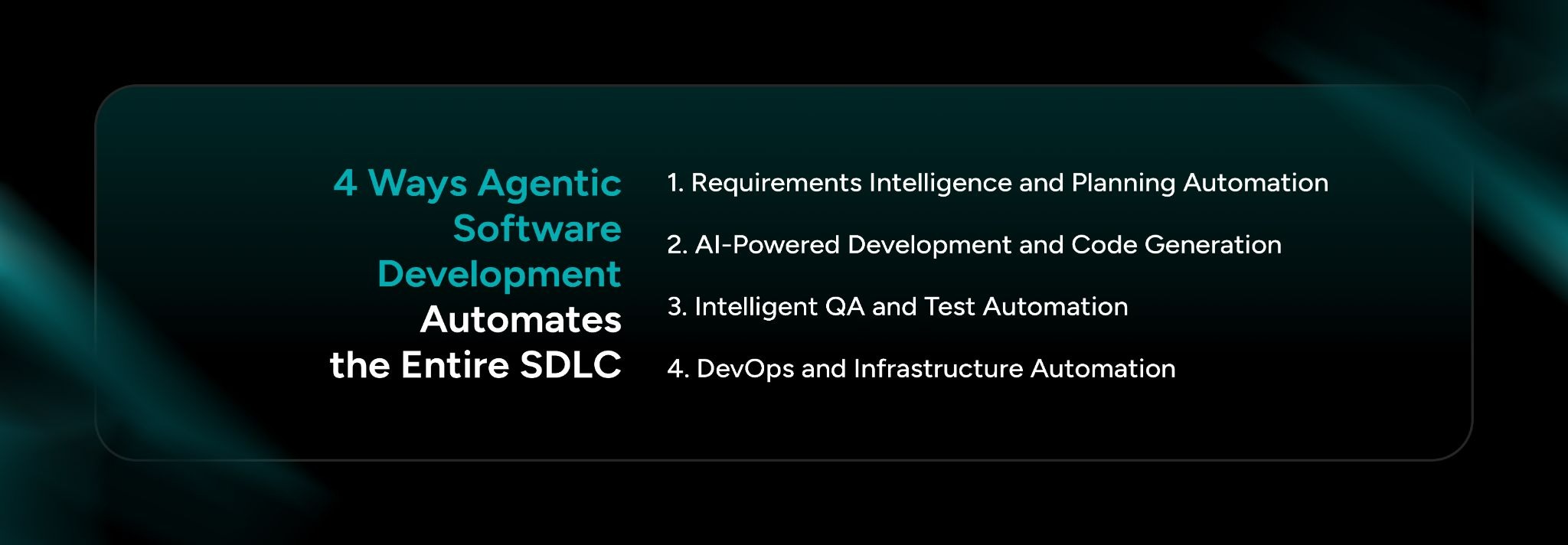
An agentic software development automates the entire SDLC through the following ways:

1. Requirements Intelligence and Planning Automation

2. AI-Powered Development and Code Generation

3. Intelligent QA and Test Automation

4. DevOps and Infrastructure Automation

The biggest shift agentic software development brings isn't smarter code generation; it's connected lifecycle automation. For the first time, AI doesn't just assist at one stage; it coordinates intelligence across every handoff, from a rough product idea to a deployed, monitored release.

Here's how that plays out across each phase.
4 Ways Agentic Software Development Automates the Entire SDLC

1. Requirements Intelligence and Planning Automation

Every late delivery can be traced back to the same root cause: ambiguous requirements. Product teams write in natural language. Engineers interpret differently. QA tests something else entirely. By the time misalignment surfaces, the damage is done.

ReqSpell eliminates that ambiguity at the source, automatically converting unstructured inputs such as documents, spreadsheets, stakeholder feedback, and meeting notes into engineering-ready specifications:

  • Structured user story generation from raw business requirements
  • Dependency mapping across features, modules, and release milestones
  • Risk identification before development begins, not after deadlines slip.
  • End-to-end requirements traceability linking every requirement to its corresponding code, test, and deployment artifact

2. AI-Powered Development and Code Generation

The real value of generative AI for software development isn't generating clever new code; it's eliminating the low-value work that quietly consumes developer hours daily.

CodeSpell generates production-ready code directly from structured requirements and design inputs, automating:

  • Boilerplate reduction across repetitive code patterns
  • API generation from architecture and design specifications
  • Frontend-to-backend wiring of components, services, and data models
  • Legacy modernization — analyzing and refactoring old codebases without halting active development

Developers stop functioning as code typists and start operating as architects — a fundamental reallocation of engineering capacity toward work that demands human judgment.

3. Intelligent QA and Test Automation

Testing is where traditional SDLC automation consistently breaks down. Manual test creation is slow, coverage is uneven, and regression suites balloon into bottlenecks themselves. Most teams ship with known gaps simply because there isn't enough runway to test everything.

AI-driven QA automation through TestSpell changes that equation; test cases are generated automatically and directly linked to requirements and Jira tickets, ensuring coverage reflects actual product intent:

  • Automated test case generation from requirements, user stories, and tickets
  • Requirement-linked coverage ensures nothing ships untested.
  • UI, API, and mobile test execution without manual scripting
  • Parallel execution compresses testing timelines significantly.
  • Regression automation validating every release against the full existing test suite.

4. DevOps and Infrastructure Automation

Even well-written, thoroughly tested code hits friction at deployment. Pipelines are manually configured, infrastructure provisioning depends on tribal knowledge, and environment drift causes failures that are expensive to diagnose under release pressure.

SoftSpell's integrated platform extends agentic intelligence through to delivery, ensuring automation doesn't stop at the code editor:

  • CI/CD pipeline generation is automated based on project context and tech stack.
  • Infrastructure as code optimized for cloud environments without manual scripting
  • Deployment orchestration with built-in consistency checks across every environment
  • Environment provisioning, eliminating configuration drift between dev, staging, and production
AI-powered SDLC automation platform for enterprise engineering teams

What Are the Business Benefits of End-to-End Agentic SDLC Automation?

When AI coordinates the full SDLC, not just individual tasks, the business impact compounds across speed, cost, and quality simultaneously.

  • Faster Release Velocity — Automated handoffs between requirements, code, and QA eliminate wait time between pipeline stages, significantly compressing release cycles.
  • Lower Operational Costs — Reducing manual effort across testing, code review, and deployment means fewer engineering hours spent on repetitive work and more on high-value delivery.
  • Improved Developer Experience — Developers spend less time on boilerplate, context switching, and rework, and more time on architecture and problem-solving.
  • Reduced Defects — Requirement-linked test coverage and automated regression catch issues earlier in the pipeline, before they reach production.
  • Better Traceability — Every requirement, code change, and test result stays connected across the lifecycle, giving teams a clear audit trail from spec to deployment.
  • Improved Engineering Visibility — Leadership and engineering leads gain real-time insights into delivery status, bottlenecks, and quality metrics without chasing updates across tools.
  • Faster Modernization Initiatives — Legacy system migration and refactoring accelerate when AI handles code analysis, generation, and test coverage simultaneously.

Why Are Platforms Like SoftSpell Emerging as the Next Layer of Enterprise SDLC Automation?

Most enterprises already use dozens of development tools across planning, coding, testing, and DevOps. The real problem is that these systems rarely work together with shared intelligence. Teams operate in silos, context is lost between stages, and traceability at scale breaks down entirely.

SoftSpell addresses this not as another isolated AI tool but as a unified lifecycle intelligence platform in which every stage connects to the next.

Here's what makes that different in practice:

1. ReqSpell — Where the SDLC Actually Begins

Most SDLC delays originate before development starts, in scattered, ambiguous, or undocumented requirements. ReqSpell eliminates this at the source:

  • Ingests PDFs, emails, spreadsheets, legacy codebases, and release notes, converting unstructured inputs into clean, structured, development-ready specifications
  • The Knowledge Graph builds a real-time, interactive map of every module, entity, and dependency, so teams understand system impact before writing a single line of code
  • Agent Mode converts finalized requirements into AI-generated execution plans, triggering Git-based development workflows automatically, eliminating the handoff gap between requirements and development
  • Natural language querying lets any team member ask plain-English questions across documents, code modules, and test artifacts simultaneously — no waiting on subject-matter experts
  • Automatically maps features → requirements → user stories → test cases — giving QA coverage visibility before development even begins

2. CodeSpell — From Requirement to Production-Ready Code

Once requirements are structured, CodeSpell ensures they translate into code without the usual friction:

  • Design Studio converts Figma designs directly into production-ready React, Angular, or React Native code, eliminating the manual designer-to-developer translation layer
  • Generates standards-compliant backend scaffolding directly inside the IDE, tech stack selection, tool configuration, and boilerplate handled automatically
  • Creates Terraform scripts for cloud infrastructure configuration, servers, databases, and environments provisioned consistently without manual setup
  • Generates API test scripts from OpenAPI specs, Swagger docs, or plain-English instructions, complete with logging and reporting built in
  • AI-powered code explanation, optimization, and documentation run continuously, keeping codebases maintainable as they scale
  • Works natively inside VS Code, Eclipse, and IntelliJ — no workflow disruption, no new tools to learn

3. TestSpell — Quality That Moves With Development, Not Behind It

Legacy QA tools enter the picture too late. TestSpell integrates testing into the SDLC from the requirement stage:

  • Generates test cases, test data, and test scripts directly from requirements and JIRA inputs before development begins, not after.
  • Runs UI, API, and mobile tests in a single unified execution flow, replacing fragmented tool stacks enterprises have accumulated over the years.
  • Parallel execution across environments, devices, and configurations turns multi-day regression cycles into same-sprint activities.
  • AI-driven test maintenance automatically updates tests as the application changes, keeping suites stable without manual intervention
  • Organizes tests by modules, sprints, or full suites, matching enterprise delivery structures rather than forcing teams to adapt
  • Real-time execution reports give product owners, QA, and engineering a shared quality view, eliminating end-of-cycle status chasing
Discover how SoftSpell helps enterprises reduce delivery bottlenecks and improve release speed with agentic AI. 

Closing Thoughts

Agentic software development is quickly moving from experimentation to operational necessity. As software delivery becomes more complex, enterprises can no longer rely on disconnected tools, manual workflows, and isolated automation to scale efficiently.

The future of AI and software development is not about replacing engineers. It is about augmenting engineering teams with intelligent agents that reduce repetitive work, improve collaboration, and accelerate delivery across the entire SDLC.

The biggest competitive advantage will come from connected engineering intelligence — where requirements, code, testing, infrastructure, and deployment operate as one continuous workflow.

Organizations that adopt end-to-end SDLC automation early will move faster, reduce operational friction, and improve software quality at scale.

Platforms like SoftSpell are leading this shift by unifying requirements intelligence, AI-powered development, test automation, and DevOps workflows into a single enterprise-ready ecosystem.

Ready to modernize your SDLC with AI-driven automation?

Book a demo with us to explore how SoftSpell can help your engineering teams build, test, and deliver software faster with greater control and efficiency.

Table of Contents

    FAQs

    1. What is agentic software development?
    Agentic software development is an AI-driven approach where intelligent agents automate and coordinate multiple stages of the SDLC, including requirements gathering, coding, testing, deployment, and infrastructure management. Unlike standalone AI coding tools, it connects the entire software lifecycle through shared workflow intelligence.
    2. How is agentic AI different from traditional DevOps automation?
    Traditional DevOps automation focuses mainly on deployment pipelines and infrastructure tasks. Agentic AI extends automation across the full SDLC by integrating requirements, development, QA, and operations into a single intelligent workflow with end-to-end traceability and decision support.
    3. Can agentic AI replace software engineers?
    No. Agentic AI is designed to augment engineering teams, not replace them. It automates repetitive, manual tasks such as test generation, boilerplate code, and infrastructure setup, allowing developers to focus on architecture, problem-solving, and innovation.
    4. What are the biggest benefits of end-to-end SDLC automation?
    End-to-end SDLC automation helps organizations: Accelerate software delivery, Reduce manual engineering effort, Improve code quality and test coverage, Minimize operational bottlenecks, Increase collaboration across teams, and Improve release consistency and scalability.
    5. How does SoftSpell support enterprise SDLC automation?
    SoftSpell provides an integrated AI-powered SDLC platform that combines requirements intelligence, code generation, QA automation, and DevOps orchestration through products like ReqSpell, CodeSpell, and TestSpell. This helps enterprises streamline delivery workflows while improving traceability, governance, and engineering productivity.
    Blog Author Image
    Gautham

    AI-Native Product Strategist

    LinkedInBlog Social IconBlog Social IconBlog Share Link

    Don’t Miss Out
    We share cool stuff about coding, AI, and making dev life easier.
    Hop on the list - we’ll keep it chill.