


Changelog
July 1, 2026
.svg)
You have a modernization plan. Your architecture team has signed off on the target stack. The board has approved the budget. Then, four months in, a senior engineer opens a module that controls a pricing rule nobody knew about and the entire timeline starts slipping.
This is not an edge case. It is what happens when teams migrate legacy systems without first understanding what those systems actually do. Not what the documentation says. Not what the original architects intended. What the code, right now, actually does.
For CTOs and senior engineers leading these initiatives, the technical risk is almost never in the migration approach itself. It is in the invisible layer underneath: the business logic that has accumulated over a decade of production patches, undocumented decisions, and institutional knowledge that walked out the door with engineers who left years ago.
SoftSpell's ReqSpell is built to surface that layer before your migration begins, turning an opaque legacy codebase into a structured, queryable, traceable set of requirements your entire team can work from.
Legacy systems are not badly built by accident. They are the result of years of reasonable decisions made under production pressure, each one leaving a small deposit of implicit logic that never made it into formal documentation.
A validation rule added after a compliance audit in 2011. A calculation branch that handles a specific client's edge case, patched directly into the core module. An integration dependency that only activates under certain load conditions, discovered in a post-incident review and then silently fixed without any documentation update.
None of this is visible from the outside. It does not appear in requirements documents because those documents were never updated. It does not appear in test coverage because there are no automated tests for it. It lives only in the code and often only in the memory of engineers who may no longer be available.
When modernization teams encounter this logic mid-migration, they face three options: guess at the intent and accept regression risk, pause the migration for manual investigation, or escalate to whoever might remember. Each option is expensive. Collectively, they are why legacy migrations consistently run over budget and past deadline.
The solution is not to be more careful during the migration. It is to know what you are migrating before you start.
ReqSpell is an AI-powered requirements analysis module. In a legacy modernization context, it operates as an intelligent reverse-engineering layer between your existing system and your migration plan. Here is what it actually does.
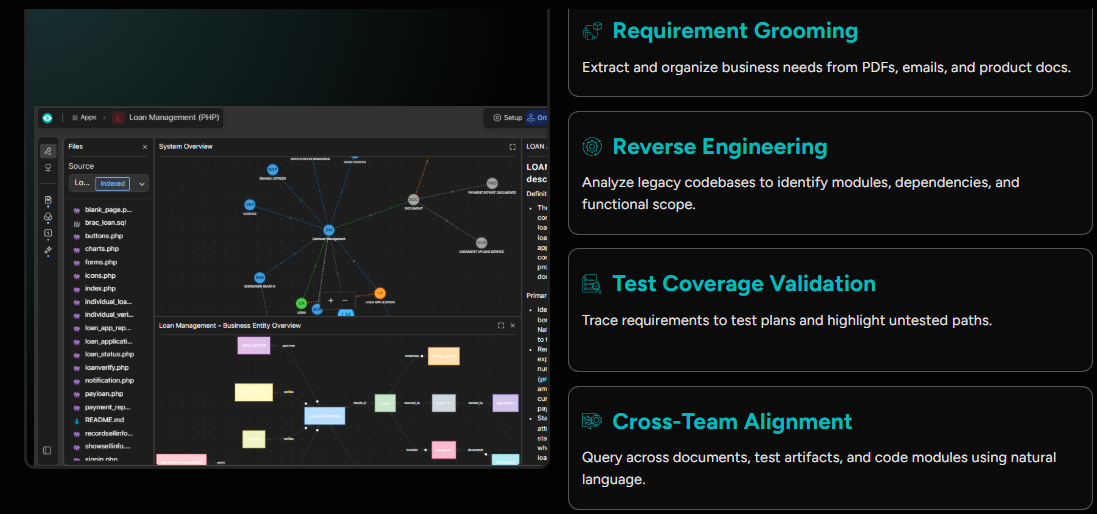
ReqSpell analyzes your existing codebase to identify modules, map dependencies, and extract functional scope. It works without requiring complete documentation to begin. It ingests what exists, including source code, code comments, partial specs, PDFs, emails, release notes, and spreadsheets, and constructs a structured picture of what the system does and how its components relate to each other.
For senior engineers, this means you no longer have to manually trace dependency chains through thousands of lines of unfamiliar code before you can make an architectural decision. ReqSpell does that mapping for you and surfaces it as structured, reviewable output.
One of ReqSpell's most operationally useful features for technical leadership is the ability to query across documents, test artifacts, and code modules in plain English. A CTO preparing a migration scope review can ask "What are the functional requirements for the payments module?" A QA lead can ask "Which tests cover login edge cases?" and get immediate, structured answers without digging through thousands of lines of code manually.
This eliminates the archaeology work that typically falls on your most senior engineers, the people you can least afford to have tied up in investigative work before the migration even begins.
ReqSpell does not produce a pile of observations. It converts its analysis into structured, traceable requirement documents and user stories. Implicit business logic that lived only inside the code is translated into explicit, reviewable specifications. Stakeholders can review and approve these before any migration work begins. The result is a documented baseline of what the system actually does, rather than an assumption about what it should do.
Undocumented logic is, almost by definition, untested logic. ReqSpell traces the requirements it extracts to existing test plans and surfaces paths that have no test coverage. This gives your engineering and QA teams a precise view of where the gaps are before the migration starts, not after something breaks in production. For regulated industries, this creates a compliance-ready audit trail from day one.
ReqSpell's export capability matters from a governance perspective. Teams working within ReqSpell can download the complete analysis conversation as a structured document, covering requirement discussions, generated user stories, system analysis outputs, and clarifications, formatted and ready for sharing across product, engineering, and leadership teams. This transforms what would otherwise be ad hoc discovery work into a formalized, auditable artifact that accelerates handoffs and satisfies internal documentation requirements.
For a CTO, the business case for starting with ReqSpell is straightforward. Undocumented business logic is the primary driver of scope creep in legacy modernization. Every surprise your team encounters mid-migration translates directly into delay, rework, and re-alignment with stakeholders. ReqSpell eliminates the surprise by turning the unknown into documented, structured requirements before the first migration task is scheduled.
For senior engineers and architects, it changes the quality of the starting point entirely. Migration planning built on a complete understanding of what the legacy system does is fundamentally different from planning built on assumptions. Architecture decisions made from ReqSpell's structured output are more accurate. And the risk profile of the entire initiative shrinks accordingly.
For organizations in regulated industries such as finance, healthcare, insurance, and utilities, there is an additional dimension. The ability to export ReqSpell conversations as structured documentation gives compliance teams an auditable record of the analysis that preceded the migration. That is often a requirement, not a nice-to-have.
ReqSpell is the first module in SoftSpell's end-to-end SDLC platform, and its output drives everything downstream.
Once ReqSpell has surfaced and documented the business logic, CodeSpell uses those structured requirements to guide code transformation. Rather than ad hoc rewrites, CodeSpell generates a structured execution plan with a step-by-step task breakdown and approval-based execution before making any changes across the codebase. Developers can review the planned modifications, understand the full scope, and approve the execution path before a single file is touched. This keeps the migration controlled, transparent, and aligned with what ReqSpell uncovered.
The result is a modernization workflow where nothing is unknown at any stage and every change is traceable back to a documented requirement.
Legacy modernization is one of the most consequential technical initiatives an organization undertakes. The teams that execute it successfully are not the ones who move fastest. They are the ones who understood their starting point completely before committing to a path.
ReqSpell gives CTOs, engineering leads, and senior architects the ability to answer the question that determines whether a modernization succeeds or stalls: what does this system actually do?
If you are in the planning phase of a modernization initiative, or if a current project has slowed because of logic nobody fully understands, that is the conversation worth having with SoftSpell.



July 1, 2026
Don’t Miss Out
We share cool stuff about coding, AI, and making dev life easier.
Hop on the list - we’ll keep it chill.

© 2026, SoftSpell. All Rights Reserved


