


Changelog
July 1, 2026
.svg)
.png)
In today’s fast-paced digital landscape, organizations are constantly striving to deliver software solutions more quickly without compromising on quality or compliance. However, the journey from business requirements to functional applications is often fraught with challenges. Misinterpretation of requirements, manual coding dependencies, and limited visibility across the development lifecycle can lead to delays, increased costs, and inconsistencies in the final product.
ReqSpell addresses these challenges by introducing Requirement-to-Code Automation, an AI-driven approach that seamlessly transforms business intent into production-ready applications. By bridging the communication gap between business stakeholders and engineering teams, ReqSpell ensures clarity, alignment, and accelerated delivery. This enables enterprises to innovate with confidence while maintaining governance, scalability, and operational efficiency.
Requirement-to-Code acceleration refers to the systematic conversion of structured business or functional requirements into executable source code. This approach minimizes ambiguity, enhances collaboration, and ensures that the delivered software accurately reflects stakeholder expectations.
ReqSpell offers a comprehensive suite of capabilities designed to streamline the software development lifecycle and enhance enterprise agility.
1. AI-Powered Requirement Parsing
ReqSpell leverages advanced natural language processing to interpret user stories, business requirements, and functional specifications. This ensures accurate translation of business intent into technical artifacts, significantly reducing ambiguity and rework.
2. Automated Code Generation
The platform generates production-ready code across multiple layers of the application stack, including:
This capability accelerates development while ensuring adherence to enterprise coding standards.
3. End-to-End Traceability
ReqSpell establishes a direct linkage between requirements and generated artifacts. This traceability supports:
4. Predefined Architectural Blueprints
Organizations can leverage customizable architectural templates aligned with microservices, monolithic, or serverless patterns. This ensures consistency across projects and accelerates solution design.
5. Standards and Governance Enforcement
ReqSpell embeds enterprise coding standards, security policies, and compliance requirements into the generated code, ensuring uniform quality and reducing technical debt.
6. Multi-Technology Stack Support
The platform supports diverse technology ecosystems, enabling code generation in popular frameworks such as:
7. Seamless DevOps and CI/CD Integration
ReqSpell integrates effortlessly with modern DevOps toolchains, enabling automated builds, testing, and deployments. Supported integrations include:
8. API and Database Design
Based on the interpreted requirements, ReqSpell generates:
9. Rapid Prototyping and Scaffolding
The platform accelerates project initiation by generating boilerplate code and application scaffolding, enabling teams to focus on business logic rather than repetitive setup tasks.
10. Change Impact Analysis
When requirements evolve, ReqSpell identifies the affected components and regenerates the necessary code, ensuring synchronization between business intent and implementation.
11. Collaboration and Stakeholder Alignment
ReqSpell fosters cross-functional collaboration by providing a unified platform where business analysts, architects, and developers can validate and refine requirements before implementation.
12. Security and Compliance by Design
Security best practices, such as authentication, authorization, input validation, and encryption are embedded within the generated code, ensuring compliance with enterprise and regulatory standards.
Business requirements are captured from user stories, BRDs, or agile tools.
AI-driven engines interpret the functional and non-functional aspects of the requirements.
Requirements are aligned with predefined architectural blueprints and technology stacks.
Production-ready code, APIs, and database schemas are generated.
Generated artifacts undergo automated validation and are integrated into CI/CD pipelines for seamless deployment.
Sample Business Requirement
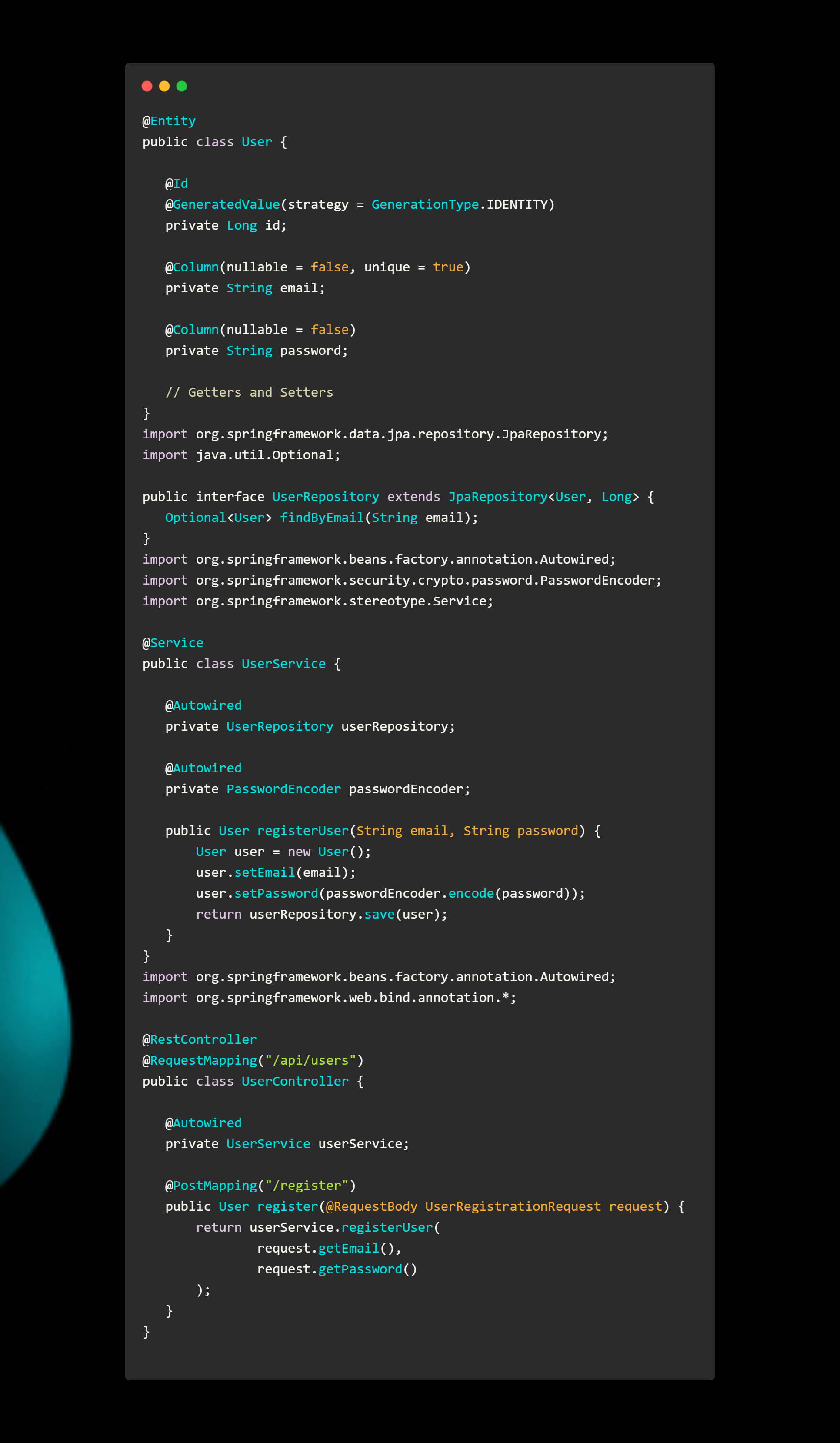
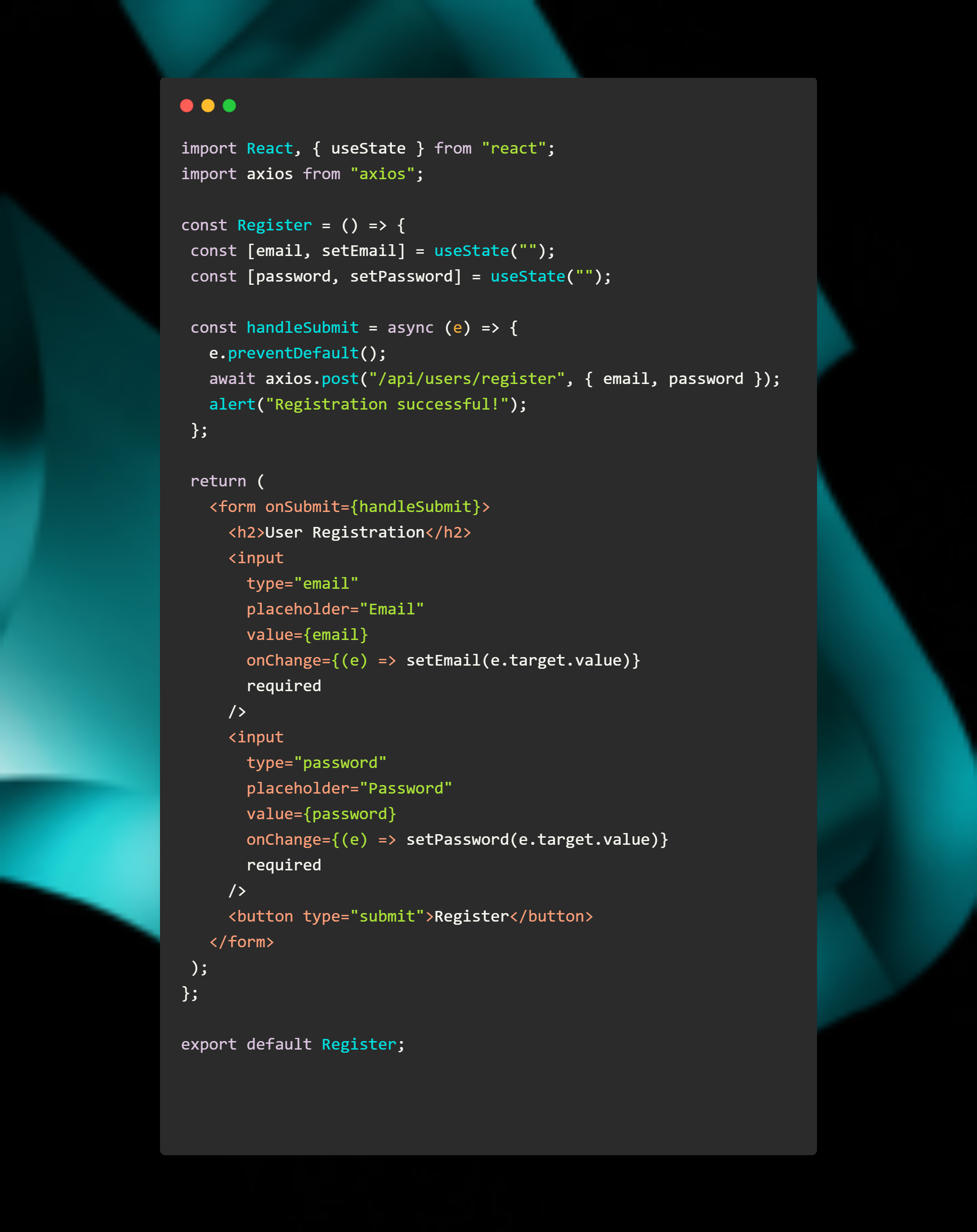
“As a user, I want to register an account using my email and password so that I can access the platform securely.”
Generated Backend Code (Spring Boot)
Generated Front-End Code (React)
1. Accelerated Time-to-Market
Accelerate code generation significantly reduces development timelines, enabling organizations to respond swiftly to market demands.
2. Enhanced Quality and Consistency
Standardized templates and governance mechanisms ensure uniform code quality across projects.
3. Reduced Operational Costs
By minimizing manual development efforts, enterprises can optimize resource allocation and improve return on investment.
4. Improved Collaboration
ReqSpell establishes a unified language between business and technical stakeholders, eliminating ambiguity and enhancing alignment.
5. Regulatory Compliance and Auditability
Built-in traceability supports compliance with industry standards and simplifies audit processes.
6. Scalability and Future Readiness
With support for multiple technology stacks and cloud-native architectures, ReqSpell ensures that organizations remain adaptable to evolving technological landscapes.
Requirement-to-Code transformation represents a transformative shift in modern software engineering. ReqSpell empowers enterprises to convert business intent into scalable, secure, and production-ready applications with unparalleled efficiency. By embedding intelligence, governance, and automation across the development lifecycle, ReqSpell positions organizations to achieve sustainable innovation and competitive advantage.



July 1, 2026
Don’t Miss Out
We share cool stuff about coding, AI, and making dev life easier.
Hop on the list - we’ll keep it chill.

© 2026, SoftSpell. All Rights Reserved


