


Changelog
July 1, 2026
.svg)
.png)
The cost of running legacy systems is not static. It compounds every year.
In 2026, the gap between organizations running modern platforms and those still operating on legacy infrastructure is widening across every measurable dimension: speed, cost, quality, and talent.
What legacy systems are costing enterprises right now:
The decision is not whether to modernize. It is whether to do it on your terms now or be forced into it under pressure later.
Signs Your System Needs Modernization Now
These signals indicate modernization has moved from strategic consideration to urgent business need:
Technical signals:
Business signals:
Risk signals:
If more than half of these apply, the business case for modernization is already made. The question is execution.
There is no single right approach. The correct strategy depends on your system's complexity, business constraints, timeline, and risk tolerance. Most large programs use a combination applied to different components simultaneously.
1. Encapsulate
Wrap the existing system in APIs to expose functionality without changing internals. The lowest risk of entry points. Best when core logic is sound, but interfaces are outdated.
2. Rehost (Lift and Shift)
Move the system to new infrastructure, typically cloud, without changing application code. Fast and low risk but delivers limited modernization benefits on its own.
3. Replatform
Move to a new platform with targeted code changes to leverage modern infrastructure capabilities. A middle path between rehosting and full re-architecture.
4. Refactor
Restructure existing code without changing external behavior. Reduces technical debt and improves maintainability while preserving proven business logic.
5. Re-architect
Redesign the system architecture, typically moving from monolith to microservices or event-driven design. Higher investment but delivers maximum long-term flexibility and scalability.
6. Replace
Build a new system from scratch or adopt a commercial solution. The highest cost and risk option, but sometimes the only viable path when a system is beyond rehabilitation.
The right answer for most enterprises is a hybrid: apply the minimum effective strategy per component based on risk, value, and complexity.
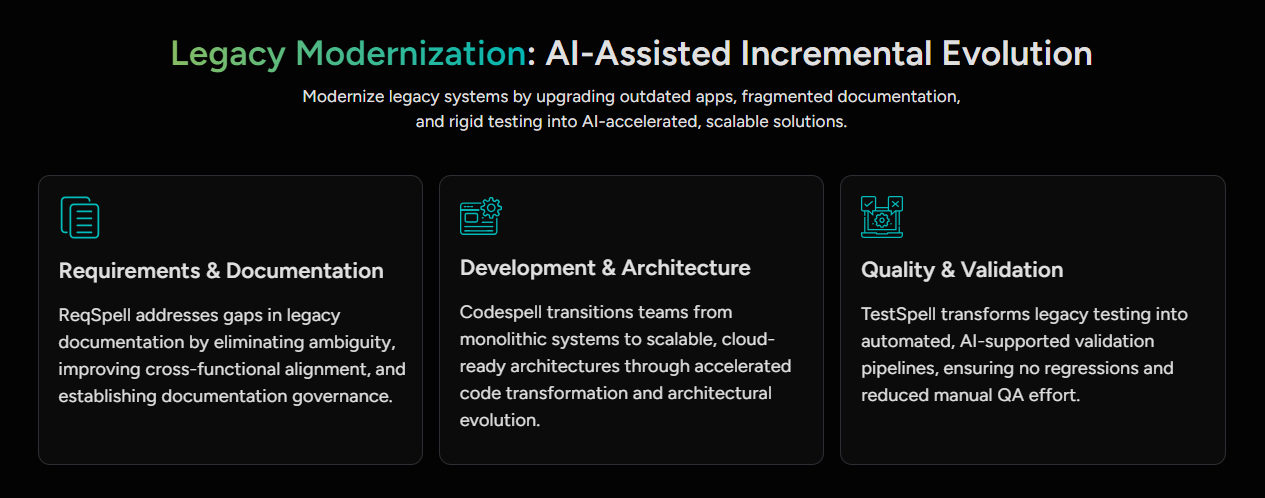
A modernization program without a structured roadmap becomes an expensive, open-ended project that loses stakeholder trust fast.
Step 1: Assess Your Current State
Understand what you have before you change anything. Document every system component, dependency, integration point, and data flow. Map existing code back to business requirements. Identify which components are most critical and which carry the highest change risk.
Manual assessment of large legacy codebases is slow and expensive. SoftSpell's ReqSpell accelerates this by extracting and structuring requirements directly from existing code, compressing assessment timelines from months to weeks.
Step 2: Define Business Objectives
Define success in business terms: faster feature delivery, reduced operational cost, improved compliance posture, better customer experience, or scalability to support growth targets. Every roadmap decision should trace directly back to one of these.
Step 3: Select Your Strategy Per Component
Apply the right modernization approach to each system component. Not everything needs to be re-architected. Minimum effective strategy per component keeps cost and risk controlled.
Step 4: Sequence for Quick Wins and Risk Management
Structure the roadmap to deliver visible business value early, tackle the most critical components after the approach is proven, and maintain business continuity throughout. Clear milestones and go/no-go checkpoints keep stakeholder confidence high across the programme lifecycle.
Step 5: Build in Governance and Measurement
Define success metrics upfront. Track deployment frequency, defect rates, system performance, developer productivity, and cost per feature. Adjust based on data, not assumptions.
Cost is the most common question and one of the hardest to answer without context. The range varies significantly based on scope, complexity, and approach.
Key cost drivers:
The cost of not modernizing:
Every business case must weigh modernization investment against the ongoing cost of staying on legacy infrastructure: rising maintenance spend, productivity loss, security incident risk, compliance exposure, and widening competitive gap. This cost grows every year and does not appear on a single invoice, which is why it is consistently underestimated.
How SoftSpell changes the economics:
Enterprises using SoftSpell for legacy modernization report approximately 25% reduction in overall project cost and approximately 50% faster end-to-end SDLC delivery. These outcomes materially change the modernization cost equation compared to traditional approaches.
Every modernization program carries risks. The goal is not to eliminate it but to manage it systematically.
Risk 1: Business Disruption
What happens: Modernization changes break existing functionality and disrupt live operations.
Mitigation: Use a phased approach. Run old and new systems in parallel during transition. SoftSpell's TestSpell reduces manual testing effort by approximately 30 to 40%, making comprehensive coverage far more achievable before any cutover.
Risk 2: Knowledge Loss
What happens: Critical business logic embedded in legacy code is misunderstood or lost during transformation.
Mitigation: SoftSpell's ReqSpell maps existing code back to business requirements and generates structured documentation before transformation begins, eliminating the guesswork that causes costly rework.
Risk 3: Scope Creep
What happens: The program expands beyond original boundaries without delivering proportional value.
Mitigation: Define clear scope boundaries upfront. Use phased milestones with go/no-go decisions. Tie every addition to a defined business objective.
Risk 4: Stakeholder Confidence Loss
What happens: Delays, cost overruns, or early defects cause leadership to pull support mid-programs.
Mitigation: Deliver quick wins early. Report on business metrics. SoftSpell's approximately 60% faster issue-to-PR cycle with Autonomous AI Agents keeps the program moving visibly and consistently.
Risk 5: Security Exposure During Transition
What happens: The transition period creates temporary vulnerabilities as old and new systems coexist.
Mitigation: Conduct security assessments at each phase. SoftSpell is SOC 2 Type 2 compliant with AI-generated code checked against public repositories for compliance, enterprise indemnification, and network egress controls built in.
AI is fundamentally changing what is possible in legacy modernization in terms of both speed and safety.
Code understanding at scale: AI analyzes large undocumented codebases and extracts business logic, dependencies, and requirements in a fraction of the time manual analysis requires. Assessments that used to take months now take weeks.
Automated documentation generation: AI generates BRDs, functional specifications, and technical documentation from existing code, closing the documentation gap that makes legacy modernization risky in the first place.
Requirement traceability: AI maintains full traceability between existing code, extracted requirements, new code, and test cases, giving teams complete visibility into what is changing and what might break.
Accelerated development: AI coding assistants that understand your full codebase generate context-aware suggestions that respect existing patterns, conventions, and dependencies rather than producing generic templates that create integration friction.
Test automation at pace: AI generates unit and regression tests automatically, keeping coverage current with development speed without adding manual testing overhead.
The outcome: modernization programs that previously took three to five years are completing in 12 to 24 months with better quality and lower defect rates.
SoftSpell is an end-to-end AI-powered SDLC platform built for the specific challenges that make legacy modernization slow, expensive, and risky. It addresses the three core problems directly: lack of documentation, lack of test coverage, and slow development velocity.
ReqSpell: Understand What You Have Before You Change Anything
The biggest risk in legacy modernization is not knowing what the system actually does. ReqSpell eliminates that risk before a single line of new code is written.
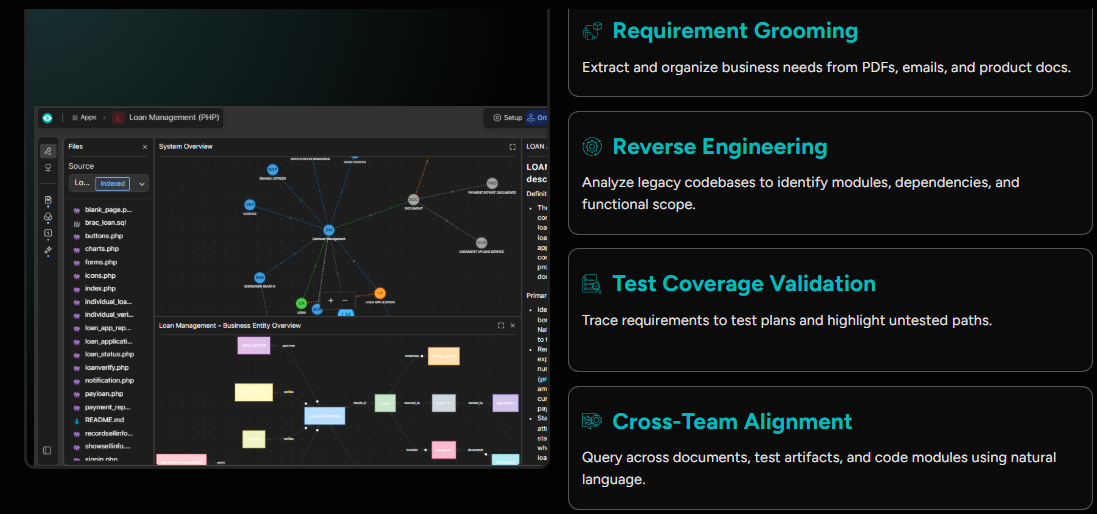
What ReqSpell does for legacy modernization:
The result: Teams start modernization with documented clarity rather than inherited ambiguity. Assessment timelines compress from months to weeks.
CodeSpell: Accelerate Development with Full Codebase Context
Generating new code for a legacy modernization project without understanding the existing system is how defects and rework happen. CodeSpell solves this by understanding your entire codebase, not just the file currently open.
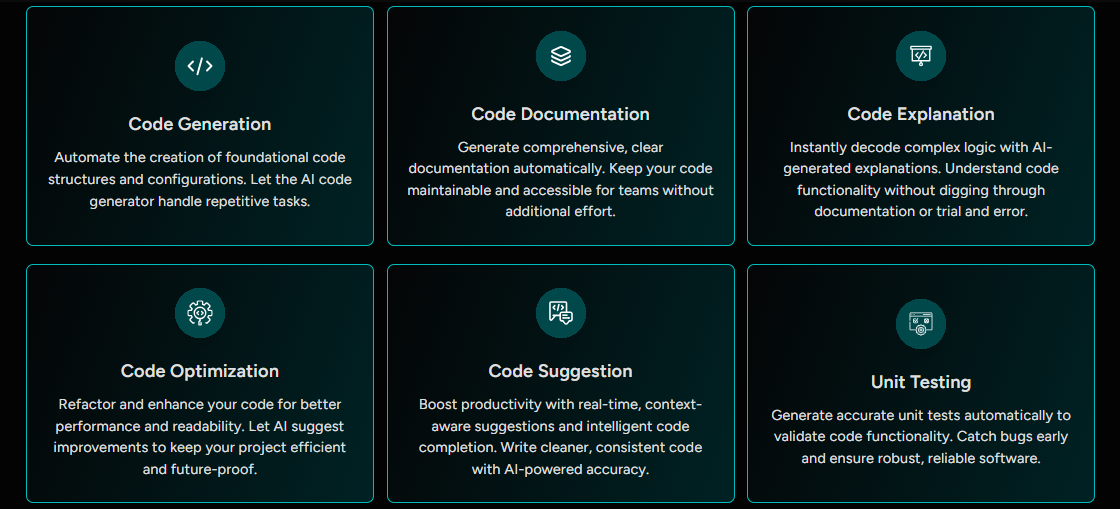
What CodeSpell does for legacy modernization:
Supported IDEs: VS Code, Eclipse, IntelliJ
The result: Developers move faster, make fewer integration mistakes, and produce code that fits the existing system. Teams report 3x faster feature delivery.
TestSpell: Modernize with Confidence, Not Hope
Legacy systems typically carry little or no automated test coverage. That gap is one of the primary reasons modernization projects break things in production. TestSpell closes it systematically.
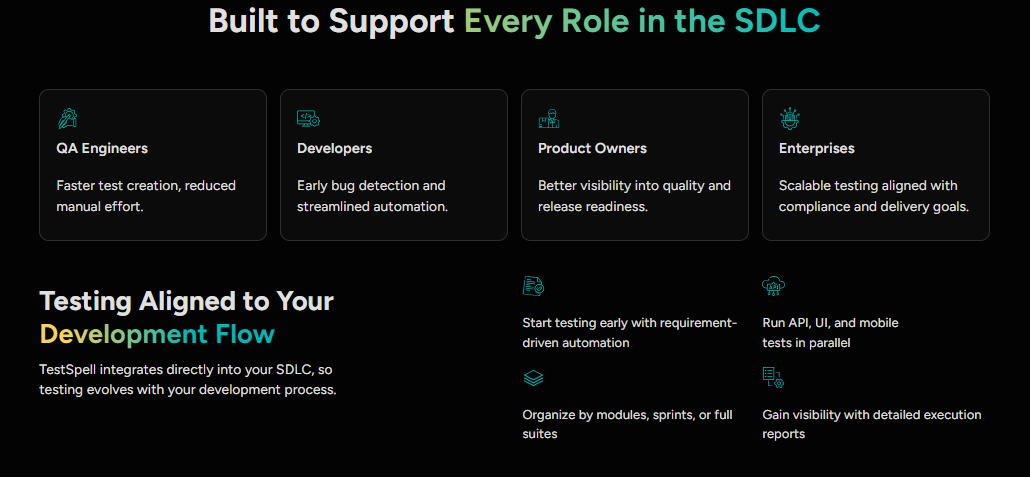
What TestSpell does for legacy modernization:
The result: Modernization teams ship with verified quality. Defect rates drop. Production incidents during migration become the exception rather than the rule.
Autonomous AI Agents: Orchestrate the Entire Modernization Workflow
SoftSpell's Autonomous AI Agents coordinate specialized agents across the entire development workflow simultaneously, so your engineers focus on outcomes rather than execution.
What Autonomous Agents do:
The result: What used to take weeks of compresses into days. Teams deliver more with the same headcount at higher quality throughout the entire modernization lifecycle.
Engineering teams at Coconut, Synergita, Aspire, and more trust SoftSpell as their modernization platform.
Proven delivery outcomes:
Enterprise-grade security and compliance:
SoftSpell does not replace your engineers. It amplifies them. Humans set direction and make critical decisions. AI handles repetitive, time-consuming execution. That combination is what makes modernization faster, safer, and more predictable than any traditional approach.
Talk to the SoftSpell team and see how enterprises are completing modernization programmes faster, at lower cost, and with better outcomes than traditional approaches deliver.


July 1, 2026
Don’t Miss Out
We share cool stuff about coding, AI, and making dev life easier.
Hop on the list - we’ll keep it chill.

© 2026, SoftSpell. All Rights Reserved


