


Changelog
July 1, 2026
.svg)
%20(1).jpg)
Generative AI creates code and content from prompts. Agentic AI can plan, execute, test, and optimize tasks across the SDLC. For enterprises seeking faster releases and end-to-end automation, Agentic AI delivers greater long-term value than Generative AI alone.
Your competitors aren't just writing code faster; they're shipping entire features while your team is still reviewing pull requests.
Right at the center of that shift sits a debate most engineering leaders are getting wrong: agentic AI vs generative AI.
Here's what's actually happening.
Teams adopt the best AI coding assistant, see an early productivity bump, and then quietly hit a ceiling. It suggests code, drafts docs, and answers questions, but it doesn't think ahead or autonomously act across SDLC stages.
That's the critical distinction: AI-assisted tools help developers move faster through the work they're directing, while agentic AI code generation completes multi-step workflows autonomously, planning and executing toward a goal rather than just responding to prompts.
This blog maps to real SDLC stages, shows where each approach wins, and helps you decide which approach, or combination, your team actually needs.
Generative AI is a type of artificial intelligence that generates content, code, documentation, and other outputs in response to user prompts. In AI software development, it serves as a highly capable assistant that helps teams complete tasks more quickly by generating suggestions, drafts, and code snippets.
However, it is fundamentally reactive. It responds to instructions but does not independently plan, execute, or manage workflows across the Software Development Life Cycle (SDLC).
Used in the right context, Generative AI meaningfully accelerates individual development tasks:
Agentic AI is an advanced form of artificial intelligence that can reason, plan, make decisions, and execute tasks autonomously to achieve a specific goal.
Unlike Generative AI, which waits for prompts and generates outputs, Agentic AI can take a high-level objective, break it into multiple steps, choose the right tools, execute actions, evaluate results, and adapt when something goes wrong.
In the context of the AI SDLC, it functions more like a digital teammate than a content generator.

Before you decide which AI software development tool fits your SDLC, it helps to see the contrast directly.
The differences aren't subtle.
Understanding the difference in a table is one thing. Seeing it play out across every phase of your actual development lifecycle is where it gets actionable.
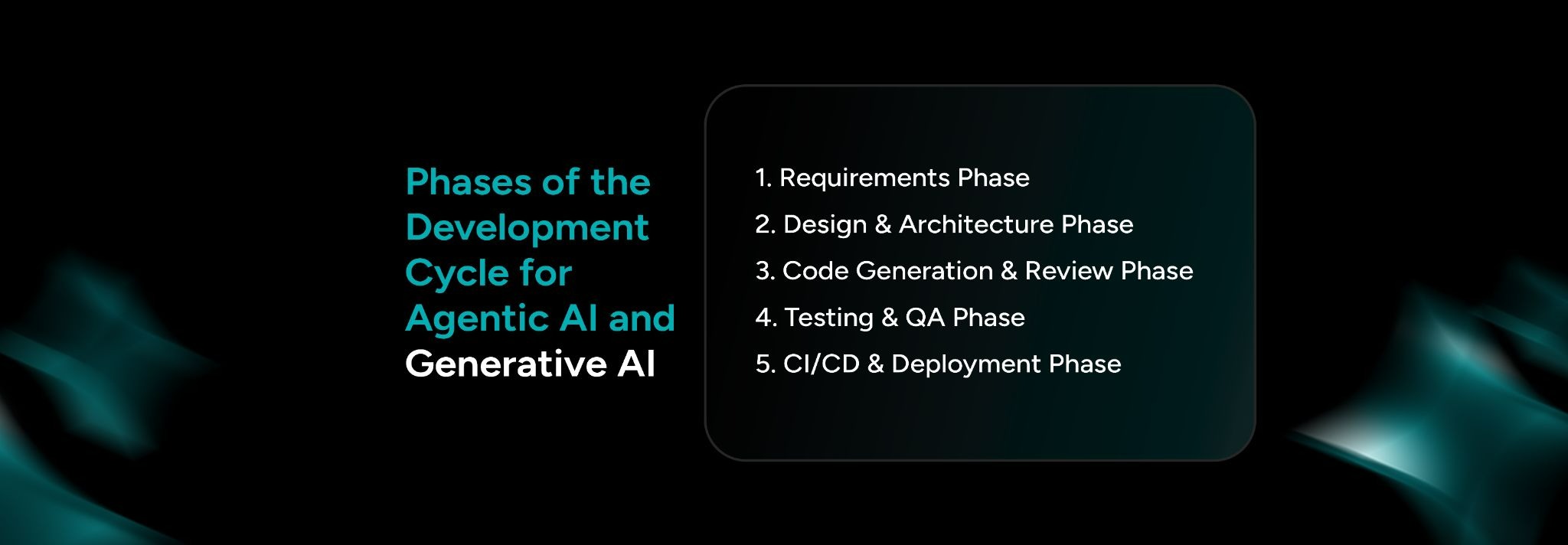
1. Requirements Phase
Think of requirements as the blueprint for the entire project. Generative AI can summarize or draft requirements, but messy documents, inconsistent feedback, or multi-format inputs often break the flow, leaving gaps that cause downstream defects.
Agentic AI approaches this differently: it can extract and structure functional and non-functional requirements, flag ambiguities early, and maintain a traceable link to every downstream stage, helping teams avoid costly misalignments before coding even begins.
2. Design & Architecture Phase
Design is where ideas meet reality. Generative AI may suggest patterns or components, but it cannot verify whether they fit your existing architecture or dependencies. Agentic AI translates design inputs into actionable, structured specifications that map to real system constraints.
This reduces miscommunication between product and engineering and ensures that what is designed is immediately buildable.
3. Code Generation & Review Phase
Writing code is just one step; maintaining context and consistency is the hard part. Generative AI can autocomplete functions or suggest refactors, but it forgets context when sessions close.
Agentic AI maintains awareness across stages, generating code that aligns with requirements, identifies edge cases, and iterates automatically, so developers spend less time fixing inconsistencies and more time innovating.
4. Testing & QA Phase
Tests are the safety net, but manually creating and validating them slows releases. Generative AI can propose test cases, yet it stops there.
Agentic AI executes tests across UI, API, and mobile in parallel, analyzes failures, and traces defects back to their origin in the requirements. This proactive feedback loop catches issues early, reduces last-minute surprises, and ensures that quality scales with speed.
5. CI/CD & Deployment Phase
Even the best code can fail in deployment. Generative AI can write scripts, but it cannot respond if a pipeline breaks. Agentic AI monitors and orchestrates the entire deployment process, adapts to errors in real time, and keeps the workflow continuous and predictable.
It turns deployment from a manual, high-risk step into a managed, autonomous process that minimizes downtime and accelerates delivery.
Reading about the difference is useful. To make the right decision for your team, identify your team’s unique needs, assess current pain points in your SDLC, and use these insights to select the right AI approach. Here’s a practical framework to help you take concrete action.
Choose Generative AI If…
Generative AI is the right starting point when your goal is to accelerate individual contributors without overhauling how your team works. It fits well when:
With CodeSpell and TestSpell, you can streamline code reviews and ensure consistent test coverage, all without being limited by a solution you may outgrow.
Choose Agentic AI If…
Agentic AI is the right investment when isolated productivity gains are no longer the bottleneck, when the real drag is coordination, handoff friction, and context loss between stages.
It fits when:
Key Questions to Ask Before Adopting Either
Before committing to either approach, run your team through these three questions:
1. Where are your SDLC bottlenecks?
Single-stage delays → Generative AI may help. Systemic delays → Agentic AI is needed for full orchestration.
2. How much human oversight is required?
Agentic AI collaborates autonomously between checkpoints; human judgment remains essential for complex tasks.
3. Are workflows siloed or integrated?
Separate systems with manual handoffs → Generative AI won’t fix the system. A unified Agentic AI approach reduces errors and delays.
Most AI tools solve one problem well and leave the rest of your workflow exactly as fragmented as before. SoftSpell was built on a different premise: that the biggest drag on enterprise software delivery isn't any single stage — it's what happens between stages.
That's why SoftSpell isn't a coding assistant with extra features bolted on. It's a unified SDLC intelligence platform where every module is connected by design, not by integration effort.
The workflow runs as one continuous, traceable thread:
1. ReqSpell – Requirements Intelligence
ReqSpell transforms unstructured inputs into validated, traceable requirements, giving engineering teams clarity from day one.
2. CodeSpell – AI-Powered Code Generation
CodeSpell converts requirements into production-ready code while maintaining alignment with specifications.
3. TestSpell – Intelligent Test Automation
TestSpell closes the quality loop, turning requirements into actionable tests and continuously validating code.

Generative AI made developers faster. Agentic AI is making development teams leaner, smarter, and more structurally efficient at every stage, not just when someone remembered to open a prompt window. Next, evaluate the recurring pain points your team faces and match them to the AI solution that best addresses your needs.
To bring it back to the core question: Generative AI is a powerful assistant. Agentic AI is an autonomous operator. One accelerates the work you're already doing. The other reorganizes how that work connects across your entire delivery pipeline.
For teams serious about compressing release cycles and eliminating handoff friction, Generative AI alone will always leave a gap. The agentic SDLC is where AI participates meaningfully across the full lifecycle, planning, coding, reviewing, shipping, and operating, rather than sitting at a single checkpoint.
SoftSpell was built to close that gap across requirements, code, testing, and deployment on a single connected platform.
Book a demo to learn more about SoftSpell.




July 1, 2026
Don’t Miss Out
We share cool stuff about coding, AI, and making dev life easier.
Hop on the list - we’ll keep it chill.

© 2026, SoftSpell. All Rights Reserved


