


Changelog
July 1, 2026
.svg)
.jpg)
What if the biggest bottleneck in your software delivery is not your team, but the system around them?
Enterprise engineering teams work harder than ever. Still, timelines slip, documentation stays scattered, and quality varies across teams. AI tools promised to fix this. They helped to some extent. Developers now use AI in about 60% of their work. But they only delegate 0 to 20% of tasks fully. This gap shows that AI still has a long way to go.
This gap exists because most teams use AI as a smarter autocomplete tool. An agentic AI developer changes this completely. It moves from a passive assistant to an active and complete participant in how your team builds software.
An agentic AI developer is not a chatbot that gives code snippets. It is an AI system that sets goals, builds plans, and completes tasks step by step. It adapts based on context and works across your full development process.
Think of it this way. A traditional AI tool waits for your input. An agentic AI developer understands what comes next and takes action.
Most enterprise teams already use AI that:
An agentic AI developer works at a different level. It can:
Agentic AI systems follow a loop. They understand the context, set a goal, take action, check results, and adjust. In software development, this means the AI does more than respond to prompts. It keeps context across sessions, understands dependencies, and makes decisions step by step.
This approach makes agentic AI for software development truly different from earlier tools.
This is where theory meets real enterprise engineering. The changes are not surface-level. They are structural and affect every phase of the SDLC.
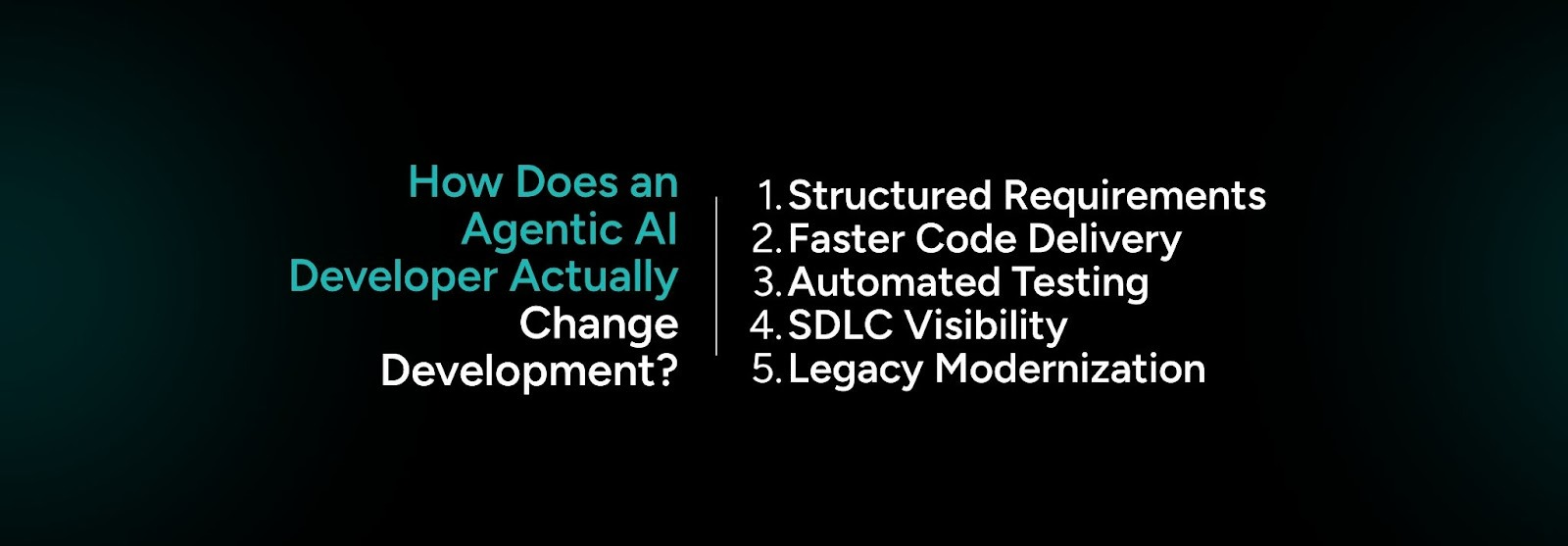
1. Turning Fragmented Requirements Into Structured Development Inputs
Requirements often cause projects to fail early. Vague specs, misaligned teams, and missing details lead to rework before coding even starts.
An agentic AI developer fixes this by:
2. Accelerating Code Delivery Without Sacrificing Quality
Speed without consistency creates new problems. Multiple teams moving fast in different directions leads to hidden rework.
Agentic AI code creation solves this by:
Engineering leaders no longer choose between speed and quality. They get both because consistency no longer depends only on individuals. You can already see how this improves your workflow.
3. Eliminating Manual Testing Bottlenecks End to End
Manual testing slows down development. It does not scale with team output. Teams often rush or skip it when deadlines get tight, even when quality matters most.
With agentic AI in your testing process:
4. Giving Engineering Leaders Real Visibility Across the SDLC
Leaders need predictability more than just speed. They need confidence in delivery timelines and quality.
Agentic AI DevOps helps by:
5. Reducing Modernization Risk on Legacy Systems
Legacy modernization carries high risk. Old systems often lack documentation. Hidden dependencies make changes risky.
An agentic AI developer reduces this risk by:
Most AI tools make individual developers faster. SoftSpell makes your entire delivery system faster.
At the core of SoftSpell is Codespell Agent Mode. It works as an execution engine inside your IDE, not just a suggestion tool.
When you define a task, Codespell Agent Mode goes beyond a single file. It does not stop early. It:
The result is code that fits production needs and flows together in one system. You do not deal with scattered edits that your developers must fix later.
What does this mean for you and your team? You start to see clear changes in how work moves forward.
What this means in day-to-day work for engineering leaders:
For enterprise teams that evaluate AI development platforms, the difference is clear. If you want to reduce SDLC friction and speed up delivery, you need autonomous execution as a baseline.

Agentic AI is not a plug-and-play solution. Done right, it's transformative. Done carelessly, it creates new problems on top of existing ones.
Here's what engineering leaders should evaluate honestly before adopting:
If your team already uses AI tools and still struggles to predict delivery dates with confidence, you need to look at how you use them.
An agentic AI developer brings a clear shift. It moves from AI that only responds to prompts to AI that drives results across your full SDLC.
We've explored what this looks like in practice. You get clearer requirements. You get consistent code at scale. You get automated testing.
Moreover, you get real visibility into delivery and safer updates for older systems. These are not small changes. Together, they change how your team builds and delivers software.
Think about your current workflow for a moment. Do you see gaps between planning, coding, and testing?
SoftSpell brings this full capability together for enterprise teams that want to move from reactive updates to a steady and predictable delivery process.





July 1, 2026
Don’t Miss Out
We share cool stuff about coding, AI, and making dev life easier.
Hop on the list - we’ll keep it chill.

© 2026, SoftSpell. All Rights Reserved


