Agentic AI vs Traditional AI:Autonomous agents plan tasks and generate code. They also run tests, review results, and improve solutions.
Best Practice Patterns:Governance controls help guide how agents operate. Clear context guidance also improves their decisions. Reusable prompts help maintain speed and quality.
Risks to Overcome:Autonomous coding agents can introduce vulnerabilities and unsafe dependencies. They may also create broken business logic.
Mitigating Risks:Layered security testing helps detect weaknesses early. Red team exercises help teams test system defenses. Continuous monitoring keeps track of agent activity.
Most enterprise AI implementations don't fail because the model is bad. They fail because the model was dropped into an environment that wasn't ready for it.
The same is now happening with agentic AI code. Developers apply AI in about 60% of their work, though they fully delegate only 0 to 20% of tasks.
Organizations are deploying autonomous coding agents, systems that can write, test, and iterate on entire code segments with minimal human input. They discover that the patterns governing traditional software development don't map cleanly onto autonomous systems.
This blog covers the core best practice patterns that balance speed with quality, and how to wire them into your existing development lifecycle.
What Is Agentic AI Coding?
Agentic AI code refers to software created by autonomous agents in AI. These agents do more than suggest code completions. They plan tasks, execute steps, evaluate results, and refine the code they produce.
A traditional AI coding assistant waits for prompts and then offers suggestions. An agentic system works differently. It breaks complex requests into smaller steps. After that, it generates code, runs tests, reviews the results, and improves the solution.
Agentic AI vs Traditional AI: The Three Pillars
When you compare agentic AI with traditional AI coding tools, three capabilities define the difference. These capabilities shape how agentic systems operate.
Autonomy: Agentic systems complete tasks independently. They can integrate external libraries, generate code, run tests, and improve the output. They perform these steps without constant human input. This autonomy increases productivity.
Context: Agentic systems review the full codebase. They also study dependencies and system requirements. This deeper understanding helps them make informed decisions. It also allows them to plan and complete several steps in sequence.
Control: Control mechanisms guide how agents operate. These controls include approval checkpoints and access restrictions. They help ensure that agents follow organizational standards.
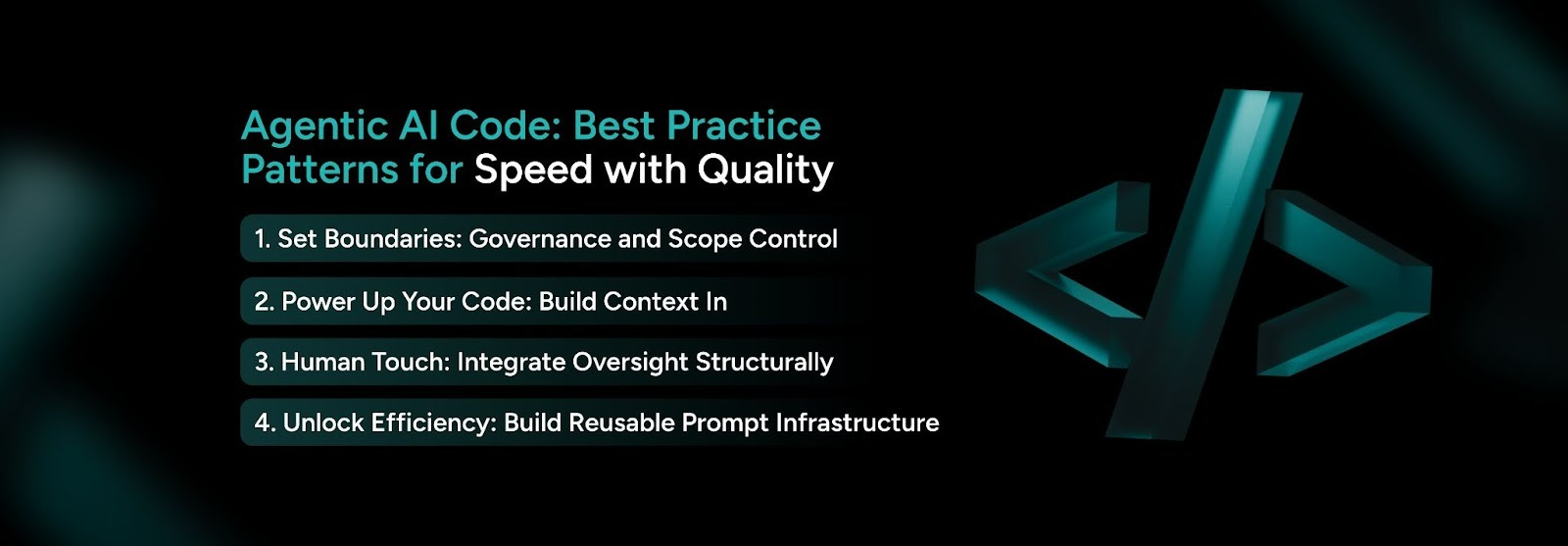
Agentic AI Code: Best Practice Patterns for Speed with Quality
Enterprises successfully deploying agentic coding systems follow repeatable patterns that allow agents to move quickly without introducing technical debt, security risks, or compliance gaps. Here are the core patterns.
1. Establish Governance and Scope Control
Without a clear scope, agentic coding agents can make decisions that violate architectural standards or introduce unapproved dependencies.
Agents should operate in non-production environments by default, with production access requiring explicit approval.
Proposed libraries must pass through supply chain reviews, SBOM checks, license verification, and vulnerability scanning before approval.
Limit the agent’s access to specific directories, modules, or services for each task, enforced programmatically via harness configurations.
2. Build Context In
An agent is only as good as the context it works with. Agents need more than access to the codebase. They need guidance.
Persistent instruction files (Rules) should always provide guidance for commands, patterns, and canonical files to follow.
Integrate platform engineering standards, API guidelines, and architecture records through Model Context Protocol (MCP) integrations with tools like Confluence or Notion.
Start fresh sessions for distinct tasks to avoid compounded noise and incorrect assumptions from long agent sessions.
3. Integrate Human Oversight Structurally
Effective human oversight complements agentic AI. Poorly structured oversight creates tension between automation and human input.
Route agent-generated code through automated checks (static analysis, dependency scanning, linting) before human review, ensuring that low-level issues are resolved.
Run a dedicated review pass after generation: Either the agent or a separate tool analyzes code line-by-line, flagging issues before human review.
Mandatory human review before merge: Despite agent capabilities, a developer must review and approve every merge for high-quality, safe code.
4. Build Reusable Prompt Infrastructure
Developed prompt patterns often remain siloed within teams. Reusable prompts help accumulate organizational knowledge.
Store valuable prompts in version control, like any other infrastructure code, to reduce redundant work.
Wrap prompts in internal tools (CLI or IDE integrations) for easy adoption and consistency across teams.
Document prompt intent and optimize for specific tasks to ensure they are used correctly.
Iterate on prompts based on agent performance: Use prompt failures as feedback for continuous improvement.
How to Mitigate Risks in Agentic AI Code?
Agentic AI code generation expands the potential attack surface in software development. However, you can manage these risks with the right safeguards.
What Are the Risks of Using Agentic AI in Code Development?
Vulnerability Introduction: Autonomous agents may create insecure logic or weak access controls. These weaknesses may reach production if teams do not review the output carefully.
Unvetted Dependencies: Agents may add external libraries without full evaluation. Some of these libraries may contain known vulnerabilities or licensing issues. This can create supply chain risks for your organization.
Business Logic Corruption: Autonomous decisions can disrupt existing workflows. They may also break compliance rules that govern transactions or authentication processes.
Compliance Gaps: Agents may make changes without passing through approval processes. These actions can create audit issues and governance risks.
How to Mitigate These Risks?
Layered Security Testing: Use static analysis and dynamic testing during development. You can also use adversarial prompts to challenge agent behavior. These steps help you examine how agents behave in different scenarios.
Red Team Exercises: Run adversarial simulations to test your governance controls. These exercises help you find weaknesses before they cause real problems.
Continuous Monitoring: Monitor agent activity in environments close to production. Set alerts that notify your team when unusual behavior appears.
Immutable Audit Trails: Record every action that the agent performs. These records create a clear history of activity. They also help your team investigate and resolve issues quickly.
Supercharge Your Dev Workflow with SoftSpell’s Agent Mode
SoftSpell’sAgent Mode improves your development workflow by handling complex tasks on its own. It helps you deliver faster while maintaining strong quality. With this mode, you can focus on design and strategy. At the same time, the AI manages the execution work.
Contextual Codebase Analysis
The AI begins by studying your codebase carefully. It reviews configuration files, dependencies, documentation, and architectural patterns. This step helps the system understand the project clearly.
Task Decomposition
The agent breaks complex requests into smaller and manageable steps. For example, it can divide a task such as moving a REST API to GraphQL into clear stages. It then shares this execution plan with developers for approval before starting the task.
Autonomous Code Execution
After approval, the agent carries out the tasks across the project. It edits files, creates modules, and runs tests when required. The process follows the same steps a developer would normally perform.
Self-Correction and Verification
When errors appear, the agent studies the logs and finds the issue. It corrects the problem and tries again until the task succeeds. This process reduces the time spent fixing bugs and improves efficiency.
Eliminates Context Switching: AI agents keep full awareness of the codebase and help streamline your workflow.
Empowers Developers to Review, Not Code: You can focus on system design, performance, and innovation.
Seamless Integration: It works with your entire toolchain and helps you produce production-ready results.
Conclusion
Agentic AI code is not a future capability that enterprises only plan for. Many teams already deploy it today. These teams also learn governance patterns while they work with the technology in real time.
The organizations that succeed will not always have the most advanced models. Instead, they follow disciplined and consistent patterns. Have you noticed how strong processes often drive better results than powerful tools?
These practices include governance and scope control, context management, human oversight, chained prompting, TDD-aligned workflows, and reusable prompt infrastructure. These patterns help agentic AI code scale properly. They also prevent technical debt and reduce compliance risks.Speed and quality in agentic AI code depend on good design choices.
1. What makes agentic AI code different from traditional AI-assisted coding?
Agentic AI systems act independently, planning, writing, testing, and iterating on code without human input, unlike traditional tools that only suggest code for developers to implement. This requires stronger governance.
2. How do autonomous agents maintain code quality without constant human review?
Quality is maintained through automated checks (static analysis, linting, vulnerability scanning) before human review. Test-driven workflows give agents a target to iterate against, making human review faster and more focused.
3. What are the biggest compliance risks with agentic AI code, and how do we address them?
Key risks include audit gaps, unapproved dependencies, and business logic alterations. Address these with mandatory audit logging, dependency governance, and scope restrictions on sensitive systems.
4. How should we manage context in agentic AI code editors?
Maintain persistent Rules files in the repository, connect agents to internal documentation via MCP, and start fresh sessions for distinct tasks to prevent fragmented context.
5. When does agentic AI code increase rather than decrease development risk?
Risk increases when governance is lacking, context is fragmented, or human oversight is ad hoc. Proper governance, context management, and structured review mitigate these risks.


.svg)
.jpg)