


Changelog
July 1, 2026
.svg)
TL;DR
In distributed engineering teams, API inconsistency leads to integration issues, slower development, and growing technical debt. Documentation and reviews alone are not enough to prevent drift at scale. SoftSpell helps teams maintain consistent API design by embedding shared standards, structured requirements, and real-time guidance directly into the development workflow.
API design tools are platforms that help teams define, structure, and manage APIs before and during development. They provide a way to design endpoints, set standards, and document APIs so that services across teams stay consistent.
In modern engineering environments, these tools are no longer just documentation utilities. They are becoming part of the development workflow itself, especially in distributed systems where multiple teams build and maintain APIs simultaneously.
As systems scale, APIs are built by different teams across services and time zones. Without structured tooling, this leads to inconsistencies in design, naming, versioning, and integration behavior.
API design tools solve this by:
However, traditional tools still rely heavily on manual enforcement, which limits their effectiveness in fast-moving, distributed environments. This is where newer AI-driven systems like SoftSpell extend their value.
With engineering teams spread across services and time zones, API development is no longer a single-team task. Multiple teams build and update APIs in parallel, which makes consistency harder to maintain.
API design tools solve this by introducing a structured workflow. They align how APIs are defined, validated, and maintained so teams can work in parallel without breaking consistency across systems.
1. Define API Intent
Every API starts with a clear understanding of what it is supposed to achieve. This step ensures alignment between business goals and technical implementation.
This prevents ambiguity and ensures teams build APIs with the same intent.
2. Structure API Design
Once intent is defined, APIs are translated into a structured format that can be implemented consistently across teams.
This helps maintain consistency across distributed development efforts.
3. Apply Standards
At this stage, shared engineering API design rules are enforced to ensure APIs follow organizational rules.
This ensures APIs behave predictably across all services.
4. Validate in IDE
Modern API design software integrates directly into development environments to ensure APIs are validated during development itself.
This improves accuracy during active development.
5. Sync Across Services
As APIs evolve, changes must be reflected across all dependent systems to avoid drift.
This ensures long-term stability in distributed architectures.
Key Insight
API design software creates a structured workflow that replaces fragmented, team-by-team decision making. By aligning intent, structure, standards, validation, and synchronization, they ensure APIs remain consistent even as systems scale.
As engineering organizations scale, API design becomes increasingly difficult to keep consistent. Teams are distributed across time zones, services are owned by different groups, and APIs evolve continuously as products grow.
In this environment, different teams interpret API design guidelines differently. Naming conventions vary. Error handling and versioning patterns drift. API design guidelinesare often designed to solve local problems rather than as part of a broader system.
Most enterprises attempt to address this through documentation, design reviews, or governance checkpoints. In practice, these approaches struggle to keep up:
The result is a widening gap between how APIs are intended to be designed and how they are actually implemented.
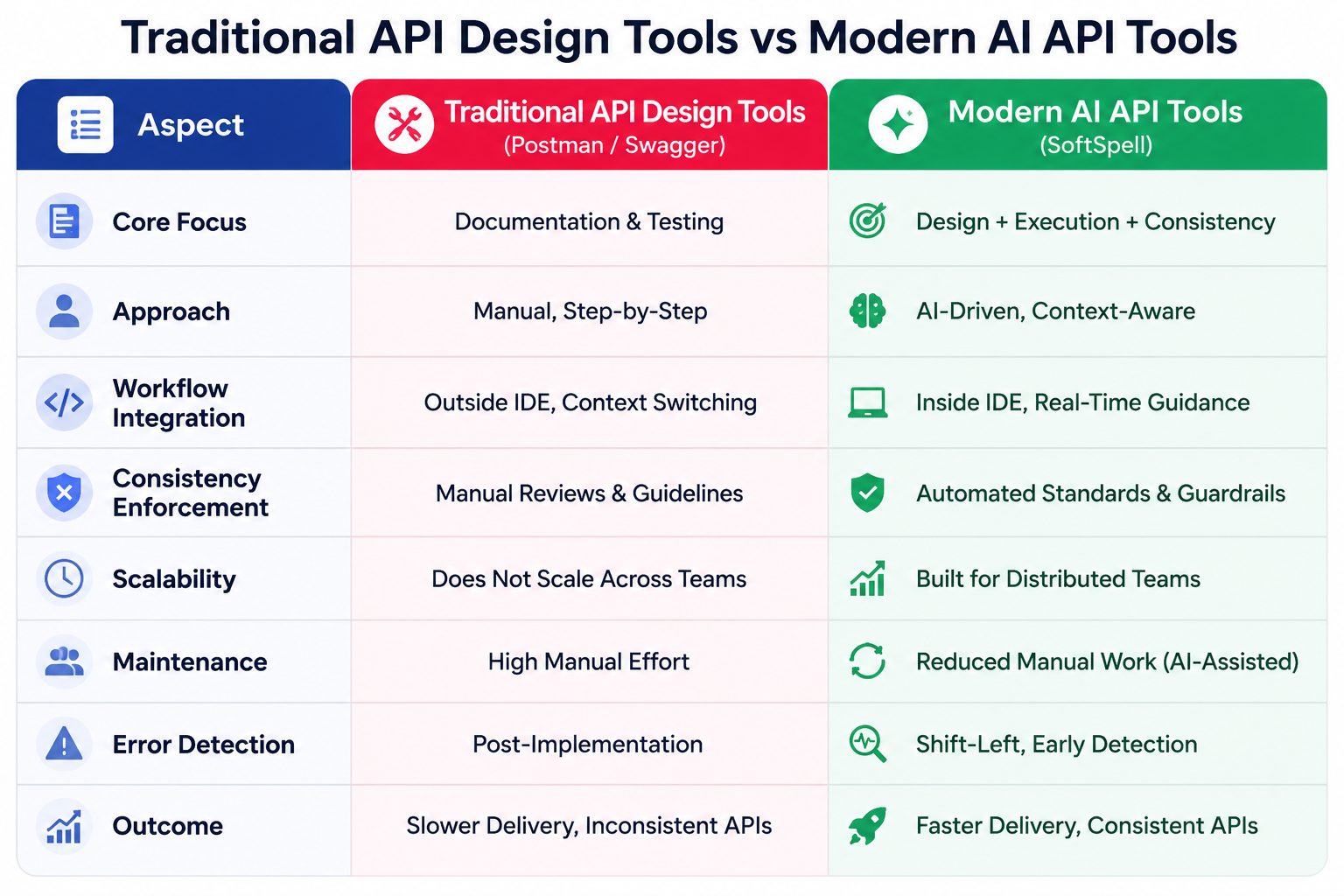
At enterprise scale, API consistency is not about cosmetic uniformity. It is about predictability and shared contracts.
Consistent API design guidelines typically includes:
When APIs follow consistent patterns, teams can integrate faster, onboard new engineers more easily, and evolve systems with less risk.
Critically, this level of consistency cannot be achieved through documentation alone. It needs to be applied during execution at the point where design decisions are made and code is written. This is where CodeSpell becomes relevant.
CodeSpell helps teams address API inconsistency by moving consistency upstream, before variation is introduced.
It starts with clarity. By structuring requirements early, CodeSpell helps ensure that the intent behind an API is clear before design begins. This reduces subjective interpretation and helps teams align on what an API is meant to do, not just how it should look.
From there, CodeSpell supports design-to-code workflows that translate intent into repeatable patterns. Instead of every team making isolated design decisions, APIs are shaped using shared structures and expectations.
This shifts API consistency from something that is reviewed after the fact to something that is built into the workflow itself. Teams retain autonomy but operate within shared guardrails that help keep the system coherent as it grows.
One of the main reasons API standards fail is that they live outside the developer’s day-to-day workflow. When guidance is separated from execution, it is easy to overlook or bypass.
CodeSpell addresses this by operating directly inside the IDE, where APIs are designed and implemented. Shared rules and contextual guidance support developers as they work, rather than relying solely on post-hoc reviews to catch inconsistencies.
Because CodeSpell works with file-level and workspace-level context, it helps maintain alignment not just within a single service, but across related services as APIs evolve. Developers receive guidance in real time while designing endpoints, making it easier to follow shared standards without slowing API design & development
For distributed teams, this is particularly important. It ensures that engineers working across locations and services are guided by the same expectations, even when they are not in constant communication.
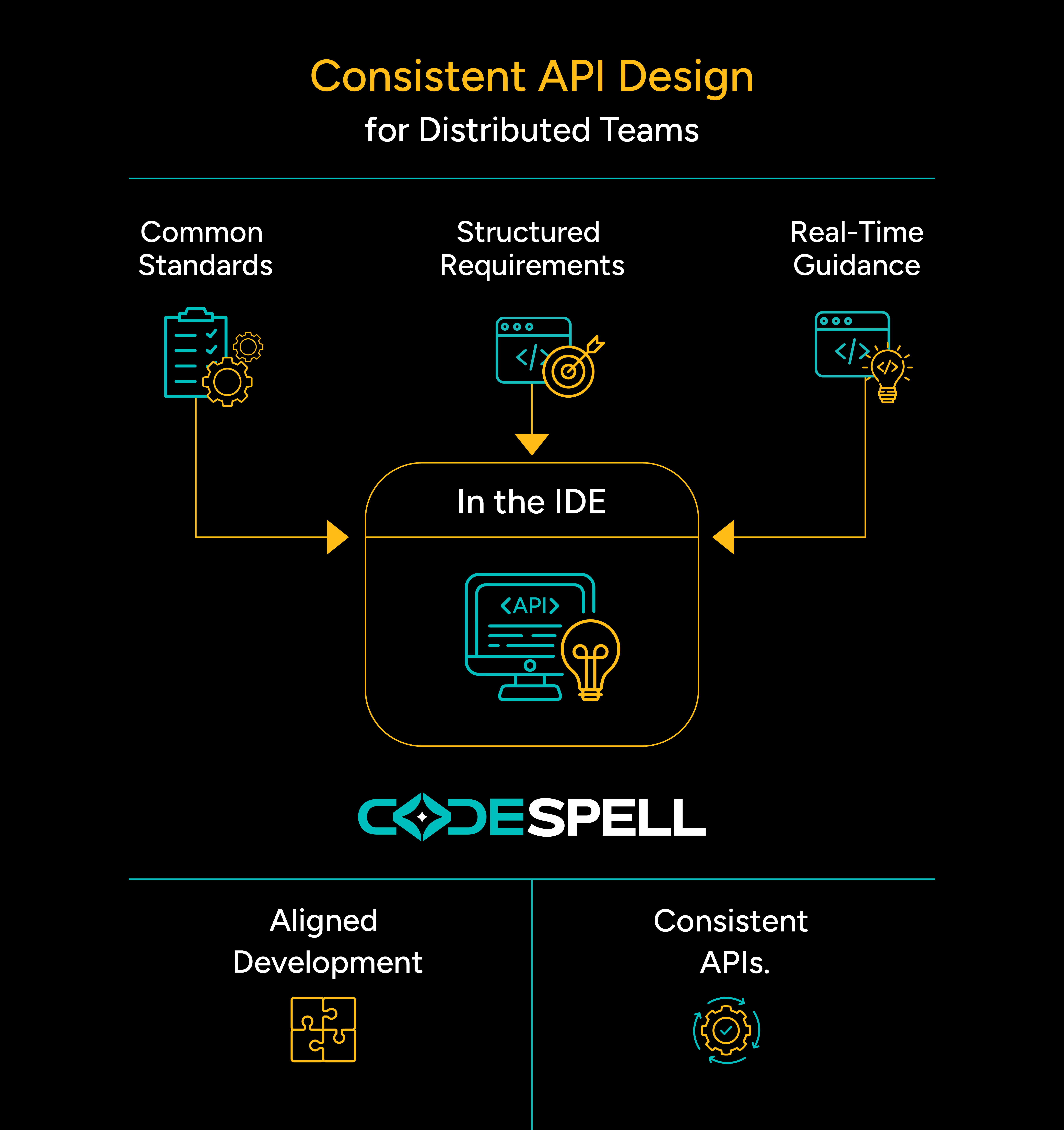
When API consistency is embedded into execution, the impact goes beyond cleaner interfaces.
Teams typically see:
For engineering leaders, this represents a shift from people-dependent enforcement to system-level reliability. API quality becomes a property of how teams work, rather than something that must be constantly monitored and corrected.
The result is a more scalable engineering organization, where distributed teams can move independently without fragmenting the system as a whole.
Consistent API design becomes a natural outcome when structure is embedded directly into the development workflow. Instead of relying on documentation, reviews, or individual team practices, consistency is enforced at the point where APIs are created and implemented.
SoftSpell ensures this by embedding shared standards, structured workflows, and real-time validation directly into the engineering process. This allows distributed teams to build and evolve APIs independently while still staying aligned at a system level.
See how SoftSpell ensures consistent API design across distributed teams. Book a Demo with SoftSpell.




July 1, 2026
Don’t Miss Out
We share cool stuff about coding, AI, and making dev life easier.
Hop on the list - we’ll keep it chill.

© 2026, SoftSpell. All Rights Reserved


