


Changelog
July 1, 2026
.svg)
.jpg)
Most QA testing tools in 2026 execute tests quickly but miss the real need: connecting tests directly to requirements. TestSpell solves this at the source. Built natively into SoftSpell's SDLC, it unifies requirements, test execution, and release visibility in a single flow.
You don’t have a QA tool problem; you have a QA integration problem. Only TestSpell was built to fix this gap by making QA part of your workflow, not an afterthought.
Most engineering teams in 2026 are running three, sometimes four, testing tools simultaneously and still shipping releases with production bugs that should have been caught two sprints ago. The tools aren't broken. They're just disconnected from the system that generates the work they're supposed to validate.
That's the trap. When QA lives downstream of development, a final gate rather than a continuous layer, test coverage will always lag behind code velocity. Speed without context isn't automation; it's expensive noise.
TestSpell was designed from the start to close the integration gap.
Not as a standalone QA product retrofitted with AI, but as a testing intelligence layer engineered inside SoftSpell's SDLC platform, where requirements, code, and tests share the same traceability backbone. That origin changes everything.
Here's why.
TestSpell outranked other QA testing tools through the following:
The problem with most QA tool comparisons is that they compare features. TestSpell competes on architecture. It was built as a native testing layer inside SoftSpell's SDLC platform — not a standalone tool with API connectors stitched in. That structural difference is what the five reasons below are really about.
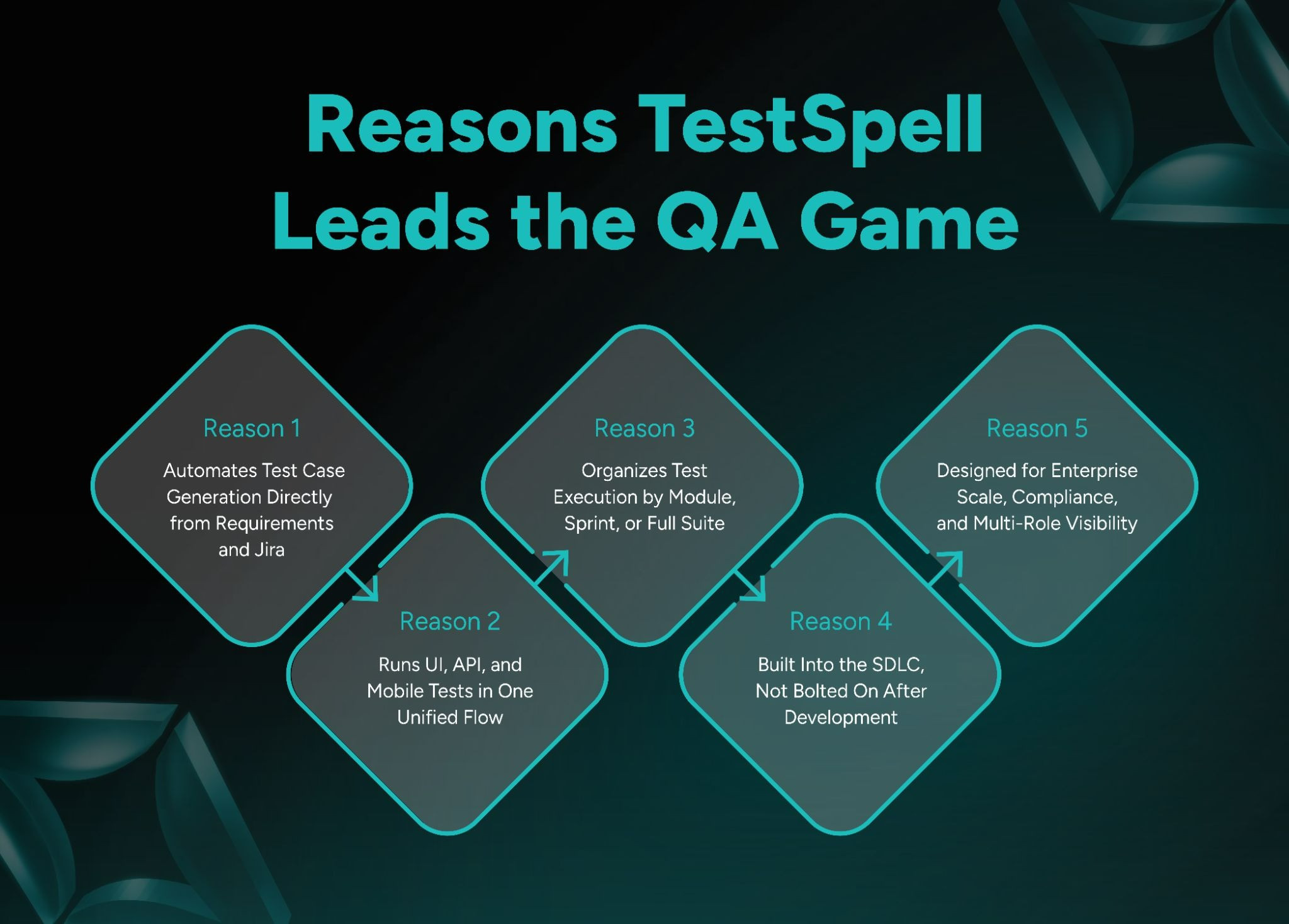
Reason 1 — Test Cases Generated Directly from Requirements and Jira
Tools like Mabl, Testim, and QA Wolf rely on testers to define tests. The tester is the source of knowledge. TestSpell removes that dependency.
TestSpell pulls input directly from requirements or Jira tickets, ensuring alignment with software specifications.
Reason 2 — UI, API, and Mobile Tests in One Unified Pipeline
Teams using Selenium, Postman, and Appium maintain triple the test suites, integrations, and maintenance. This fragmentation reduces release confidence.
TestSpell consolidates all three into a single execution flow.
Reason 3 — Execution Output Organized by Sprint, Module, or Full Suite
Standard QA tools return chronological test run logs. Mapping those results to sprint deliverables or feature readiness is manual work done by QA engineers every release cycle, invisibly consuming hours that don't show up in tool demos.
TestSpell structures output around how engineering work is actually organized:
Same execution output. Role-appropriate signal. Zero reformatting.
Reason 4 — A Native SDLC Component, Not a Bolted-On Integration
Every other QA platform in 2026 is a standalone product that connects to the SDLC via APIs, is functional but version-dependent, and is the first thing that breaks when something upstream changes.
TestSpell is a component of the SoftSpell SDLC platform, the same platform where ReqSpell manages requirements, and CodeSpell handles code generation.
Reason 5 — Enterprise-First Architecture With External Validation
Most QA tools add enterprise features as tier upgrades. TestSpell's governance capabilities, role-based access, data governance, and scalable multi-team performance are built into the platform baseline, not unlocked through premium plans.
SoftSpell's enterprise offering is purpose-built for complex, compliance-sensitive environments:

The QA tools market in 2026 is not short on options. What they are short on is clarity; most tools look identical on a feature comparison slide.
Before you commit budget, onboarding time, and CI/CD pipeline changes to a new platform, here are the five questions every engineering leader, QA team, and DevOps lead should be asking.
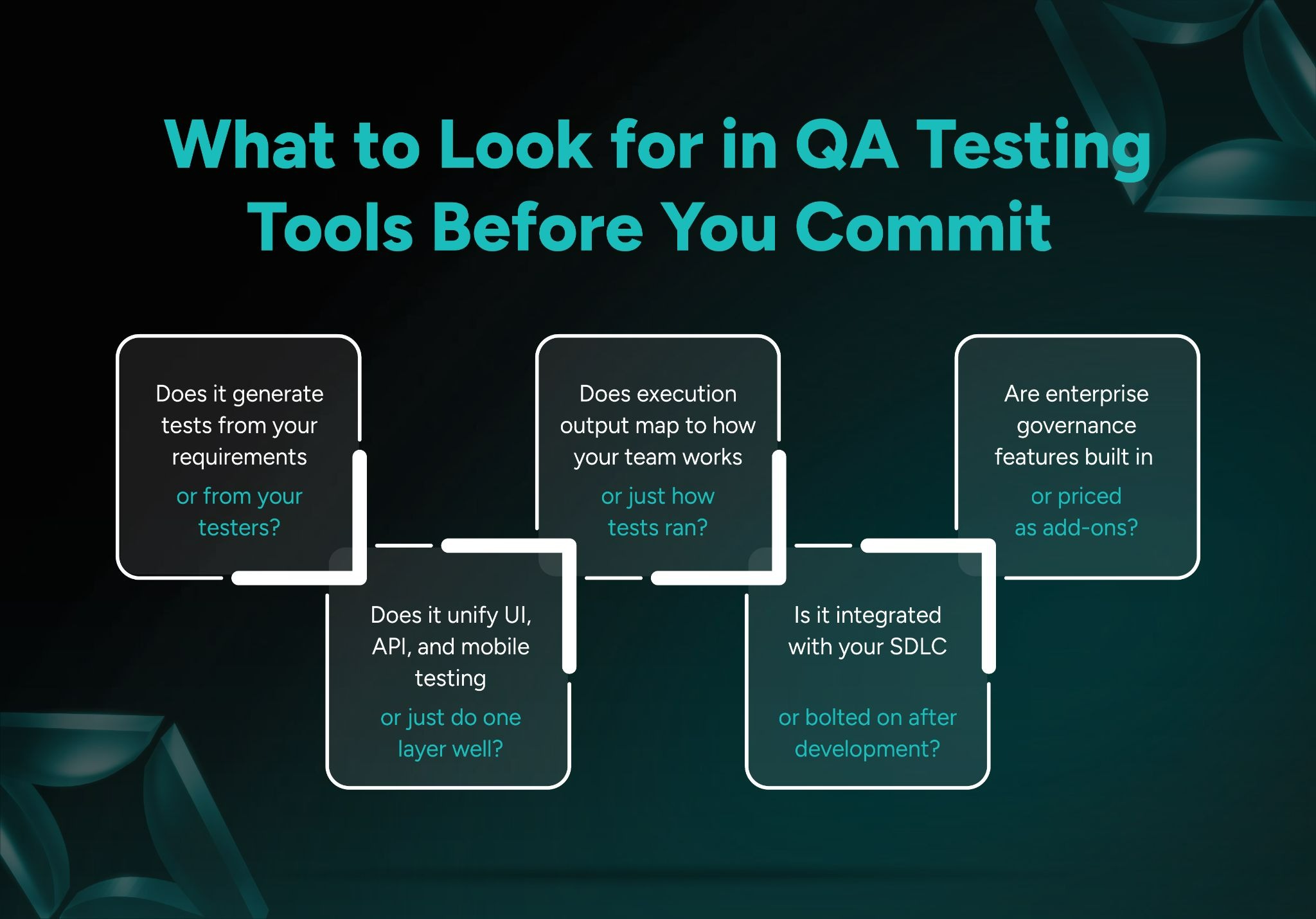
1. Does it generate tests from your requirements — or from your testers?
If the answer is "our testers write prompts or record interactions," coverage will always be limited by human memory. Look for a tool that reads directly from structured requirements or Jira tickets and automatically converts them into test inputs.
2. Does it unify UI, API, and mobile testing — or just do one layer well?
A tool that excels at UI testing but requires Postman for APIs and Appium for mobile is still three tools. Ask vendors directly: Is this one pipeline or three products packaged together?
3. Does execution output map to how your team works — or just how tests ran?
Chronological test logs are data. What QA engineers, product owners, and CTOs need is a signal, structured output that maps to sprints, modules, or suite-level release readiness without manual aggregation.
4. Is it integrated with your SDLC — or bolted on after development?
API integrations are not the same as native platform components. Ask whether the tool shares a data model with your requirements and code layers, or connects to them via webhooks and third-party connectors that break during version updates.
5. Are enterprise governance features built in — or priced as add-ons?
Role-based access, data governance, and compliance controls should be baseline capabilities, not premium-tier features. For enterprise engineering teams operating across distributed, compliance-sensitive environments, these aren't optional.

Most QA testing tools in 2026 make test execution smarter. TestSpell makes the entire QA lifecycle smarter — from the moment a requirement lands to the moment a release gets the green light.
The five reasons above aren't a feature list. They're architectural decisions baked into how TestSpell was built within SoftSpell's SDLC platform: requirement-driven test generation, unified execution across UI, API, and mobile; sprint-aligned reporting; native SDLC integration; and enterprise-grade governance from day one.
No other QA tool on the market closes all five gaps by design. That's not a claim — it's the structural difference between a testing tool and a testing intelligence layer.
If your QA cycles are still slowing down releases, the tool isn't the problem. The isolation is. TestSpell fixes that at the source.
TestSpell isn't just a better QA tool; it's the last one you'll need to evaluate. Explore TestSpell and Book a Demo for more insights.




July 1, 2026
Don’t Miss Out
We share cool stuff about coding, AI, and making dev life easier.
Hop on the list - we’ll keep it chill.

© 2026, SoftSpell. All Rights Reserved


