


TestSpell
May 27, 2026
.svg)
.png)
The CTO's Real Problem Is Not the Technology
You know your legacy systems need to go. The technical case is clear. What is not clear to your CFO, CEO, and board is why they should write the cheque.
Most legacy Modernization proposals fail not because the vision is wrong, but because the business case is built in the wrong language. Too technical. Too vague on ROI. Too light on risk modelling.
SoftSpell fixes that.
Before building a better case, understand why proposals stall:
These are framing failures, not technical ones. And SoftSpell is built to close that gap.
Enterprises running on decades-old systems face a specific challenge: Modernization projects are slow, expensive, and risky because no one fully understands what the existing system actually does.
That ambiguity destroys boardroom confidence. If you cannot clearly scope what is being replaced, you cannot price it credibly or commit to a timeline with any certainty.
This is exactly where SoftSpell starts.
1. Reverse-Engineer and Document What You Actually Have
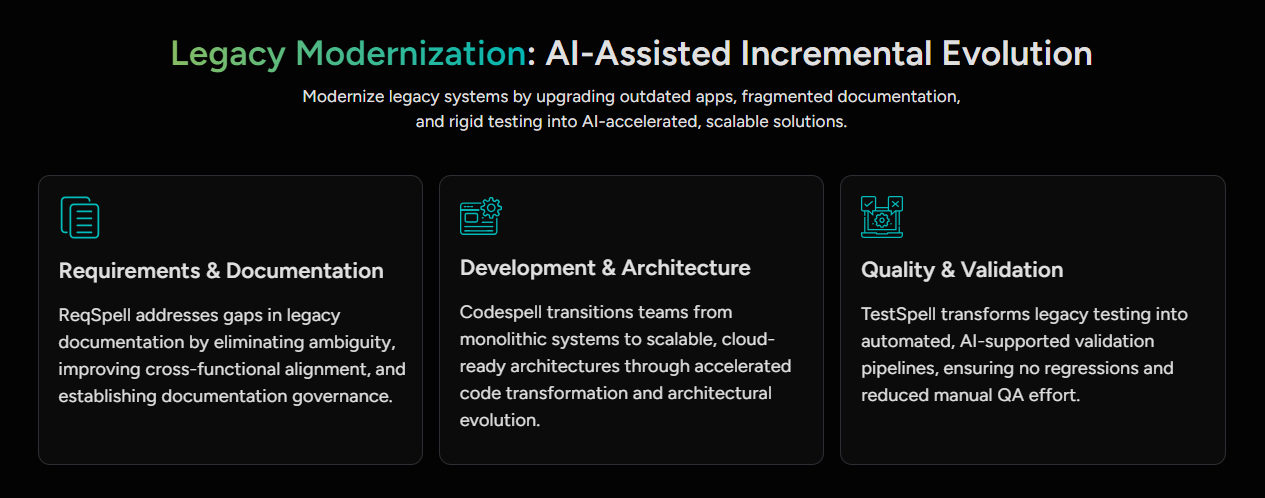
ReqSpell maps existing code back to requirements, supporting audits, compliance reviews, and change impact analysis.
You walk into the boardroom with actual documentation of what your legacy system does, what it connects to, and what it risks. That clarity alone changes the quality of the conversation.
2. Turn Technical Debt Into Financial Language
Boards understand cost and risk, not code fragility. SoftSpell helps you quantify:
When you present a figure like "our legacy architecture costs us an estimated X million annually in productivity loss and risk exposure," the room pays attention.
3. Show a Phased Roadmap That Feels Manageable
The biggest psychological barrier to approval is that Modernization feels too large to commit to.
SoftSpell's Autonomous AI Agents compress delivery timelines significantly by running specialized agents in parallel: one analyzing requirements, another generating code, another validating quality. The result:
A phased roadmap backed by these numbers makes leadership see a manageable programe, not a budget black hole.
4. Replace Risk Fear With Quality Proof Points
The board's biggest fear is that Modernization will break something critical or arrive late and defect-heavy.
SoftSpell addresses that directly:
5. Connect Modernization to Outcomes Leadership Cares About
Modernization proposals that live inside the IT department rarely get approved. You need to connect to what executives are already accountable for:
6. Model the Cost of Doing Nothing
Some of the strongest business cases are not built around the opportunity of modernizing. They are built around the growing cost of standing still.
SoftSpell helps you show:
When "do nothing" carries its own escalating risk and cost, Modernization becomes a risk management decision, not a technology preference.
Enterprise Readiness That Holds Up in the Boardroom
When legal, the CISO, and the board ask whether the platform is production-safe, SoftSpell answers:
These are the proof points that keep legal and security from killing your proposal before it reaches a vote.
SoftSpell's approach to legacy Modernization business cases is built for CTOs who:
A well-constructed business case does more than secure a budget. It sets the terms for how the program is measured from day one.
SoftSpell ensures that the delivery outcomes promised in the boardroom are actually achievable. The same AI capabilities that made your ROI case credible are the ones compressing delivery timelines, reducing defect rates, and keeping the program on track after approval.
That alignment between what was promised and what gets delivered is what protects the program and your credibility throughout the entire journey.
Legacy Modernization is one of the most consequential initiatives a CTO can drive. SoftSpell gives you the platform intelligence, delivery proof points, and quality outcomes to make your case impossible to ignore.
Talk to the SoftSpell team today.


Don’t Miss Out
We share cool stuff about coding, AI, and making dev life easier.
Hop on the list - we’ll keep it chill.

© 2026, SoftSpell. All Rights Reserved
.jpg)


