


Changelog
July 1, 2026
.svg)
.png)
Scrolling through how modern engineering teams describe their delivery pipelines, everything appears structured around CI/CD pipelines, agile workflows, and automation designed for speed and stability.
In reality, most teams still face ongoing challenges in SDLC, including delays, rework, and misalignment across requirements, development, and testing. These challenges rarely come from missing tools but from deeper structural gaps in how the SDLC is connected.
This guide breaks down the five most expensive challenges in SDLC that quietly slow delivery and increase cost, and how SoftSpell helps address them by connecting requirements, code, and testing into a unified workflow.
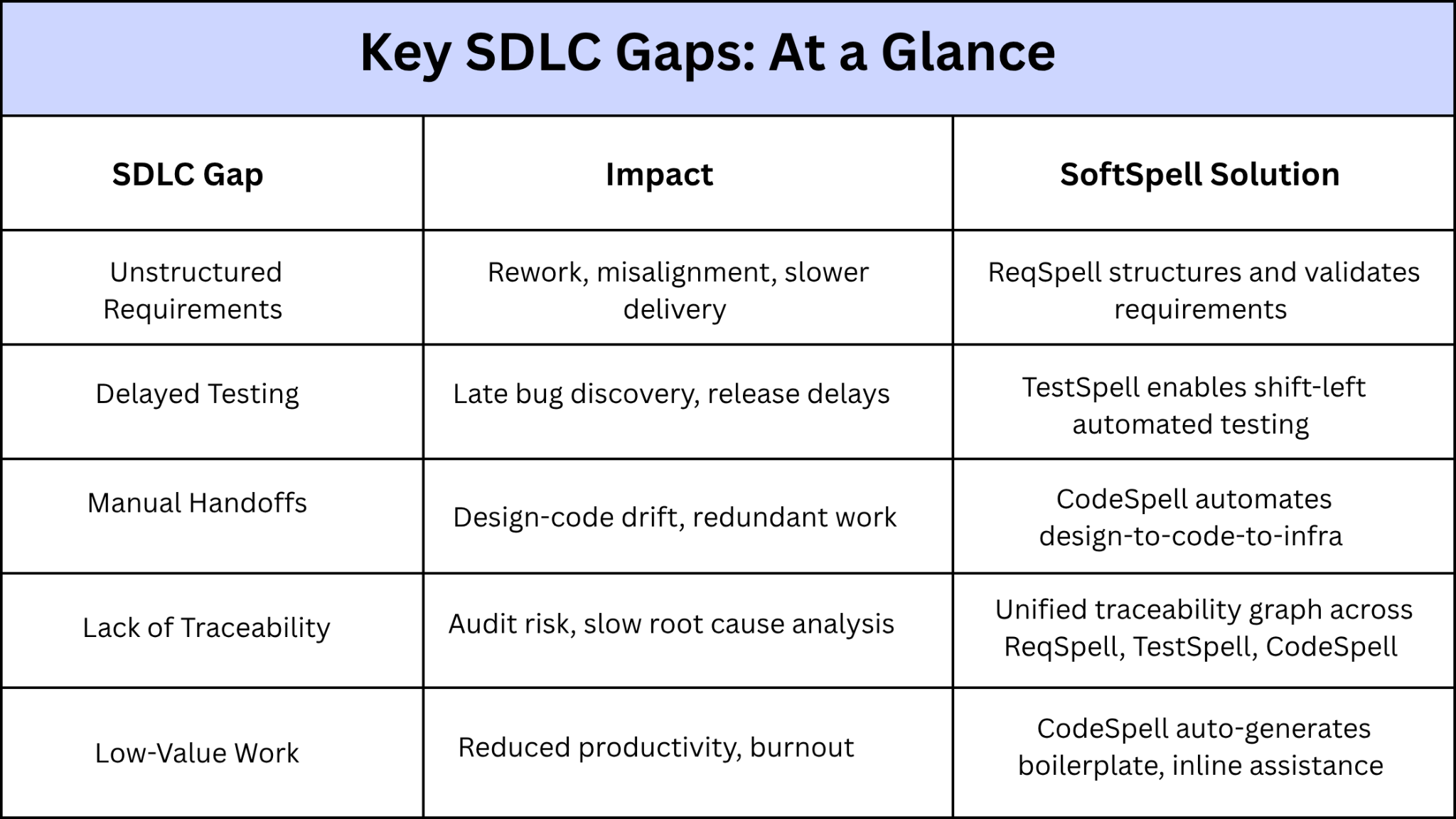
SDLC gaps rarely appear as major failures…
they show up as delays, rework, and rising costs across the delivery process. Below are five of the most common gaps that impact software teams and how they can be addressed.
Requirements in the SDLC are written in natural language, which is often ambiguous, incomplete, and open to interpretation. In many cases, what appears clear in a product specification leads to different assumptions among product, engineering, and QA teams, creating early misalignment during the SDLC.
The Problem
Requirements are unstructured and lack a consistent format across teams. This leads to missing context, unclear acceptance criteria, and fragmented communication between product, engineering, and QA. In many cases, critical technical constraints are not captured in the initial documentation, increasing ambiguity during development.
Business Impact
Industry insight: Research from the Standish Group CHAOS Report and PMI Pulse of the Profession shows that unclear requirements are a major driver of project delays and rework, contributing to nearly 30–40% of total rework effort in many software projects. This often results in high cost and timeline overruns across delivery cycles.
Further research from the IBM Systems Sciences Institute highlights that defects originating in early requirements can cost up to 10x more to fix later in the SDLC life cycle process. This reinforces the importance of structured requirements definition in reducing risk and improving delivery efficiency.
How SoftSpell Closes It
Requirement engine ReqSpell parses natural-language requirements and transforms them into structured, testable, engineering-ready specifications.
It:
This ensures developers build from complete, validated specs eliminating ambiguity from the start.
A critical gap in the SDLC phases, where testing begins only after development is complete. Even in modern workflows, QA activities such as test design, case creation, and validation often lag behind implementation, reducing the time available for meaningful quality assurance across the challenges in SDLC.
The Problem
In many organizations, QA still starts after development ends. Even with agile workflows, test planning and case creation often lag behind code, leaving little time for deep validation.
Business Impact
Delayed testing is one of the most expensive challenges in SDLC, because defects are discovered when fixes are hardest to implement.
In many engineering teams, this also leads to reduced sprint predictability, as QA work spills over into subsequent release cycles instead of being completed within the same sprint.
How SoftSpell Closes It:
TestSpell, the QA automation layer of CodeSpell, addresses this gap by shifting testing to the earliest possible stage of the SDLC life cycle process.
This enables shift-left testing where QA starts early and moves fast.
A major breakdown in the SDLC phases occurs when design, development, and infrastructure teams operate in isolation.
The Problem
Design teams work in Figma. Frontend devs convert designs to code. Backend teams build APIs. Infra teams write Terraform. These handoffs are often manual, disconnected, and error prone, creating one of the most overlooked challenges in SDLC.
Business Impact
How SoftSpell Closes It
CodeSpell automates this full transition from idea to deployment by:
Resulting in clean, consistent, and scalable code without redundant work.
A gap in the SDLC life cycle process where there is no clear linkage between requirements, development, testing, and production releases, making it difficult to track how a business requirement translates into the final deployed feature.
The Problem
When things go wrong in production, teams often can't trace failures back to specific business requirements. There’s no clear link between what was requested, what was built, and what was tested.
Business Impact
How SoftSpell Closes It
CodeSpell maintains a connected chain of custody across the SDLC:
This improves compliance, observability, and internal confidence.
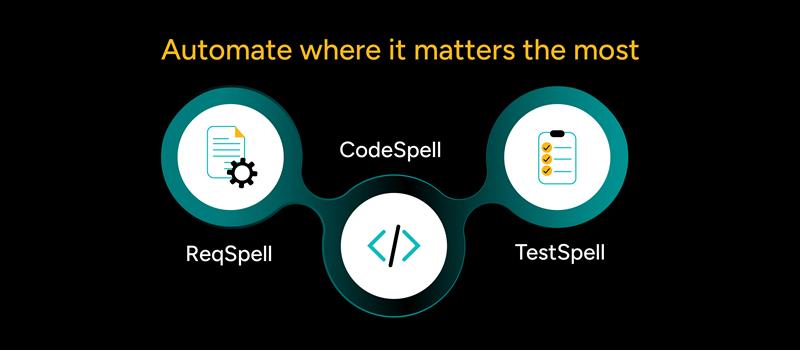
A growing inefficiency in the security in SDLC phase, where engineers spend significant time on repetitive and boilerplate tasks such as writing routes, stubs, validators, and documentation instead of focusing on core product logic and system design.
The Problem
Even senior developers still spend hours on repetitive, boilerplate tasks, writing the same routes, stubs, validators, and documentation from scratch.
Business Impact
How SoftSpell Closes It
SoftSpell acts as a full-stack co-pilot that:
Your engineers spend less time on grunt work and more time solving real problems.
These five gaps may look isolated, but together they create compounding inefficiencies that represent some of the most critical challenges in SDLC. Over time, they slow down delivery, increase rework, and reduce overall engineering predictability at scale.
By addressing these gaps through an AI-driven approach, CodeSpell helps teams bring structure to requirements, reduce handoff friction, enable earlier testing, and improve release confidence. This creates a more connected and predictable delivery flow from planning to production.
If you are looking to reduce delivery inefficiencies and improve engineering speed without adding complexity to your stack, book a demo with SoftSpell to see how end-to-end SDLC automation works in practice.



July 1, 2026
Don’t Miss Out
We share cool stuff about coding, AI, and making dev life easier.
Hop on the list - we’ll keep it chill.

© 2026, SoftSpell. All Rights Reserved


