


Changelog
July 1, 2026
.svg)
%20(1).jpg)
AI software testing automation cuts QA cycles by removing manual bottlenecks such as test creation, script maintenance, fragmented execution, and reporting. Platforms like TestSpell automate testing from requirements to release validation, helping engineering teams deliver software faster without compromising quality.
Teams using AI software testing automation are shipping features 3x faster, not by writing less code, but by eliminating the QA bottleneck that stalls every release. This acceleration stems from targeting longstanding process slowdowns—creating a significant impact across releases.
Here's the reality: most engineering leaders don't say out loud: your CI/CD pipeline moves in minutes, but your regression suite takes days. That gap isn't a process problem; it's a structural one.
High-performing DevOps teams deploy on demand. Multi-day manual QA breaks that model entirely. Every regression rerun pulls engineers away from feature work, delays release windows, and compounds across every sprint.
AI software testing automation doesn't just accelerate test execution; it replaces the manual workflow with one that's intelligent, self-healing, and integrated from the first commit.
That's the shift this blog unpacks, tracing how AI-powered automation changes each stage of the QA process.
AI software testing automation is the use of artificial intelligence to automate and improve software testing activities, including test case creation, test execution, defect detection, test maintenance, and reporting.
Unlike traditional automation, which relies on manually created scripts and rigid test paths, AI-powered test automation adapts and learns from application behavior, requirements changes, test history, and codebase updates—enabling faster, smarter, and more comprehensive testing.
In a traditional testing workflow, QA teams spend significant time creating test cases, updating broken scripts, selecting tests to run, and analyzing results. As applications grow more complex, these tasks become harder to manage and often slow down release cycles.
AI changes this model by helping teams:
Ask most engineering leaders where QA slows down, and they'll point to test execution. Run fewer tests, parallelize the suite, get faster machines — problem solved.
Except it isn't. And teams that optimize only for execution speed quickly find their QA cycles remain just as long.
Here's why: test execution is rarely the primary bottleneck.
The time loss is distributed across four upstream activities that no one tracks on a burndown chart, and AI-driven software testing automation addresses all four simultaneously.
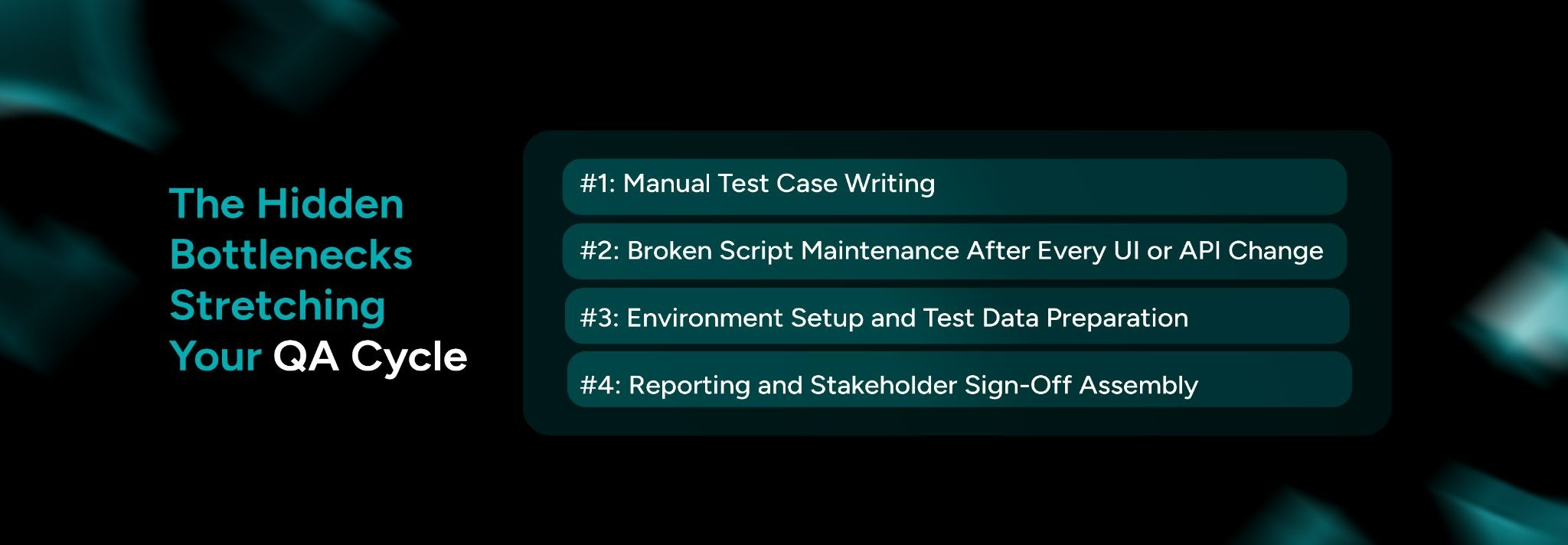
Time Sink #1: Manual Test Case Writing (~30–40% of QA Cycle Time)
Before a single test runs, someone has to write it, reading through requirements, interpreting intent, and inferring edge cases entirely by hand. This invisible overhead grows with every sprint and every new feature shipped.
Time Sink #2: Broken Script Maintenance After Every UI or API Change
Traditional automation scripts are written against a fixed application state. The moment anything changes, a button moves, an endpoint renames, a login flow updates, a portion of your suite silently breaks. These maintenance demands are time-consuming, costly, and prone to human error, consistently delaying releases at exactly the moment teams can least afford it.
Time Sink #3: Environment Setup and Test Data Preparation
Environment provisioning, database seeding, and DevOps-QA coordination routinely cost hours, sometimes full days, before a single test fires. It's pre-execution overhead that rarely appears in sprint planning but consistently eats into release timelines.
Time Sink #4: Reporting and Stakeholder Sign-Off Assembly
After the tests run, someone still has to translate raw results into structured reports that engineering leadership, product managers, and release managers can act on before a release gets approved.
The real picture: a two-week sprint ends with a four-day regression cycle, not because tests run slowly, but because everything surrounding the test run runs slowly. AI software testing automation attacks all four sinks simultaneously:

AI software testing automation cuts QA cycle time mechanically in the following ways:
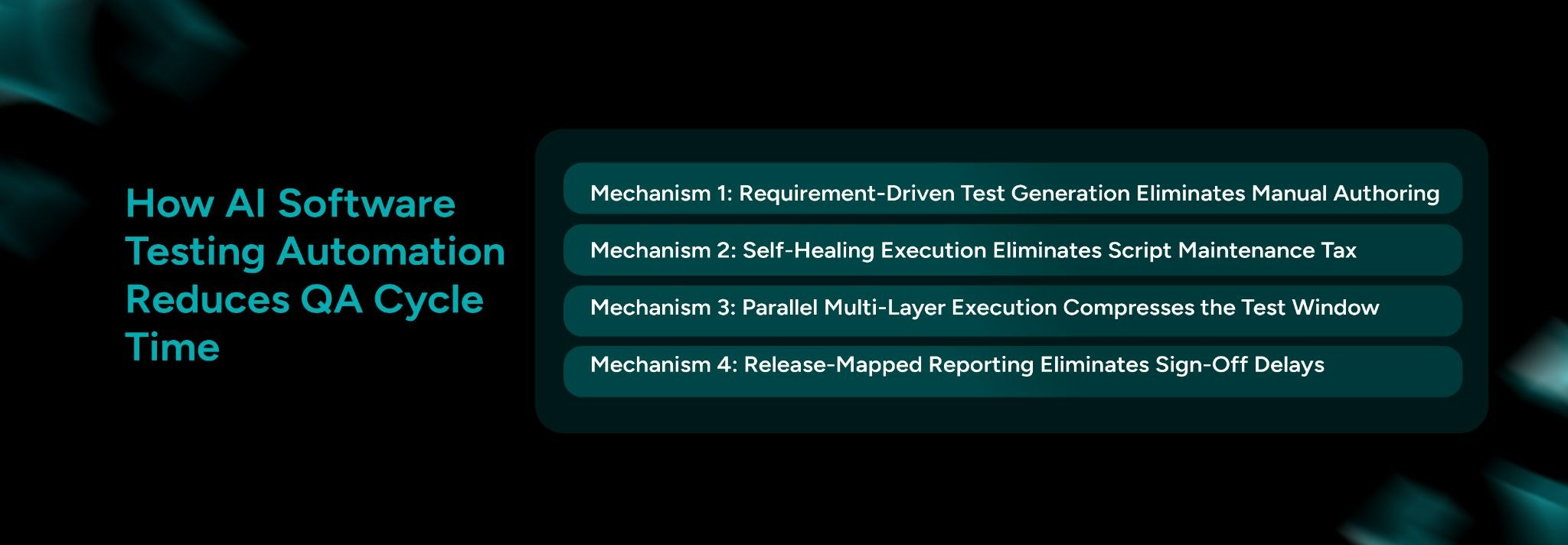
Mechanism 1: Requirement-Driven Test Generation Eliminates Manual Authoring
In traditional QA workflows, test case creation begins after development ends; a QA engineer reviews requirements, interprets intent, and writes test scripts manually. That sequencing alone adds days to every release cycle.
AI-generated tests invert this entirely. Test cases are derived directly from structured requirements or Jira tickets as soon as a sprint is defined, not after the code is written.
This is what makes SoftSpell's TestSpell structurally different from standalone QA tools. Because it connects directly to ReqSpell, SoftSpell's requirements intelligence layer, test cases aren't written against a developer's interpretation of a ticket.
They're generated from the same structured requirements that informed the code, creating end-to-end traceability from spec to test without any manual handoff.
Mechanism 2: Self-Healing Execution Eliminates the Script Maintenance Tax
Every time your application changes, a button moves, an element ID updates, or a layout shifts, traditional automation scripts break silently. The failure only surfaces when the suite runs, usually right before a release, forcing a manual script audit under maximum time pressure.
Self-healing execution removes this loop entirely. AI-driven locators don't depend on a single fixed selector. They read contextual signals, element position, surrounding structure, and semantic attributes, and adapt when the application state changes.
Mechanism 3: Parallel Multi-Layer Execution Compresses the Test Window
Most enterprise QA pipelines run UI, API, and mobile testing as three separate sequential processes, often across three separate toolchains. Selenium or Cypress handles UI. Postman handles API validation. Appium handles mobile. Each has its own scheduling window, configuration overhead, and result format.
Running them sequentially means the total test window is the sum of all three. Running them in parallel means the window is determined by whichever layer takes the longest.
Mechanism 4: Release-Mapped Reporting Eliminates Sign-Off Delays
Test completion and release approval are two different events, and in most teams, there's a manual production step between them. Someone has to take raw test logs, organize results by module or feature area, and translate pass/fail data into a release-readiness narrative that product managers and engineering leadership can actually act on.
That translation step routinely adds hours, sometimes a full day, to the post-execution phase of every release cycle.
AI-driven reporting removes the translation layer entirely:
TestSpell by SoftSpell addresses the root causes of long QA cycles in the following ways:
1: Test Cases Generated from Requirements and Jira
2: UI, API, and Mobile Testing in One Execution Pipeline
3: Execution Reports Organized by Sprint, Module, or Full Suite
4: Integrated Across the Existing Toolchain Without Workflow Overhaul
Most QA tools solve one part of the problem. They accelerate execution, improve reporting, or add some level of automation to script maintenance. TestSpell by SoftSpell is built differently — it's designed to address the root causes of long QA cycles across the entire pre-execution, execution, and post-execution workflow within a single platform.
Here's exactly how it does that.
1. Test Cases Generated from Requirements and Jira — Not Written from Memory
TestSpell connects directly to ReqSpell, SoftSpell's requirements intelligence layer. When a requirement is structured, or a Jira ticket is finalized, test cases are automatically generated to cover functional flows, edge cases, and negative paths derived from the spec itself.
2. UI, API, and Mobile Testing in One Execution Pipeline
Teams running Selenium, Postman, and Appium separately maintain three test suites, three CI integrations, and three reporting streams. The coordination overhead alone adds days to every cycle.
TestSpell runs all three layers in parallel within a single execution pipeline integrated into the CI/CD process.
3. Reports Organized for Decision-Makers — Not Raw Logs
TestSpell structures reporting for the people who act on it:
4. Integrated Across the Existing Toolchain Without Workflow Overhaul
AI testing platforms that require significant infrastructure changes create their own implementation cycle, and adoption stalls when onboarding costs are high. TestSpell is designed to fit the workflow engineering teams already have, not replace it.

Cutting QA cycles in half isn't about running faster tests. It's about eliminating the manual overhead that surrounds every test: the authoring, the script maintenance, the environment coordination, and the report assembly. That's where the time actually goes.
The shift AI makes is structural. QA stops being a periodic validation gate at the end of a sprint and becomes a continuous release signal embedded directly in the delivery pipeline. Every commit is validated. Every requirement is covered. Every stakeholder automatically gets a clear go/no-go.
Engineering teams that release with confidence aren't the ones who test more. They're the ones where testing is integrated tightly enough that it never holds up the work.
If your QA cycle is still a sprint-ending event rather than a sprint-integrated process, that's the problem TestSpell solves completely, not partially.
Stop letting manual QA set your release cadence. Book a Demo with TestSpell and see the difference in your first sprint.




July 1, 2026
Don’t Miss Out
We share cool stuff about coding, AI, and making dev life easier.
Hop on the list - we’ll keep it chill.

© 2026, SoftSpell. All Rights Reserved


