


Changelog
July 1, 2026
.svg)
%20(1).jpg)
Developers spend up to 50% of their time debugging recurring issues. SoftSpell’s AI code fixer, CodeSpell, detects root causes, applies context-aware fixes, integrates with IDEs, and automates testing to speed up enterprise-grade software delivery.
You may find yourself addressing the same bug multiple times, only for it to reappear in production.
Developers spend up to 50% of coding time debugging recurring issues. Traditional IDE tools lack memory of prior fixes, causing delays and frustration and risking customer trust with each reopened bug.
The real problem isn’t the bug; it’s the workflow: fixes are reactive, fragmented, and leave no trace of why the code exists or how errors were resolved.
Enter CodeSpell, embedded directly in your IDE.
It detects root causes, applies context-aware fixes, and learns from previous resolutions. The result: faster bug resolution, fewer regressions, and predictable releases—all without leaving your IDE.
Developers often spend 25–50% of their time debugging, according to a report. Surprisingly, most of these bugs aren’t written by the developers themselves; they stem from upstream issues that cascade into production.
The lifecycle of these recurring bugs usually follows this pattern:
This creates a patch-and-repeat cycle in which fixes address symptoms rather than root causes. Traditional IDE debuggers, breakpoints, stack traces, and logs only tell you where the crash occurred, not why the code was wrong in the first place. Hours are lost tracing the problem, slowing releases, and frustrating teams.
Finding the root cause of a bug often takes longer than fixing it. AI code fixers accelerate this process by helping developers detect errors, analyze code, and resolve issues more efficiently.
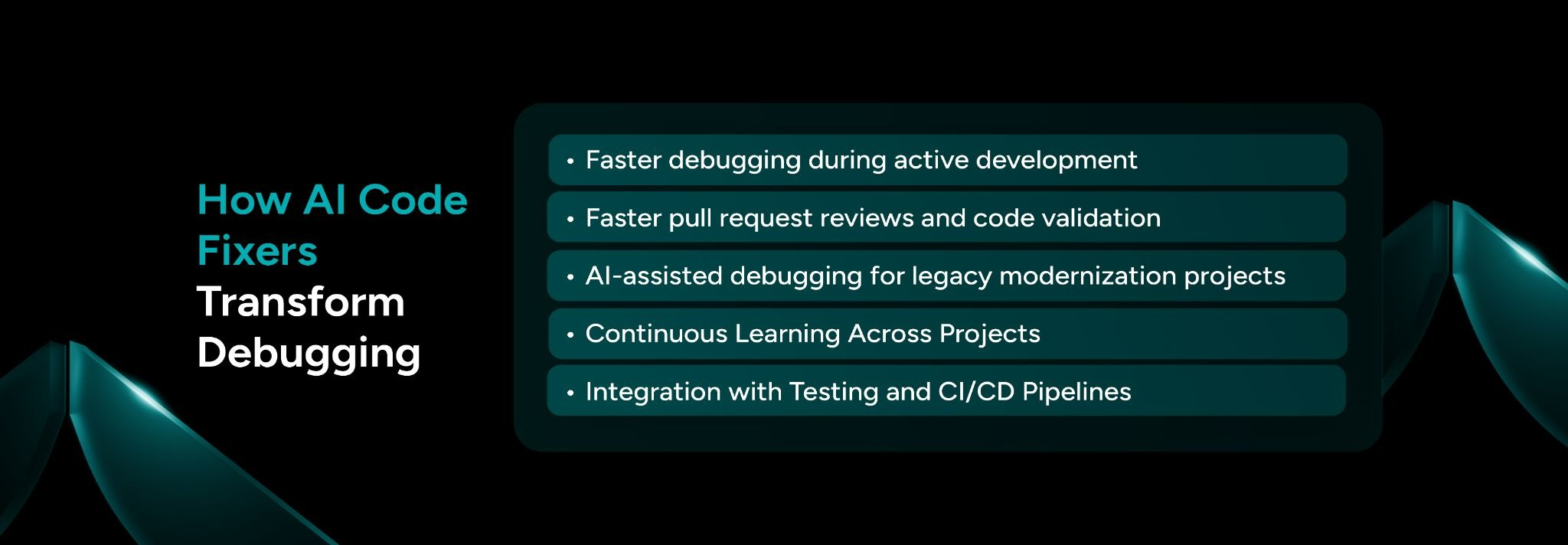
1. Faster Debugging During Active Development
AI code fixers help developers detect and resolve issues as they write code, avoiding downstream failures:
2. Faster Pull Request Reviews and Code Validation
CodeSpell assists engineering teams in validating changes before they merge, reducing regression and ensuring safer releases:
3. AI-Assisted Debugging for Legacy Modernization Projects
Large enterprises often struggle with old or undocumented codebases. AI code fixers accelerate modernization:
4. Continuous Learning Across Projects
AI code fixers improve over time by learning from previous fixes and coding patterns:
5. Integration with Testing and CI/CD Pipelines
SoftSpell integrates seamlessly into existing development workflows to catch issues early:
Also read: CodeSpell Agent Mode: True End-to-End Code Execution

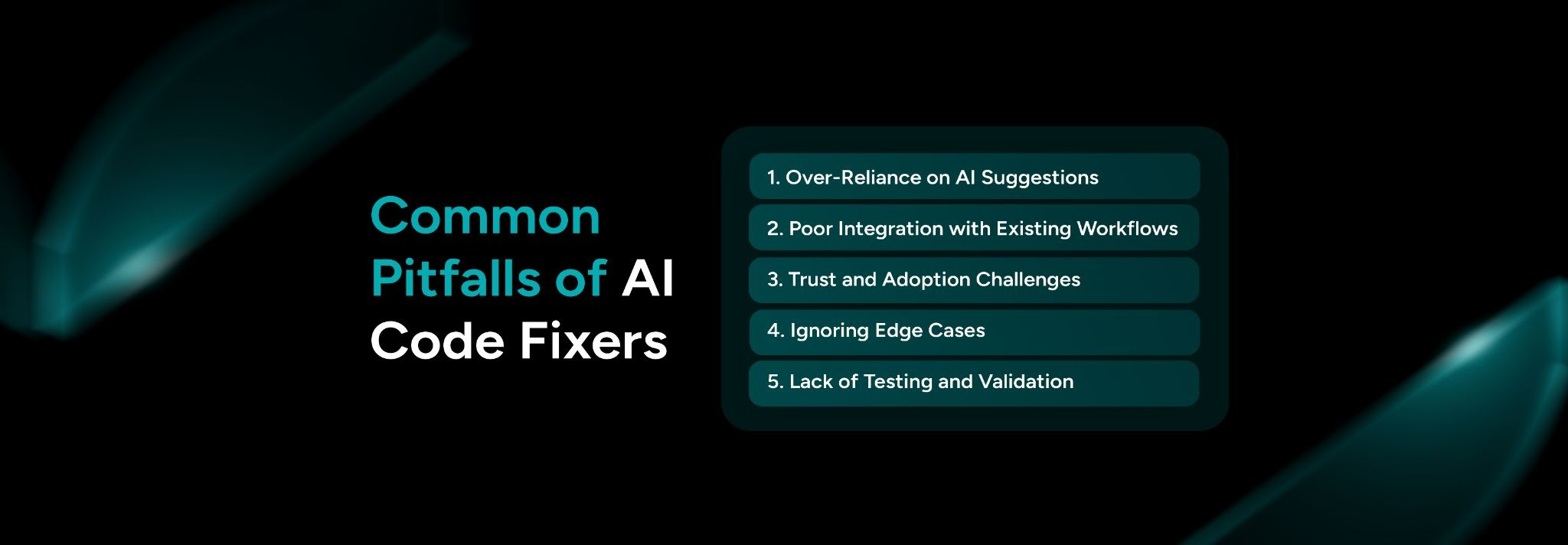
The Common Pitfalls of AI Code Fixers are:
1. Over-Reliance on AI Suggestions
2. Poor Integration with Existing Workflows
3. Trust and Adoption Challenges
4. Ignoring Edge Cases
5. Lack of Testing and Validation
AI code fixers can dramatically improve development speed, but teams often face challenges when integrating them into real-world workflows. Awareness of these pitfalls and strategies to address them ensure that the AI becomes a productivity amplifier rather than a source of friction.
1. Over-Reliance on AI Suggestions
2. Poor Integration with Existing Workflows
3. Trust and Adoption Challenges
4. Ignoring Edge Cases
5. Lack of Testing and Validation
Further read: AI Coding Assistant Copilot
Enterprise engineering teams face a unique challenge: they need faster bug resolution without compromising security, compliance, or code integrity. While AI bug fixing can significantly reduce debugging time, many organizations hesitate to adopt it due to concerns about data privacy, unauthorized code changes, and a lack of accountability.
For AI bug fixing to be enterprise-ready, teams should look for safeguards such as:
These controls ensure that AI acts as an assistant rather than an autonomous developer.
SoftSpell's CodeSpell addresses these requirements through enterprise-grade governance features. Sensitive code remains protected through SOC 2-compliant data handling practices, while role-based access controls ensure that AI-generated fixes require human approval before implementation. Every suggested change is logged, time-stamped, and fully traceable, making it easier for organizations to meet compliance and audit requirements.
By combining AI-powered bug fixing with governance, approval workflows, and auditability, SoftSpell helps engineering teams accelerate development while maintaining the security and control expected in enterprise environments.

Recurring bugs, fragmented workflows, and time-consuming debugging slow software delivery and frustrate engineering teams. Traditional IDE tools can only highlight where a crash occurs; they don’t explain why it happened or prevent it from returning.
SoftSpell’s CodeSpell transforms this process by embedding an AI code fixer directly into your IDE, linking requirements to code, generating unit tests, detecting design drift, and enforcing enterprise-grade governance.
Developers can resolve issues faster, reduce regressions, and maintain high-quality code across large, complex codebases. Whether debugging new code, reviewing pull requests, or modernizing legacy systems, CodeSpell provides a complete, traceable, and secure workflow that ensures fixes stick.
Don’t waste another hour chasing recurring bugs—explore CodeSpell today and experience AI-driven debugging that prevents problems before they disrupt your release pipeline.




July 1, 2026
Don’t Miss Out
We share cool stuff about coding, AI, and making dev life easier.
Hop on the list - we’ll keep it chill.

© 2026, SoftSpell. All Rights Reserved


