


Changelog
July 1, 2026
.svg)
.png)
SoftSpell optimises software development life cycle processes by unifying requirements, code, testing, and operations within a single AI-powered platform. Its integrated approach improves traceability, reduces manual effort, accelerates delivery, and helps engineering teams maintain quality throughout the SDLC process.
Every missed requirement, delayed test cycle, and deployment rollback usually traces back to the same problem: disconnected processes in the software development life cycle. Requirements live in documents, developers work in separate tools, QA teams operate on different timelines, and operations teams inherit decisions they were never part of.
The result is predictable: rework, slower releases, quality gaps, and limited visibility throughout the SDLC. As software systems become more complex, managing these handoffs manually becomes increasingly difficult.
SoftSpell addresses this challenge by bringing requirements, development, testing, and operations into a unified AI-powered SDLC platform. Through lifecycle automation, traceability, and intelligent workflows, it helps engineering teams reduce friction, accelerate delivery, and maintain quality across every stage of the software development life cycle process.
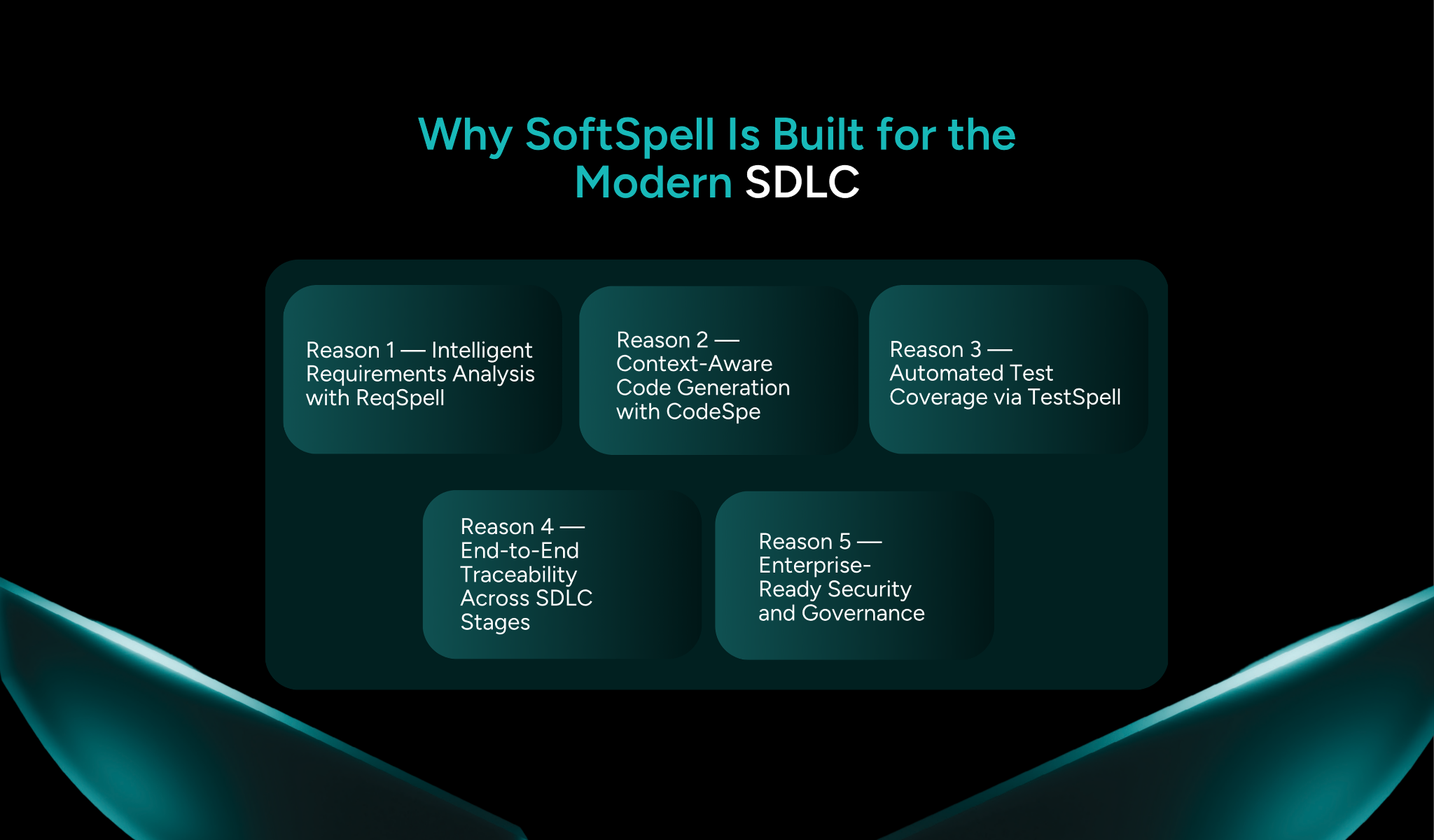
The 5 reasons SoftSpell optimizes all SDLC processes are:
Reason 1 — Intelligent Requirements Analysis with ReqSpell
Reason 2 — Context-Aware Code Generation with CodeSpell
Reason 3 — Automated Test Coverage via TestSpell
Reason 4 — End-to-End Traceability Across SDLC Stages
Reason 5 — Enterprise-Ready Security and Governance
Most platforms automate one SDLC stage in isolation. SoftSpell integrates all requirements, code, and testing into a single traceable system.
Here are five specific, evidence-backed reasons it optimises the entire software development life cycle process end to end, not just the parts that are easiest to automate.
Reason 1 — Intelligent Requirements Analysis with ReqSpell
Most requirement failures aren't dramatic; they're quiet. A spec written in a product doc gets summarized into a ticket, and the nuance that mattered most doesn't survive the rewrite.
ReqSpell removes that risk at the source.
Reason 2 — Context-Aware Code Generation with CodeSpell
Generic code generation produces code that compiles.
CodeSpell produces code that's already aligned to what the business actually asked for. This is because it's working from the same validated requirement, not a developer's best guess at one.

Reason 3 — Automated Test Coverage via TestSpell
Testing is usually the phase that absorbs every delay created upstream.
TestSpell prevents that by starting test creation the moment a requirement is created, not after a release candidate has already been built.
Reason 4 — End-to-End Traceability Across SDLC Stages
Traceability is the one thing every enterprise SDLC claims to have, and almost none can actually produce on demand. SoftSpell makes it a structural property of the system, not a document someone maintains separately.
Reason 5 — Enterprise-Ready Security and Governance
Speed and automation mean little if they can't pass a security review. This is where SoftSpell separates itself from point tools built for individual developers rather than regulated enterprises.
Most platforms ask teams to change how they work. SoftSpell is built to plug into the workflow your engineers already run, including the IDE, ticketing system, and pipeline.
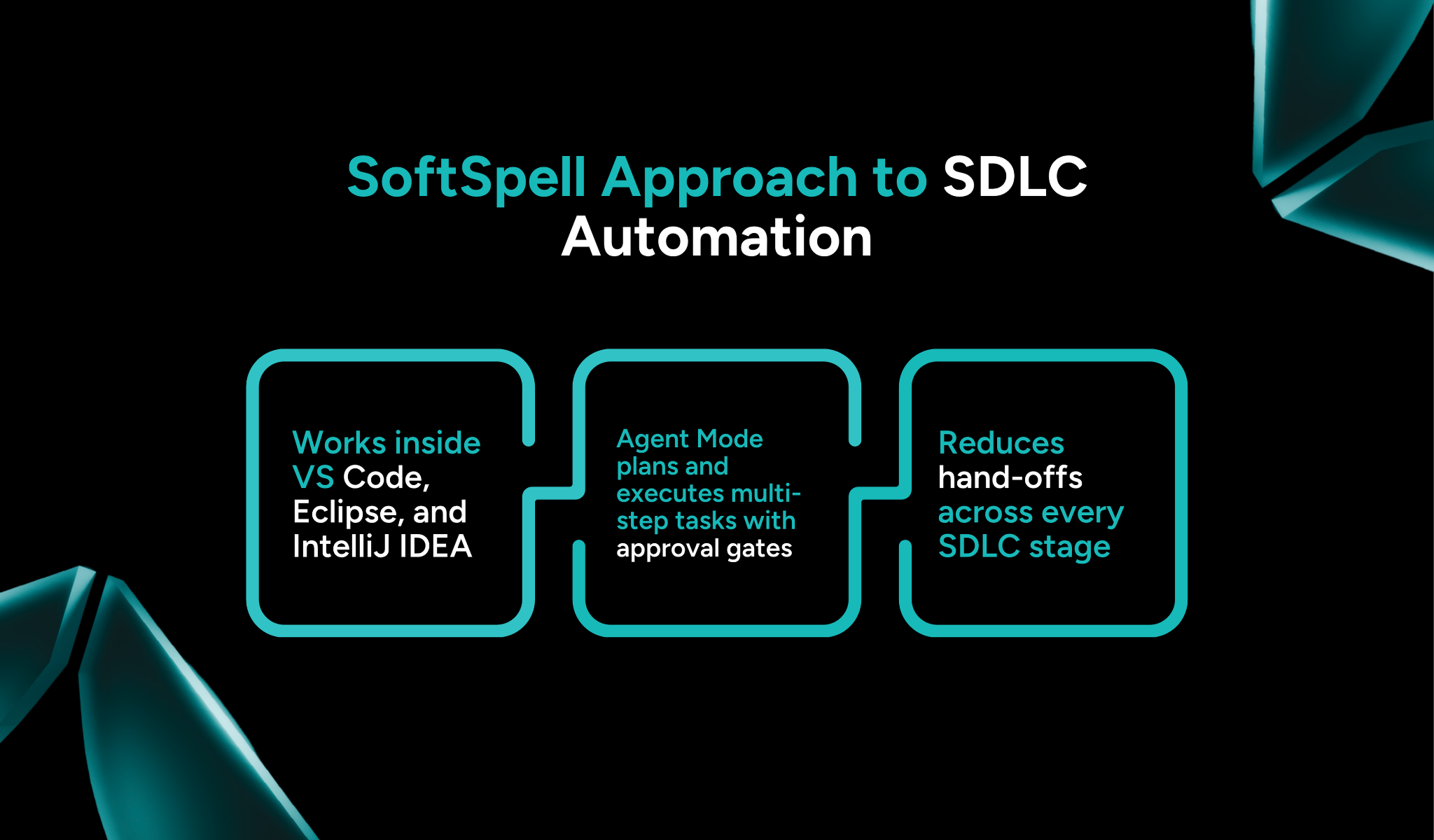
Software development life cycle process automation breaks down the moment requirements, code, and testing run as separate workflows, and that's exactly the gap SoftSpell closes.
ReqSpell extracts structured, traceable requirements from unstructured sources before development even starts. CodeSpell turns validated requirements into production-ready code and integrates directly with VS Code, Eclipse, and IntelliJ. TestSpell traces every test case back to its source requirement, catching coverage gaps before they become production defects.
Layered across all three: end-to-end traceability, role-based access, and SOC 2 Type 2–aligned governance, so speed never comes at the cost of security or visibility.
No point solution can replicate that, which is why SoftSpell isn't just another AI coding assistant but the most complete answer to optimizing the SDLC end-to-end.
Don't let fragmented tools slow your next release. Book a Demo today and see SoftSpell transform your SDLC end-to-end.




July 1, 2026
Don’t Miss Out
We share cool stuff about coding, AI, and making dev life easier.
Hop on the list - we’ll keep it chill.

© 2026, SoftSpell. All Rights Reserved


