6 Reasons SoftSpell Tops All AI Coding Assistant Tools

AI Code

June 29, 2026

TL;DR

Most AI coding assistant tools generate code but leave testing, traceability, and deployment to other systems. SoftSpell connects requirements, development, QA, and DevOps into a single AI-powered SDLC platform, helping engineering teams deliver software faster with greater visibility and control.

Your team uses GitHub Copilot or Cursor. Code gets written faster, but releases are still delayed, rework increases, and QA backlogs persist. Sound familiar?

AI autocomplete solves one sentence of a 500-page story. It doesn't address ambiguous requirements, validate logic, or close the testing gap that delays deployments.

The obstacle isn't your code editor; it's everything before and after code is written.

SoftSpell is built for the entire story: a full SDLC intelligence platform that connects requirements, development, and testing into a single, orchestrated suite.

Here are six evidence-backed reasons why SoftSpell leads where other AI coding assistant tools stop.

What are the 6 Reasons SoftSpell Tops All AI Coding Assistant Tools?

The 6 reasons SoftSpell tops all AI coding assistant tools are the following:
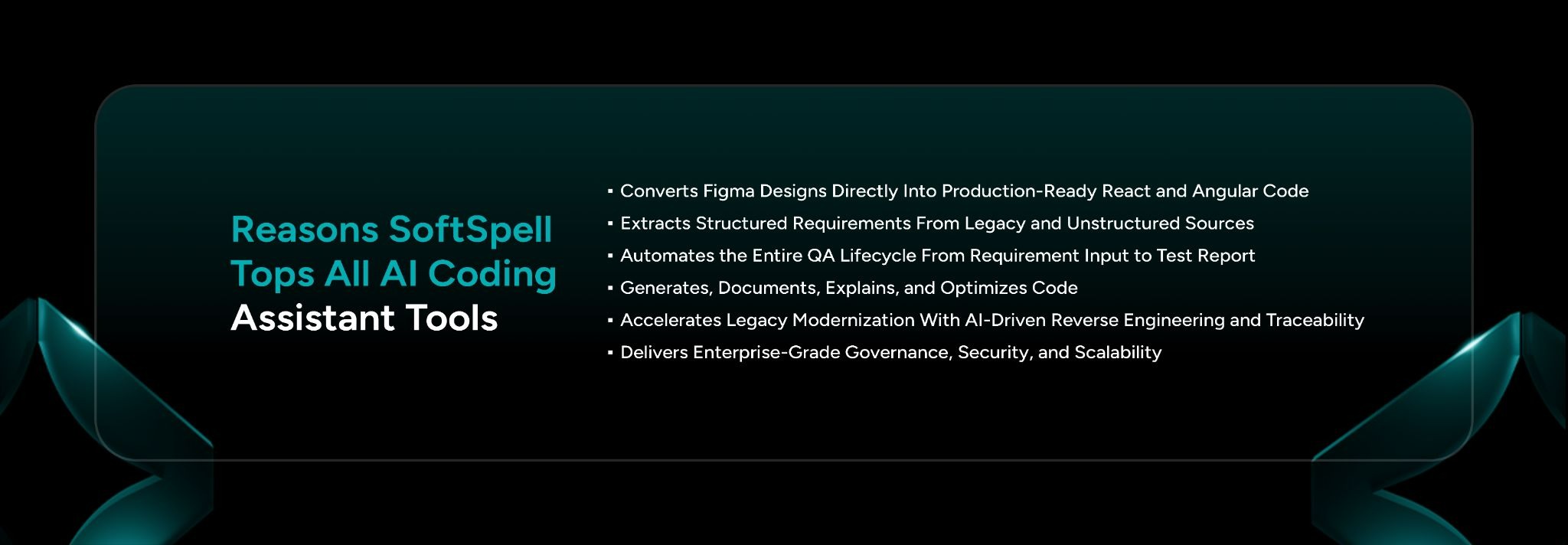
  • Converts Figma Designs Directly Into Production-Ready React and Angular Code
  • Extracts Structured Requirements From Legacy Documents and Unstructured Inputs
  • Automates the Entire QA Lifecycle From Requirement Input to Test Report
  • Generates, Documents, Explains, and Optimizes Code
  • Accelerates Legacy Modernization With AI-Driven Reverse Engineering and Traceability
  • Delivers Enterprise-Grade Governance, Security, and Scalability Across the Full SDLC
Reasons SoftSpell Tops All AI Coding Assistant Tools

Reason 1: SoftSpell Converts Figma Designs Directly Into Production-Ready React and Angular Code

Every frontend team knows the pain: designers hand off Figma frames, developers interpret them manually, and inconsistencies pile up before a single line of logic is written. SoftSpell's Design Studio eliminates that translation layer entirely.

  • Generates React or Angular components directly from Figma frames, no handoff interpretation
  • Real-time collaborative design review before code generation; changes reflect instantly
  • Differential regeneration: only updated components are rebuilt, not the entire frontend
  • Pre-built CRUD and validation templates, production-safe, not improvised.

Reason 2: SoftSpell Extracts Structured Requirements From Legacy Documents, Codebases, and Unstructured Inputs

No AI coding assistant on the market has a requirements layer. GitHub Copilot and Cursor start at the code editor; ReqSpell starts where engineering problems actually begin: ambiguous inputs, undocumented systems, and scattered product specs.

A large US retailer reduced manual documentation effort by up to 70% using ReqSpell for Oracle Forms reverse engineering. (refer to case study)

  • Converts PDFs, emails, spreadsheets, and release notes into structured, actionable specifications
  • Reverse engineers legacy codebases,  surfaces modules, dependencies, and functional scope
  • Traces requirements to test plans, highlighting untested paths before QA begins
  • Cross-team natural language querying, product, engineering, and QA work from one shared requirement layer

Reason 3: SoftSpell Automates the Entire QA Lifecycle From Requirement Input to Test Report

TestSpell doesn't just generate test scripts; it closes the requirement-to-release loop. QA teams using disconnected tools spend weeks writing scripts from scratch. TestSpell generates test cases directly from requirements or Jira tickets, covering UI, API, and mobile in one unified execution flow.

  • Test cases auto-generated from requirements, or Jira inputs, are requirement-driven, not assumption-driven
  • UI, API, and mobile testing in one flow with parallel execution
  • Every test is traced back to its originating requirement, and coverage gaps are visible before release.
  • Release-readiness signals for engineering leads, not raw, uninterpreted logs

Reason 4: CodeSpell Generates, Documents, Explains, and Optimizes Code — Not Just Autocompletes It

GitHub Copilot suggests the next line.SoftSpell's Code module manages the full development workflow through six purpose-built, named capabilities. This makes it fundamentally different from any single-function AI coding assistant too.l.

  • Code Generation — automates foundational structures so developers focus on logic, not scaffolding.
  • Code Documentation — generates comprehensive docs automatically, keeping codebases maintainable.
  • Code Explanation — decodes complex or legacy logic instantly, eliminating trial-and-error debugging
  • Code Optimization — proactively flags inefficiencies and refactors for performance and readability
  • Code Suggestion — real-time, context-aware completions for cleaner, more consistent code
  • Unit Testing — auto-generates accurate unit tests before code reaches QA

Reason 5: SoftSpell Accelerates Legacy Modernization With AI-Driven Reverse Engineering and Traceability

"Modernize Legacy Systems Faster with AI" is SoftSpell's primary positioning, and it's a capability no other AI coding assistant has ever addressed.

A leading US airline used ReqSpell to automate reverse engineering across complex operational systems, improving traceability across critical enterprise applications.

  • Reverse engineers legacy codebases to identify modules, dependencies, and functional scope, without manual documentation
  • Surfaces tribal knowledge trapped in undocumented systems and makes it traceable
  • Provides a structured requirement baseline to modernize legacy code with CodeSpell’s AI-powered SDLC automation
  • The full chain — legacy code → extracted requirements → new code → validated tests — runs inside one platform.

Reason 6: SoftSpell Delivers Enterprise-Grade Governance, Security, and Scalability Across the Full SDLC

Standalone AI coding tools are built for individual developers. SoftSpell Enterprise is architected for engineering organizations with four named pillars that tools like Copilot, Cursor, or Tabnine simply don't offer.

  • End-to-End Automation — every SDLC stage from requirements to release covered with AI
  • Enterprise-Grade Security — role-based access, private deployments, and data governance built in
  • Scalable Performance — handles large teams and complex enterprise workloads natively.
  • Seamless Integration — connects with Figma, Jira, GitHub, Jenkins, and existing CI/CD pipelines.
  • Trusted by engineering teams at GoCoconut, Synergita, and Aspire

A Closer Look at SoftSpell's Three Core Product Modules

SoftSpell isn't a single tool with a broad feature list; it's three purpose-built modules, each engineered to eliminate a specific, documented bottleneck across the SDLC. Here's what each one does.
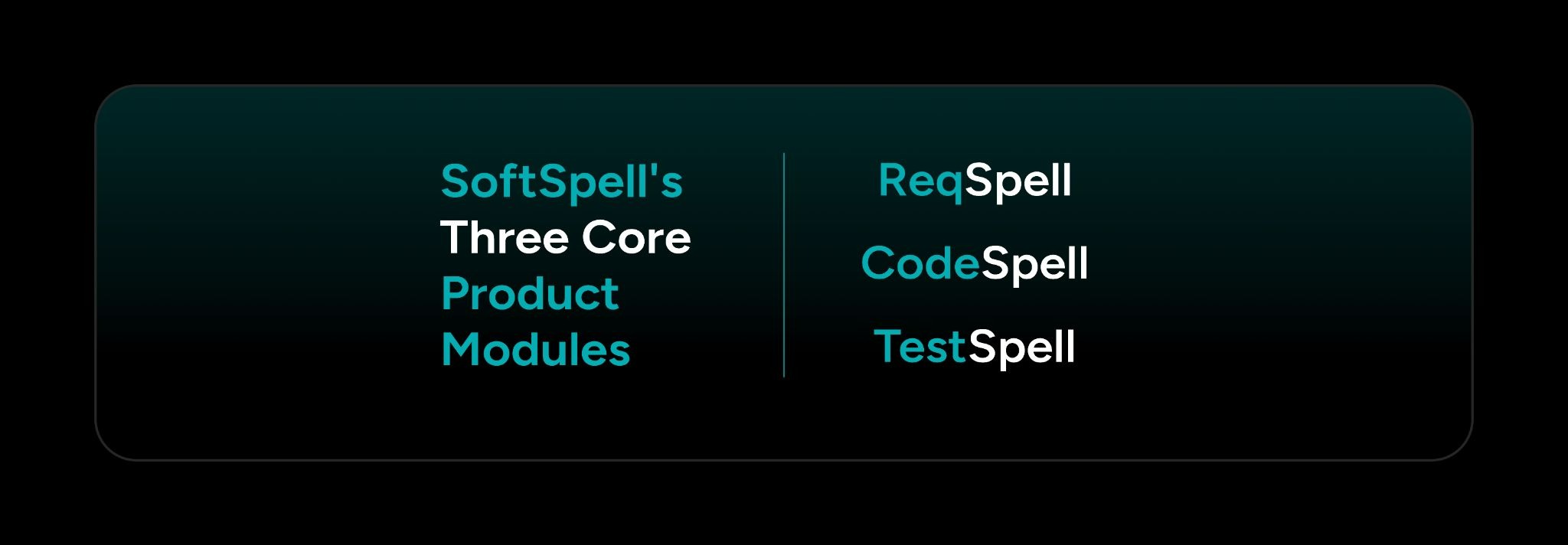
SoftSpell's Three Core Product Modules

ReqSpell — From Requirement Chaos to Structured Development Blueprints

Most engineering delays don't start in the code editor; they start with ambiguous, scattered, or undocumented requirements. ReqSpell transforms unstructured inputs (PDFs, emails, legacy documents, and spreadsheets) into structured, traceable specifications that engineering and QA teams can actually build from.

  • Requirement Grooming — extracts and organizes business needs from any document format into actionable development specs
  • Reverse Engineering — analyzes legacy codebases to surface modules, dependencies, and functional scope without manual documentation effort.
  • Test Coverage Validation — traces requirements directly to test plans and flags untested paths before QA begins, not after a release fails
  • Cross-Team Alignment — product, engineering, and QA query the same requirement layer using natural language, eliminating tool-switching and miscommunication

Also read: Enterprise Requirement Management Software. 

CodeSpell — AI Coding Assistance, Figma-to-Code, and Design Studio in Your IDE

SoftSpell's Code module is where design meets development. Rather than suggesting the next line of code, the Code module manages the full development workflow, from Figma frames to production-ready React or Angular components, without leaving your IDE.

  • Six Core Capabilities — code generation, documentation, explanation, optimization, suggestion, and unit testing, each addressing a distinct developer workflow gap
  • Design Studio — converts Figma frames into React or Angular components with collaborative design review and differential regeneration for iterative updates.
  • FastTrack API — generates structured APIs tied directly to project architecture, not generic boilerplate.
  • Native IDE Plugins — available for VS Code and JetBrains, integrating directly into the tools your engineering team already uses daily

TestSpell — Automated Test Lifecycle From Requirement to Release Report

TestSpell doesn't generate isolated test scripts; it runs the complete QA lifecycle from requirement input through parallel execution to release-ready reporting. QA teams stop writing from scratch and start shipping with confidence.

  • Requirement-Driven Test Generation — auto-generates test cases from requirements or Jira tickets, eliminating manual test authoring entirely.
  • Unified Testing Flow — covers UI, API, and mobile testing in one execution environment with parallel execution for faster cycle completion.
  • Full Requirement Traceability — every test is mapped back to its originating requirement, making coverage gaps measurable before release, not discovered after deployment
  • Structured Release Reporting — delivers clear test reports with release-readiness signals built for product owners and engineering leads, not raw logs.

Closing Thoughts

Most AI coding assistant tools hand developers a faster typewriter. SoftSpell hands engineering teams a fully orchestrated SDLC. This includes requirements that are structured before development starts, code is generated, documented, and optimized in your IDE, and QA runs from requirements input to the release report without manual intervention.

No rework from ambiguous specs. No QA backlogs from untested paths. No handoff friction between design, development, and testing.

That's SoftSpell's USP, and no standalone AI coding assistant on the market delivers it.

Stop patching your SDLC with disconnected tools. See how SoftSpell connects requirements, code, and testing into a single intelligent platform.

Book Your Demo.

Table of Contents

    FAQs

    1. What makes SoftSpell different from other AI coding assistant tools?
    SoftSpell integrates requirements, code, testing, and DevOps into one intelligent SDLC platform, unlike tools that only generate code
    2. Can SoftSpell reduce manual testing and QA effort?
    Yes. TestSpell automates test creation, execution, and reporting, cutting down QA time while improving coverage and accuracy.
    3. Does SoftSpell work with existing development workflows and IDEs?
    Absolutely. SoftSpell integrates seamlessly with Jira, GitHub, VS Code, JetBrains, and standard CI/CD pipelines.
    4. Is SoftSpell suitable for large enterprise teams?
    Yes. It offers enterprise-grade security, role-based access, and workflow governance, making it ideal for large-scale engineering operations.
    5. How does SoftSpell accelerate software delivery?
    By automating repetitive tasks across requirements, coding, testing, and DevOps, SoftSpell reduces rework, speeds releases, and ensures traceable workflows.
    Blog Author Image
    Gautham

    AI-Native Product Strategist

    LinkedInBlog Social IconBlog Social IconBlog Share Link

    Don’t Miss Out
    We share cool stuff about coding, AI, and making dev life easier.
    Hop on the list - we’ll keep it chill.