Scaling SaaS at Enterprise Speed with AI-Driven SDLC & SoftSpell

Enterprise

September 18, 2025

Scaling software in enterprise SaaS is harder than it looks. Teams face delays, rework, and misaligned workflows across requirements, development, and testing.

Even with Agile, CI/CD, and DevOps, delivery speed often hits invisible walls. A significant portion of engineering effort is lost to requirements gaps and handoff issues, with PMI research showing that rework can account for 30–40% of total project effort in software delivery.

AI-driven SDLC platforms like SoftSpell help teams integrate requirements, code, testing, and release into a single continuous workflow. 

This article shows how enterprises can use AI to scale delivery, reduce errors, and achieve faster, predictable software releases.

The Hidden Bottleneck Slowing SaaS Velocity

Most SaaS teams don’t lose momentum because of weak engineering. They lose it at the first step of the SDLC.

Here’s the traditional pattern:

  • Designers produce visually polished Figma prototypes.
  • Engineers spend weeks translating those designs into production-ready code.
  • Manual handoffs introduce errors, delays, and alignment gaps.

As products scale, this gap widens. Delivery timelines slip, cross-functional collaboration breaks down, and product quality suffers.

The problem is not a lack of talent or resources - it’s a design-to-code friction point that becomes a velocity killer.
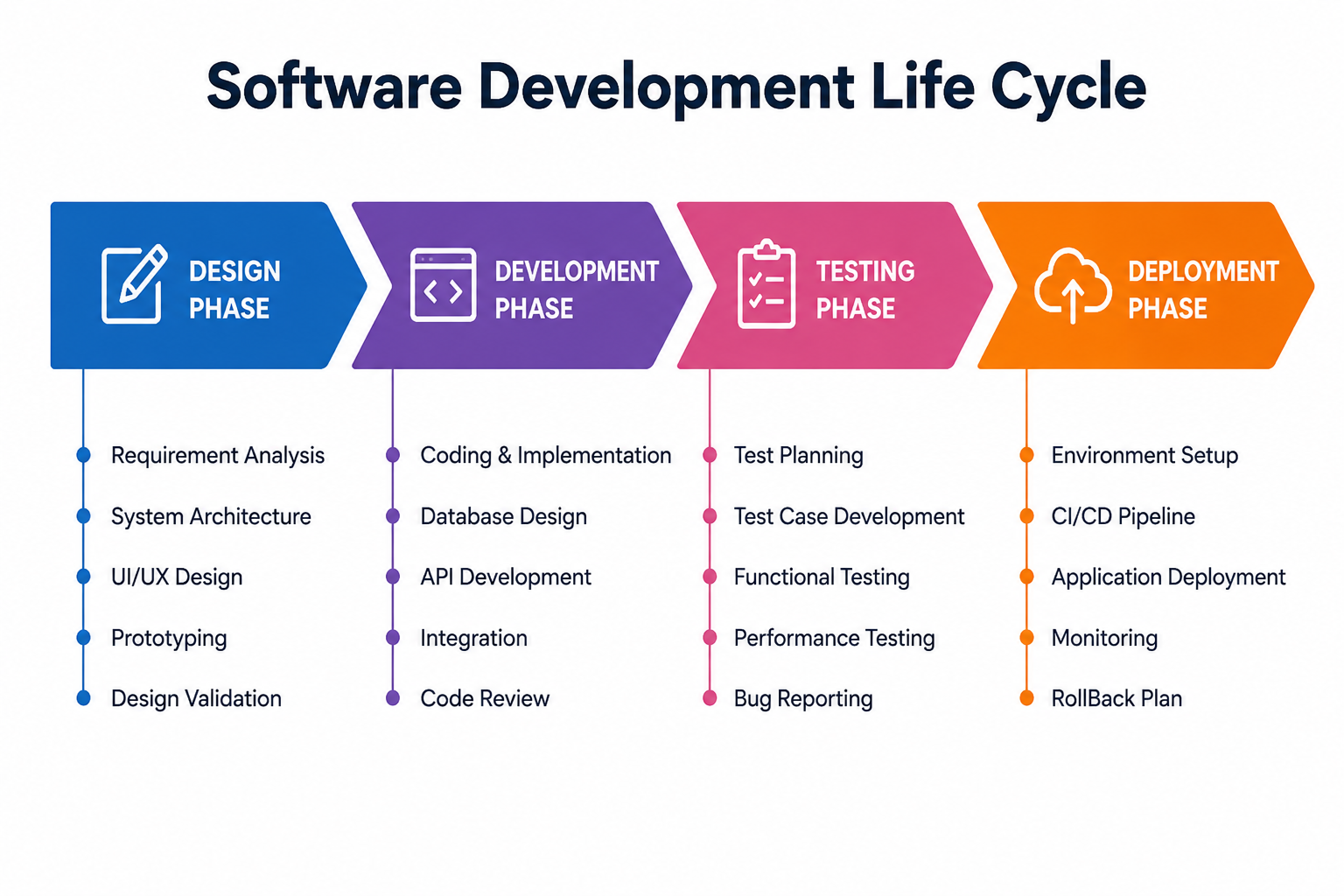
Why Traditional SDLC Slows Down SaaS Growth

The traditional SDLC follows a linear and siloed structure where each stage depends on the completion of the previous one. While this brings order, it also creates delays, weak feedback loops, and slow iteration speed. In high-growth SaaS environments, this model struggles to support continuous delivery and fast release cycles.

Design Phase: Static Prototypes Slow Down Flow

UX and UI teams create static designs that often lack real-time technical validation. These designs move forward without considering implementation constraints early.

Development Phase: Manual Code Conversion

Engineers manually translate designs into working code. This step is time-consuming and often introduces interpretation gaps between design and implementation.

Testing Phase: Late Quality Validation

QA teams begin testing only after development is complete. This delays defect detection and increases the cost of fixing issues.

Deployment Phase: Final Stage Bottlenecks

DevOps teams configure pipelines and deploy code at the end of the cycle. Any upstream issue can delay release, making deployment a high-risk stage.

Each stage acts as a handoff rather than a continuous flow, creating bottlenecks that compound over time. In high-growth SaaS environments, this model cannot sustain the pace.

Comparative Snapshot: Traditional SDLC vs. SoftSpell-Powered SDLC

Capability Traditional SDLC With SoftSpell.ai
Requirement Capture Manual user stories AI-structured via ReqSpell
Design-to-Code Transition Manual handoffs and delays Automated Figma-to-Code conversion
Development Speed Limited by manual coding AI-driven code generation and reviews
Testing Post-development phase Embedded, auto-generated via TestSpell during development
CI/CD Deployment Manual pipeline setup Fully integrated and automated

This transformation is not just about speed - it’s about building a scalable, resilient, and innovation-ready software delivery engine.

How AI Is Rewriting the SDLC From the Start

AI has made inroads in coding assistance, automated testing, and DevOps orchestration - but the real breakthrough is starting automation at the design layer.

By automating design-to-code conversion and requirements capture, teams can accelerate the entire SDLC, turning a fragmented process into a continuous design-to-deploy flow.

Reqspell: AI-Powered Requirements Enabler

  • Converts raw business requirements or user stories into clear, structured, testable specifications.
  • Establishes scope clarity before design begins, minimizing late-stage rework.
  • Creates a shared understanding between business, product, design, and engineering.

Reqspell ensures that every design and every feature start with well-defined requirements, eliminating the ambiguity that often derails enterprise projects.

Figma-to-Code Acceleration

  • Converts complex Figma designs directly into clean, production-ready front-end and back-end scaffolding.
  • Eliminates weeks of manual setup and front-end assembly.
  • Ensures pixel-perfect UI implementation aligned with design intent.

This allows design teams to stay creative while giving engineering teams a running start with real code, not static mockups.

AI-Powered Development

  • Provides context-aware code suggestions, boilerplate generation, and standards enforcement.
  • Reduces cognitive load, enabling engineers to focus on core business logic and innovation.
  • Increases velocity without increasing headcount.

By embedding AI into daily development workflows, Codespell enables faster, safer iteration without technical debt accumulation.

Testspell: AI-Generated Feature Files and Testing

  • Automatically generates Gherkin-based BDD feature files directly from requirements.
  • Produces unit, integration, and edge-case tests alongside the code.
  • Ensures traceability from requirements → feature files → automated tests.
  • Cuts down the QA backlog, enabling continuous quality at scale.

Testspell shifts testing left in the lifecycle, making QA proactive rather than reactive.

Embedded Testing and CI/CD

  • Injects test scripts directly into pipelines as code is generated.
  • Integrates seamlessly with modern CI/CD pipelines like GitHub Actions, GitLab CI, and Jenkins.
  • Enables rapid, reliable deployments with lower defect rates.
  • Reduces post-release bugs and accelerates iteration cycles.

This closes the loop between build and deploy, creating an always-release-ready environment.

Introducing SoftSpell.ai- Redefining SDLC Velocity

SoftSpell.ai places AI where it creates the highest leverage: at the design stage.

Instead of waiting until the development stage to introduce automation, Codespell integrates AI from the very first design file.

Core Capabilities

  • Reqspell: Converts requirements into structured specifications.
  • Figma-to-Code Engine: Instantly converts design specs into functional code scaffolding.
  • AI Coding Assistant: Accelerates complex feature development with real-time suggestions, auto-complete logic, and error detection.
  • Testspell: Generates automated feature files and tests alongside development.
  • CI/CD Orchestration: Streamlines deployment pipelines to move clean code into production faster and with fewer errors.
Codespell core capabilities

Strategic Impact

By collapsing the gap between requirements, design, development, testing, and deployment, SoftSpell empowers SaaS teams to:

  • Accelerate product launches without compromising quality.
  • Maintain a cleaner codebase as projects scale.
  • Enhance cross-functional alignment across design, engineering, QA, and DevOps.
  • Increase release frequency without sacrificing stability.

Comparative Snapshot: Traditional SDLC vs. Codespell-Powered SDLC

Capability Traditional SDLC With Codespell.ai
Requirement Capture Manual user stories AI-structured via Reqspell
Design-to-Code Transition Manual handoffs and delays Automated Figma-to-Code conversion
Development Speed Limited by manual coding AI-driven code generation and reviews
Testing Post-development phase Embedded, auto-generated via Tespell during dev
CI/CD Deployment Manual pipeline setup Fully integrated and automated

This transformation is not just about speed - it’s about building a scalable, resilient, and innovation-ready software delivery engine.

Why This Matters for SaaS Decision-Makers

From an enterprise strategy standpoint, the adoption of AI-driven SDLC delivers:

  • Higher development throughput: Faster iteration cycles mean quicker market entry.
  • Lower operational overhead: Automation minimizes redundant tasks and reduces human error.
  • Improved product consistency: Design fidelity and coding standards are maintained end-to-end.
  • Stronger competitive edge: Early market entry often defines category leaders in SaaS.

These outcomes align directly with core business KPIs like time-to-market, engineering efficiency, release cadence, and customer satisfaction.

How SoftSpell.ai Fits into Modern SaaS Architectures

To maximize ROI from Codespell, SaaS enterprises can integrate it within their existing development ecosystem:

  • Design Layer: Figma and other design tools feed directly into Codespell’s Figma-to-Code engine.
  • Development Layer: AI-assisted coding merges seamlessly into IDEs and code repositories like GitHub and GitLab.
  • Testing Layer: Auto-generated test suites from Tespell are stored alongside source code, enabling continuous QA.
  • Deployment Layer: CI/CD pipelines (Jenkins, GitHub Actions, GitLab CI) pull tested code directly from Codespell outputs.

This modular yet unified approach ensures teams don’t need to overhaul their current toolchain - Codespell simply amplifies existing workflows.

Business Use Cases: Where SoftSpell Delivers Maximum Impact
  1. Rapid MVP Launches
    Early-stage SaaS teams can go from prototype to production in days, validating ideas faster and reducing capital burn. This reduces development cycles and helps teams validate ideas earlier with less rework.
  2. Large-Scale Product Refactors
    Enterprises undertaking system overhauls can accelerate front-end rebuilds while maintaining quality assurance through automated tests. Teams can refactor step by step without disrupting production stability.
  3. Continuous Feature Delivery
    Scaling SaaS platforms can deploy features at a higher frequency without destabilizing their production environments. Test coverage runs in parallel with development, reducing late-stage defects and delays.
  4. Regulated Industries
    Industries like fintech or healthtech can leverage Reqspell + Tespell to maintain compliance traceability from requirement to release. Every change stays documented, testable, and audit-ready across the lifecycle.
The Road Ahead 

The SDLC is evolving, not disappearing. With AI becoming part of everyday engineering workflows, teams are moving away from fragmented tools toward connected, continuous delivery systems powered by ai sdlc tools. The focus is shifting from managing phases to optimizing flow across the entire lifecycle.

What this shift looks like in practice:

  • Continuous SDLC flow instead of isolated phases
  • Faster decision-making with connected workflows
  • Reduced dependency on manual handoffs and coordination
  • Higher release confidence through built-in validation

SoftSpell is designed for this transition, helping teams align their SDLC around ai driven sdlc execution and scalable delivery.

If your team is rethinking how software is built and shipped, this is the right time to explore what a unified SDLC can unlock. Book a Demo with SoftSpell.

Book a demo

Table of Contents

    Frequently Asked Questions

    Q1. How does Codespell accelerate the design-to-development process?
    Codespell converts Figma designs into production-ready code scaffolding, eliminating manual handoffs and reducing setup time from weeks to hours.
    Q2. Can Codespell integrate with existing CI/CD workflows?
    Yes, Codespell seamlessly integrates with modern CI/CD pipelines, enabling automated deployments and faster release cycles.
    Q3. Does using AI for code generation impact code quality?
    No, Codespell enforces coding standards and best practices while generating code, ensuring maintainability and high-quality output.
    Q4. How does Codespell support large SaaS teams working at scale?
    By centralizing design, coding, testing, and deployment on one platform, Codespell reduces operational silos and improves cross-functional collaboration.
    Q5. What makes Codespell different from other AI coding tools?
    Unlike traditional AI tools that focus on isolated tasks, Codespell accelerates the entire SDLC from requirements to deployment, driving end-to-end velocity.
    Blog Author Image

    Market researcher at SoftSpell, uncovering insights at the intersection of product, users, and market trends. Sharing perspectives on research-driven strategy, SaaS growth, and what’s shaping the future of tech.

    Don’t Miss Out
    We share cool stuff about coding, AI, and making dev life easier.
    Hop on the list - we’ll keep it chill.