


Changelog
July 1, 2026
.svg)
.png)
Every few years, a major news cycle reminds the world that COBOL is still running critical infrastructure. During the COVID- 19 pandemic, unemployment systems built on COBOL collapsed under unprecedented load. Government agencies issued emergency calls for COBOL programmers who had been retired for a decade. The broader public got a brief window into something the enterprise technology world had quietly known for years: COBOL is not a legacy curiosity. It is the backbone of global financial infrastructure.
Estimates put COBOL code in production at somewhere between 220 and 800 billion lines. It runs 95 percent of ATM transactions and approximately 80 percent of in- person transactions worldwide. The systems that process payroll, insurance claims, pension payments, tax collection, and core banking operations in most large economies are running on COBOL programs that in many cases predate the engineers currently maintaining them.
This is not, by itself, a crisis. Stable systems that do what they are supposed to do are assets, not liabilities - as long as someone can maintain them. The crisis is that the engineers who can maintain them are leaving, and the window for a managed, knowledge- preserving modernization is narrowing with every retirement.
In 2026, for the first time, AI- assisted tooling makes COBOL modernization tractable at enterprise scale. This guide explains how.
Organizations have been attempting COBOL modernization for 30 years. Many have failed. The reasons are consistent.
The undocumented business logic problem
COBOL programs written in the 1970s, 1980s, and 1990s were not written with future maintainers in mind. Variable names are cryptic. Logic is procedural and deeply nested. Comments are sparse or absent. And the business rules embedded in those programs - the calculation logic for pension benefits, the eligibility criteria for insurance claims, the fee structures for banking products - have been modified hundreds of times over decades without the changes being documented anywhere except in the code itself.
When a modernization team tries to replace a COBOL system without fully understanding what it does, they build a replacement that doesn't correctly replicate the original system's behavior. The gaps surface in testing or in production, often in high- stakes financial transactions where errors are expensive and visible.
The COBOL expertise gap
Reading and reasoning about COBOL requires specialized knowledge that is becoming genuinely scarce. The average age of COBOL programmers is in the mid- 50s to early 60s. Universities stopped teaching COBOL decades ago. Organizations that relied on internal COBOL expertise for maintenance are finding that expertise is leaving with the engineers who possess it.
This creates a compounding problem: the longer you wait to modernize, the less institutional knowledge is available to support the migration.
The scale problem
Large COBOL environments are not hundreds of programs. They are hundreds of thousands of programs. A major bank or insurance company may have millions of lines of COBOL across thousands of batch jobs, CICS transactions, and JCL workflows. The sheer volume of code makes manual migration economically impossible for most organizations.
The risk problem
COBOL systems often run the most critical, highest- volume operations in an enterprise. A failure in a COBOL- based core banking system is not a minor incident - it is a front- page event. The consequence of getting modernization wrong is severe enough that many organizations have repeatedly decided to do nothing rather than accept the migration risk.
Two things have materially changed the COBOL modernization equation.
AI- assisted business logic extraction
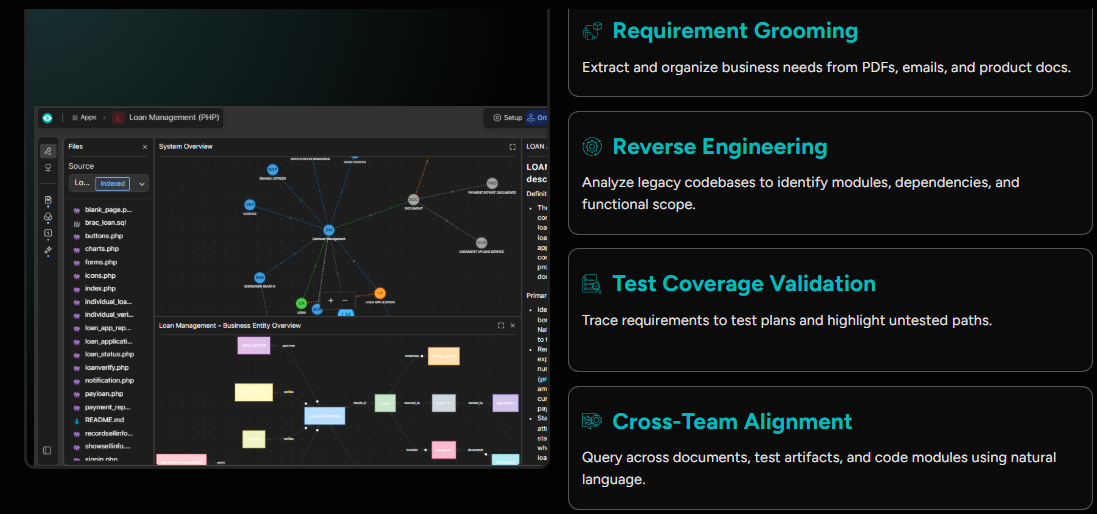
The hardest part of COBOL modernization - understanding what the code actually does - is now automatable. ReqSpell analyzes COBOL programs directly and extracts structured, human- readable business requirements. Calculation rules, eligibility logic, exception handling, data transformation patterns - all of it is converted from cryptic COBOL into documented, queryable requirement specifications that engineering teams and business stakeholders can review and validate.
This collapses the requirements archaeology phase from months or years of specialist analyst time to weeks of AI- assisted extraction. And because the extraction is systematic - processing every line of every program rather than sampling - it catches the edge cases and rarely- executed code paths that manual review misses. Those paths are where post- migration defects come from.
AI- assisted code transformation
Once business logic is extracted and documented, CodeSpell handles the mechanical translation from COBOL to modern languages - Java, Python, or cloud- native equivalents. CodeSpell does not perform naive line- by- line translation, which produces unmaintainable code that inherits COBOL's procedural patterns in a language not designed for them. Instead, it generates modern code from the structured requirements that ReqSpell produced - writing Java or Python the way a modern engineer would write it, implementing the same business logic in maintainable, testable code.
The result is genuinely modern code, not COBOL in disguise.
Approach 1: Full re- platform to cloud- native
The most comprehensive approach - replacing COBOL programs with modern- language equivalents running on cloud- native infrastructure. This approach delivers the most value: modern development practices, cloud economics, and code that engineers can understand and maintain without COBOL expertise.
It is also the highest- effort approach. For large COBOL environments, a full re- platform is a multi- year program. AI tooling (ReqSpell for extraction, CodeSpell for transformation) makes it feasible where it previously was not, but it requires sustained program investment.
Best for: Organizations where the COBOL expertise is close to leaving, where the business logic complexity is high, and where the modernization has executive commitment and multi- year budget.
Approach 2: Selective re- platform with strangler fig
Rather than replacing the entire COBOL environment at once, this approach identifies the highest- value or highest- risk components for modernization and replaces them incrementally while the rest of the COBOL system continues to operate.
New capabilities are built in modern languages. High- risk COBOL programs are replaced one at a time. The legacy COBOL system gradually "strangles" as its functions are replaced by modern equivalents. At some point - years into the program - the COBOL system is handling a small enough subset of operations that it can be decommissioned.
Best for: Large COBOL environments where a full replacement is not feasible in a single program, but specific high- risk or high- value components can be prioritized.
Approach 3: Rehost and wrap
The fastest approach - move the COBOL environment to a cloud- compatible mainframe runtime (such as AWS Mainframe Modernization or Google Cloud's mainframe migration services) without changing the COBOL code itself. Expose COBOL functionality via APIs that modern applications can consume.
This approach captures cloud infrastructure economics and integrates the COBOL system into a modern application ecosystem without the risk and duration of code transformation.
Best for: Organizations that need cloud benefits quickly and where the COBOL code is stable, well- tested, and not an active development bottleneck. This is often a first step toward a longer- term re- platform program.
Approach 4: Encapsulate and retire incrementally
Similar to the strangler fig, but more explicitly decommission- focused. COBOL programs are wrapped with APIs that modern systems consume. As modern replacements are built for each business function, the API- wrapped COBOL program is retired. The COBOL environment shrinks over time as modern replacements take over each function.
Best for: Organizations with a clear long- term target state but no immediate deadline for full decommissioning. Allows incremental value delivery without a forced cutover.
Step 1: COBOL inventory and dependency mapping
Before any migration work begins, produce a complete inventory of your COBOL environment. Every program, every JCL job, every CICS transaction, every copybook, every called subprogram. Map the dependencies between programs and to the data stores - VSAM files, DB2 tables, IMS databases - they read and write.
ReqSpell handles this automatically, analyzing the COBOL source library and producing a structured dependency map. What your team thought was 500 programs may turn out to be 1,200. Better to know that in planning than in execution.
Step 2: Business logic extraction
This is the phase that makes or breaks COBOL modernization. ReqSpell ingests COBOL programs and extracts:
The output is a structured requirements specification in human- readable form. Business stakeholders - the actuaries, the loan officers, the compliance teams - can review and validate the extracted logic without reading a line of COBOL. This is critical: business validation of extracted requirements is what separates a migration that works from one that produces financial calculation errors in production.
Step 3: Requirements validation with business stakeholders
Schedule structured review sessions with the business owners of each COBOL system. Walk through the extracted requirements and validate that the logic is correct. Pay particular attention to:
Every requirement that is clarified or corrected in this phase is a production defect that won't exist in the new system.
Step 4: Code transformation with CodeSpell
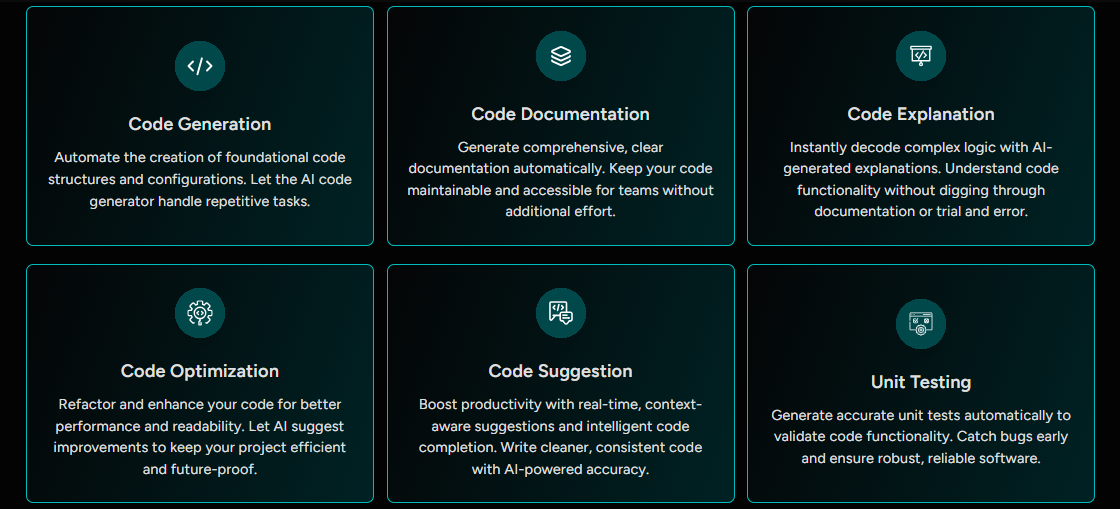
With validated requirements in hand, CodeSpell generates modern- language implementations. The generated code is:
Engineering teams review CodeSpell's output, apply architectural judgment, and guide the generation toward the right patterns for the target architecture. The mechanical translation work is handled by the platform. The judgment work - architecture decisions, edge case handling, integration design - is handled by the team.
Step 5: Test coverage with TestSpell
COBOL systems typically have no automated test coverage. Replacing a COBOL system without comprehensive test coverage is high- risk: you have no way to validate that the new system replicates the original system's behavior under all the conditions it will encounter in production.
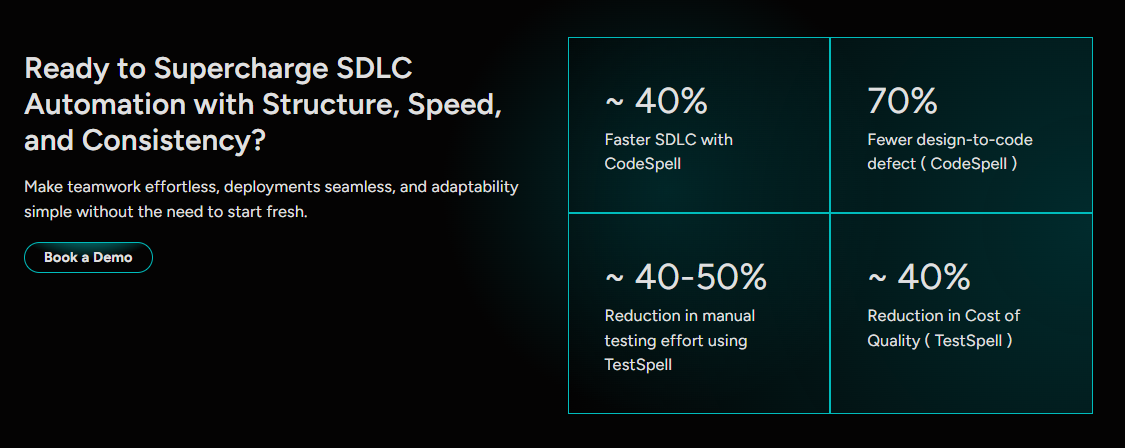
TestSpell generates test cases from the requirements that ReqSpell extracted. Coverage maps to business rules - every calculation rule has a test case, every eligibility condition has positive and negative test cases, every exception path is tested. This is requirement- linked coverage, not just code path coverage, which means the test suite reflects actual business intent rather than what developers thought to test.
For financial systems where calculation correctness is not optional, this test coverage is what gives the organization confidence to cut over.
Step 6: Parallel validation
Before cutover, run the new system in parallel with the COBOL system on a representative set of transactions. Compare outputs. The new system should produce identical results for identical inputs. Differences are defects - investigate and resolve each one before cutover.
Parallel validation is the definitive test of whether the migration preserved the original system's business logic. For high- stakes financial systems, it is not optional.
Step 7: Phased cutover
Migrate transaction volumes to the new system in phases. Start with lower- volume, lower- criticality transaction types. Validate stability before adding volume. Progress to higher- volume and higher- criticality transactions as confidence builds.
Define explicit rollback criteria for each cutover phase. Know in advance what conditions will trigger a rollback and how long rollback takes. Test the rollback procedure before go-live.
One dimension of COBOL modernization that doesn't get enough attention in technical discussions is the talent dimension. COBOL expertise is leaving the workforce whether you modernize or not. The question is not whether you will eventually need to migrate - it is whether you migrate in a planned, knowledge- preserving way or in a crisis when the last COBOL expert retires.
The window for a managed migration - where the engineers who understand the system are still available to validate the extracted requirements and review the generated code - is closing. Every year of delay narrows it further.
ReqSpell's business logic extraction is the mechanism for capturing that knowledge before it leaves. The output is a durable, queryable requirements repository that preserves the institutional knowledge of COBOL systems in a form that modern engineers can understand and work with.
Running a COBOL environment and thinking about what comes next?
Book a Demo - SoftSpell's platform handles the full COBOL modernization lifecycle: ReqSpell for business logic extraction, CodeSpell for COBOL- to- modern transformation, and TestSpell for coverage rebuild. We will run a live demonstration on a representative sample of your COBOL code and show you what your modernization timeline realistically looks like.



July 1, 2026
Don’t Miss Out
We share cool stuff about coding, AI, and making dev life easier.
Hop on the list - we’ll keep it chill.

© 2026, SoftSpell. All Rights Reserved


