The QA Stack for Enterprise Teams: Top 9 AI Software Testing Tools

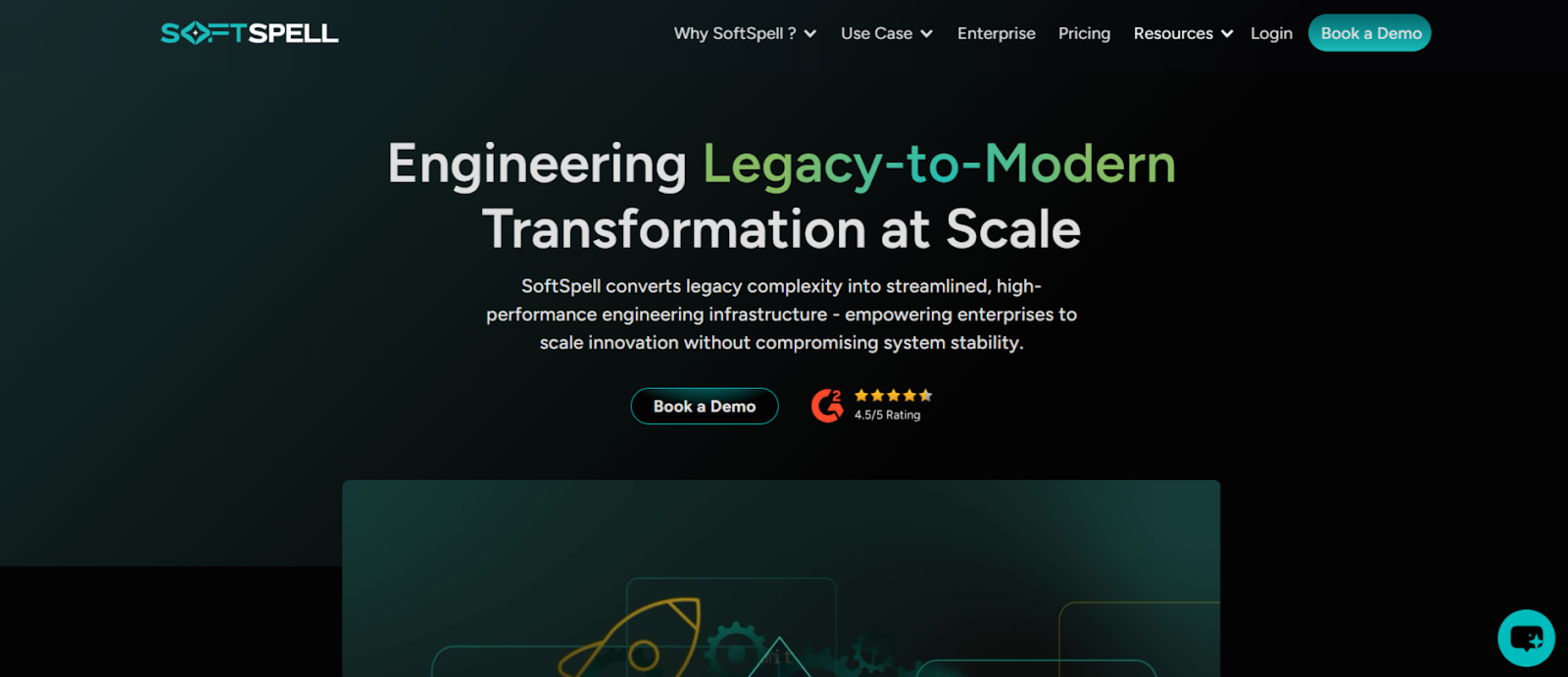
TestSpell

March 19, 2026

TL;DR

The top 9 AI testing tools for enterprises are TestSpell from SoftSpell, TestMu AI, BrowserStack, Leapwork, ACCELQ, Mabl, TestGrid, Applitools, and Functionize.

Are you still relying on manual testing when speed and accuracy matter more than ever? 

AI software testing tools are changing the way teams work. They handle repetitive tasks, improve accuracy, and reduce delivery time. As a result, your team can focus on more important work and move faster with confidence.

In fact, the best AI tools for software testing improve test reliability by 33% and reduce defects by 29% percent. Think about how much faster your testing could move with the right tools in place.

In this blog, we share the top 9 AI software testing tools like TestSpell. This will help you choose the right one for your team and speed up your testing process.
9 Essential AI Software Testing Tools for Smarter QA

S.No AI Tools for QA Testing Best Feature Who It's For
1 TestSpell Requirement-driven test generation Enterprises needing end-to-end AI-powered automation
2 TestMu AI Multi-modal, persona-based AI agents Teams needing scalable cloud test execution
3 BrowserStack One-line WCAG accessibility integration Teams automating accessibility in CI/CD
4 Leapwork No-code visual engine + AI modules Enterprises on multi-platform applications
5 ACCELQ Unified multi-channel codeless platform Teams needing no-code enterprise automation
6 Mabl Agentic AI test maintenance & feedback QA teams eliminating testing bottlenecks
7 TestGrid CoTester AI for autonomous execution Teams needing flexible test infrastructure
8 Applitools Proprietary Visual AI (4B+ screens trained) Teams validating UI quality and compliance
9 Functionize Self-healing agents with 99.97% accuracy Enterprises scaling with minimal human input

1. TestSpell from SoftSpell

 SoftSpell accelerating SDLC by about 40 percent while reducing defects by 70 percent through AI-driven development automation.

TestSpell from SoftSpell is one of the best AI software testing tools. This AI-powered test automation platform supports the full test lifecycle. It covers everything from requirement intake to final reporting. It creates test cases directly from requirements or JIRA inputs, so QA engineers spend less time on manual writing. 

It runs UI, API, and mobile tests in one flow. This keeps quality in sync with development speed in every sprint.

Key Features

  • Requirement Driven Test Generation: SoftSpell reads requirements and JIRA inputs. It creates relevant test cases early, even before you write code. This reduces the gap between specification and test coverage.
  • Parallel Multi-Channel Test Execution: UI, API, and mobile tests run at the same time in one flow. This cuts test cycle time and gives faster feedback without using many tools.
  • SDLC Integrated Modular Test Organization: You can organize tests by modules, sprints, or full suites. These tests connect directly to your development pipeline.

Who is it for?

Enterprises that want scalable, end-to-end AI-powered testing automation with faster delivery and fewer bugs.
https://www.softspell.ai/book-a-demo

Suggested Read: Evaluating AI Testing Platforms? Here’s How TestSpell Outperforms Traditional Automation Tools 
2. TestMu AI

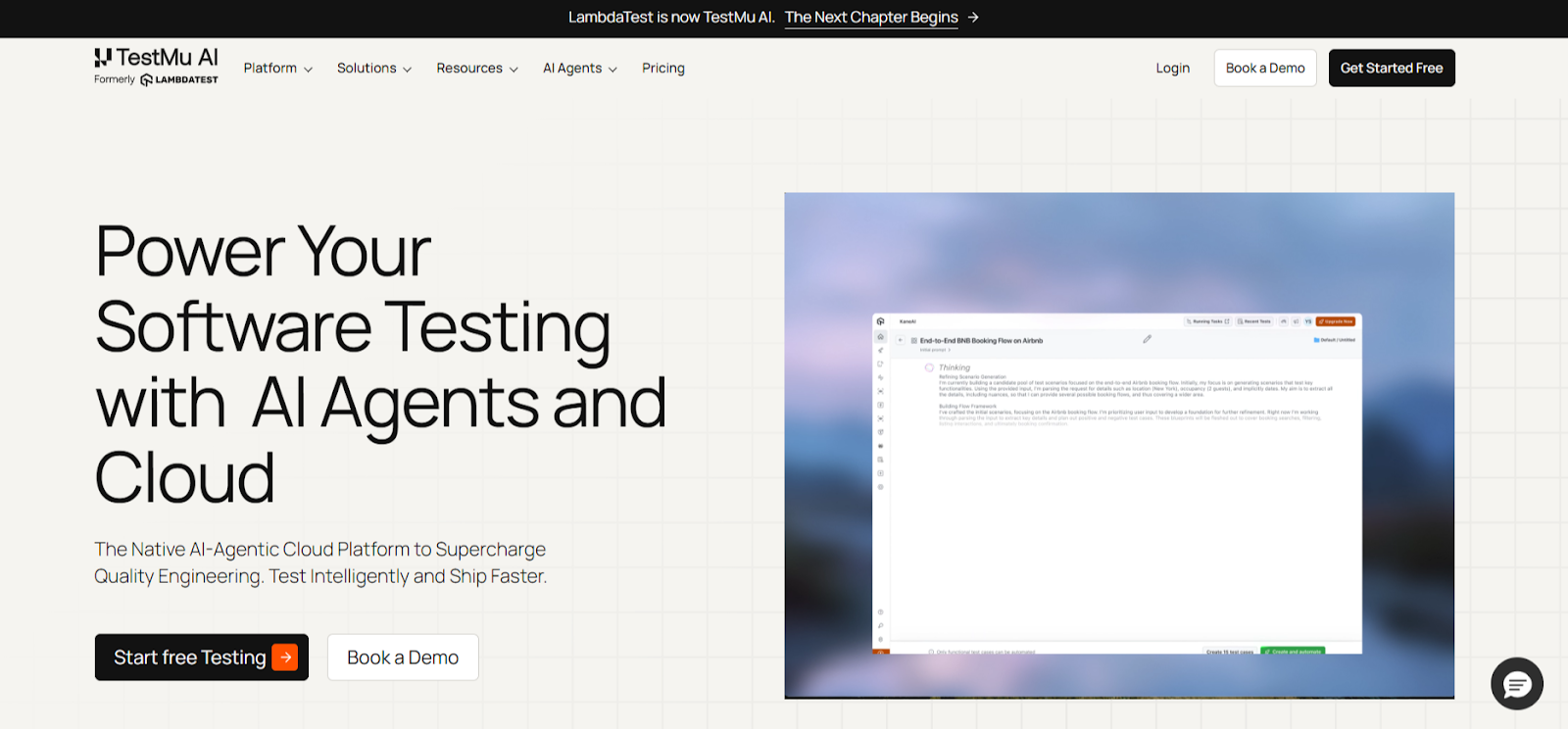
TestMu AI agents and cloud-powered testing helping teams run faster tests.

TestMu AI, earlier known as LambdaTest, now works as a full agent-driven cloud testing platform. It runs on its main agent, KaneAI. It accepts inputs like text, diffs, tickets, images, and documents. It plans, writes, and runs tests at scale. Over 2 million users trust it worldwide.

Key Features

  • Multi-Modal Persona-Based Testing: KaneAI processes different inputs and runs AI-generated tests from many user views. This suits complex enterprise setups.
  • AI Native Test Analytics: Built-in analytics show performance, risk scores, and trends. This helps teams make better decisions.
  • Unified Agent Test Cloud: A strong execution cloud supports any framework, language, browser, device, or API.

Who is it for?

Organizations that need a scalable and unified test cloud for complex environments.
3. BrowserStack

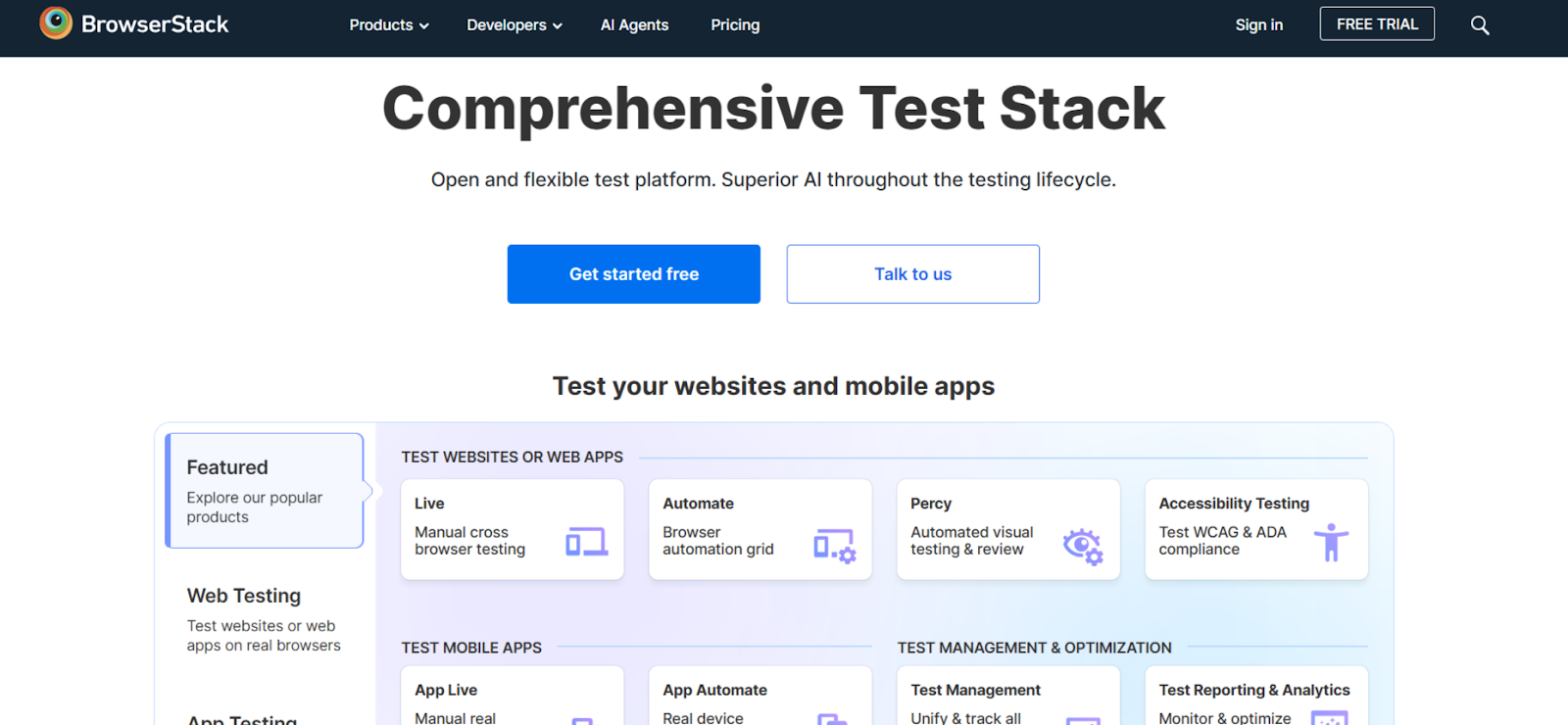
BrowserStack test platform helping teams run flexible testing workflows

BrowserStack focuses on accessibility testing automation. As one of the top artificial intelligence tools for software testing, it provides a simple way to achieve WCAG compliance within CI and CD workflows. Its SDK helps you add checks with one small code change.

Key Features

  • One Line Accessibility Integration: Install the SDK and enable checks easily. You do not need extra code or effort.
  • Screen Reader Automation in CI and CD: Teams can run screen reader simulations during test runs.
  • Centralized Compliance Reporting: All reports appear in one dashboard with easy issue tracking and Jira logging.

Who is it for?

Teams that want to add accessibility testing to CI and CD with ease.
4. Leapwork

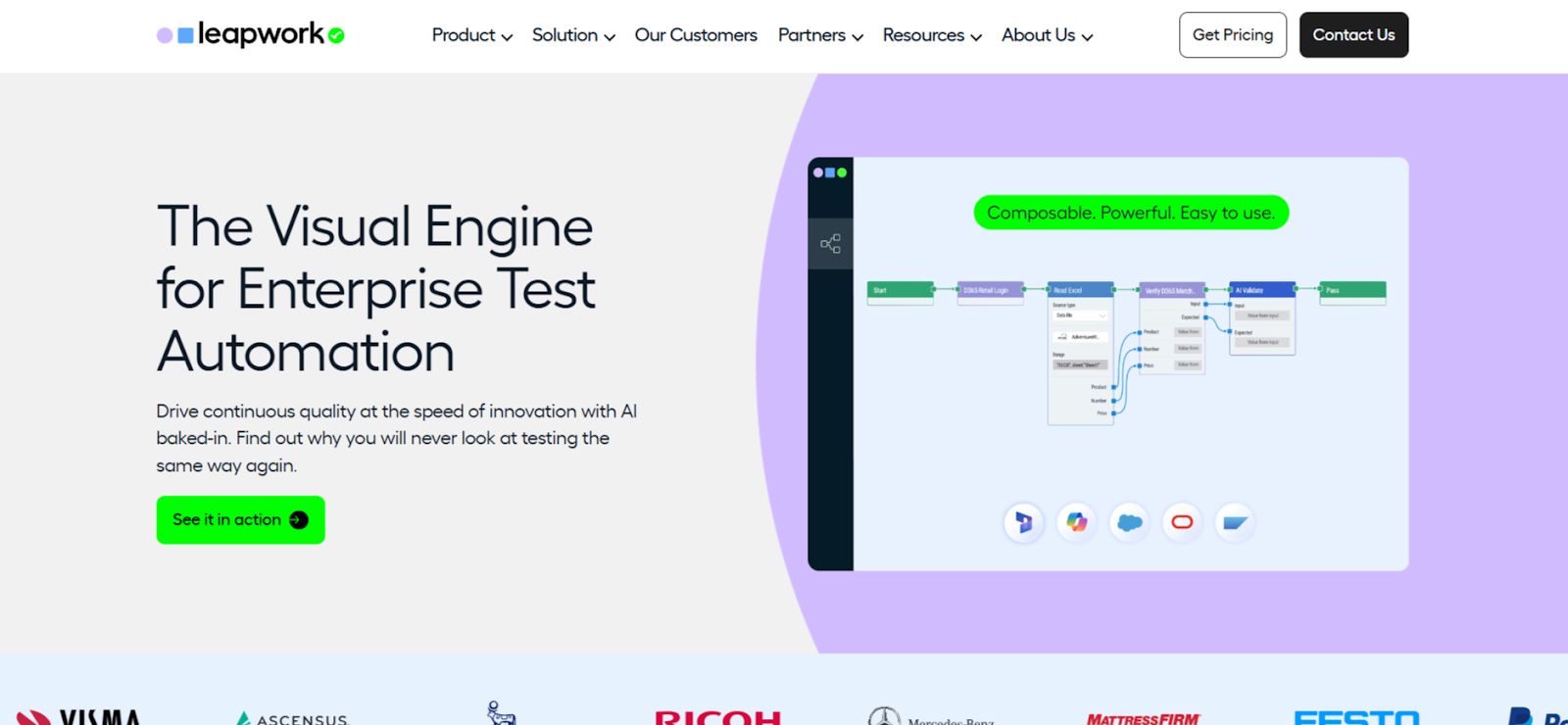
Leapwork AI helps teams generate and extract test data faster while enabling advanced testing.

Leapwork is a visual test automation platform that needs no code. It lets users build and manage tests using a visual flow. It also includes AI modules for smarter automation.

Key Features

  • No Code Visual Test Creation: You can create complex tests using drag and drop. This helps even non-technical users contribute.
  • AI Modules for Smart Automation: Modules handle data comparison, data creation, and visual extraction.
  • AI Testing AI Capability: Leapwork can test AI applications like Microsoft Copilot. It detects errors and risks in outputs.

Who is it for?

Enterprises that need scalable and smart test automation across many platforms.
5. ACCELQ

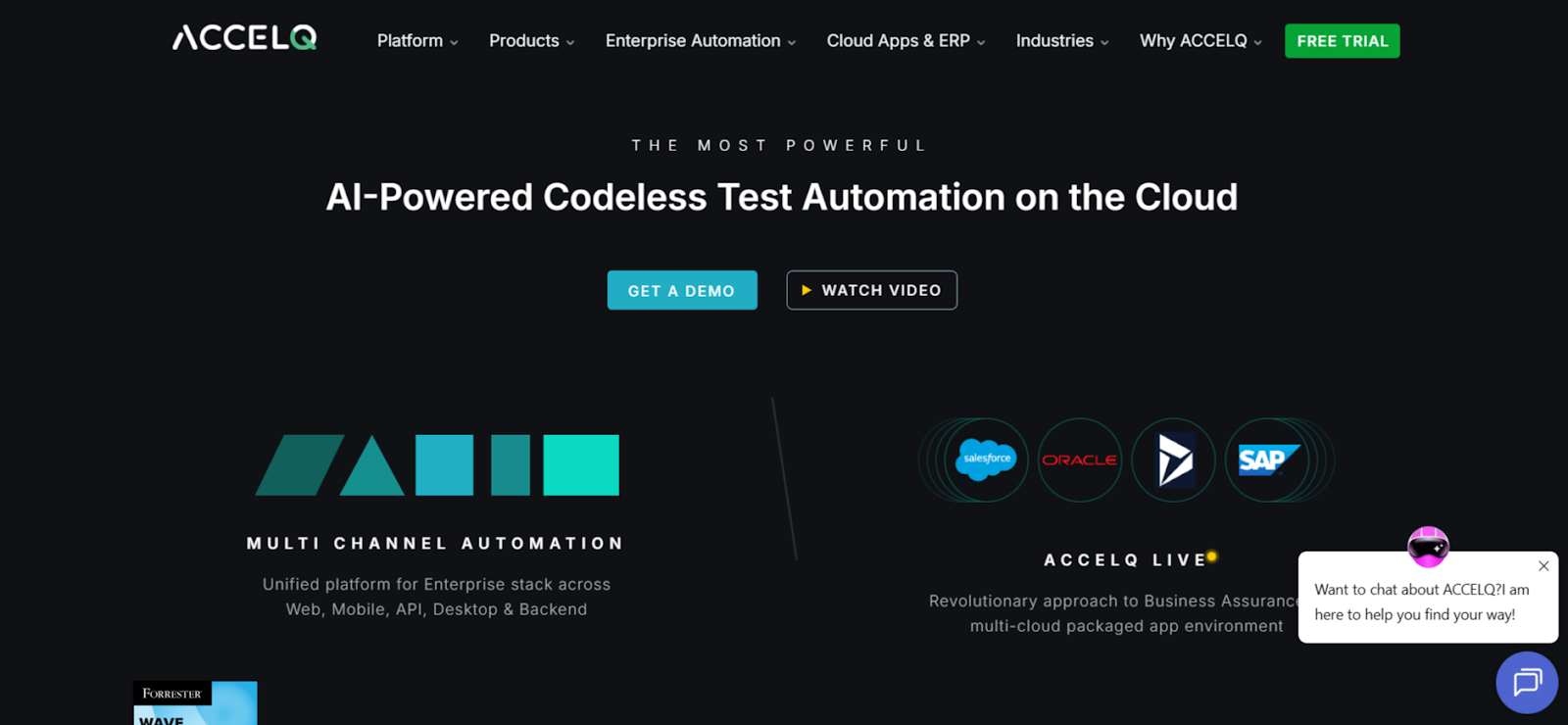
ACCELQ cloud-based AI platform enabling codeless test automation to help teams build.

ACCELQ is an AI-powered automation platform that needs no code. It supports testing across web, mobile, API, desktop, and backend systems. It manages the full quality lifecycle in one place.

Key Features

  • Unified Multi-Channel Automation: It handles all testing types from one platform. This removes the need for many tools.
  • Zero Code Test Design: Both manual testers and automation engineers can use it easily.
  • Packaged App Assurance: It supports live automation for business apps with pre-built assets.

Who is it for?

Teams that want a powerful and simple no-code solution for enterprise testing.
6. Mabl

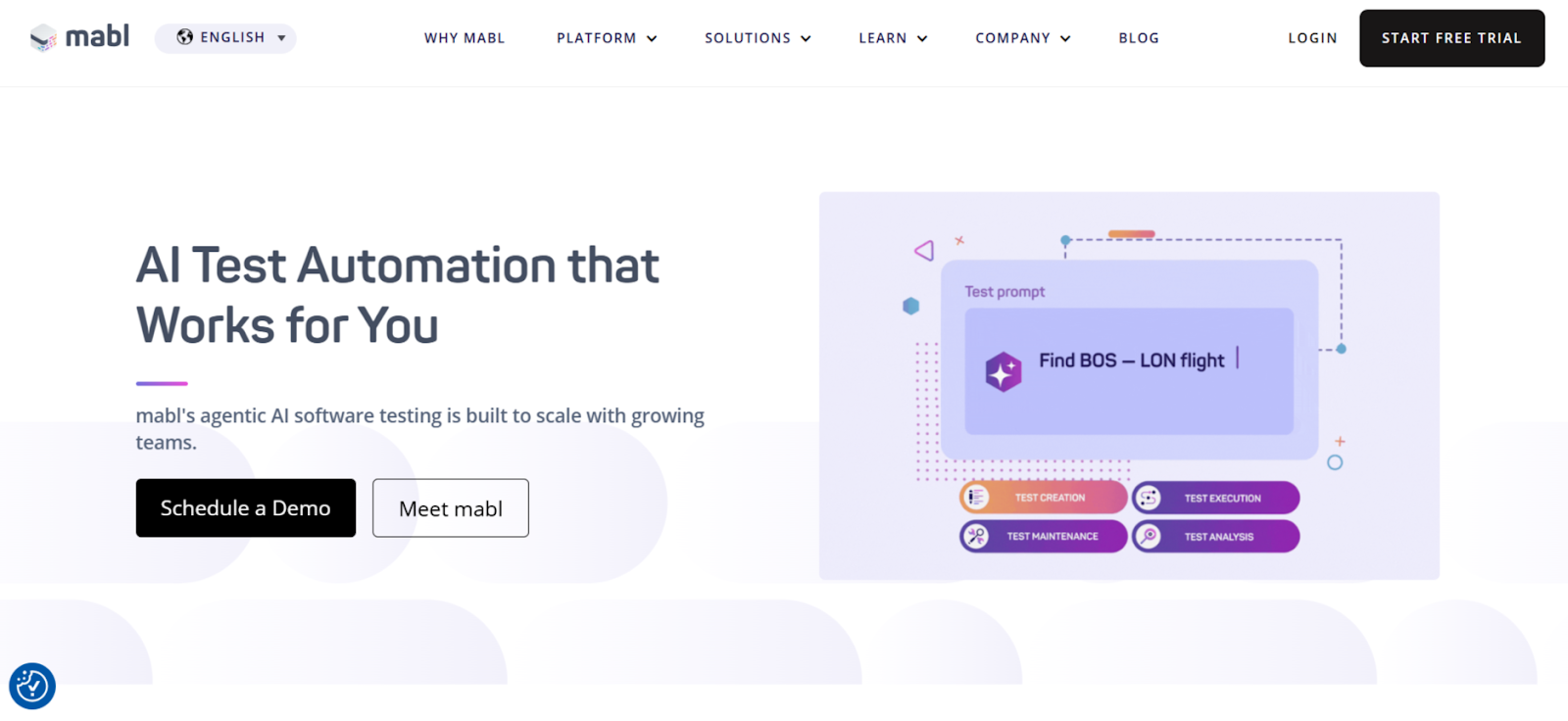
Mabl agentic AI testing platform helping growing teams scale automated testing 

Mabl acts like a digital testing teammate. It manages test creation, execution, analysis, and maintenance on its own. It fits well into developer workflows through the IDE and CLI.

Key Features

  • AI-Powered Test Maintenance: It detects app changes and updates tests automatically.
  • Auto Test Failure Analysis: It studies failures and shares insights directly in tools like Jira.
  • Agent-Driven Test Creation: It creates tests faster by leveraging prompts and context. Think about how much time your team could save here.

Who is it for?

Teams that want to remove testing delays and scale with AI-driven automation.
7. TestGrid
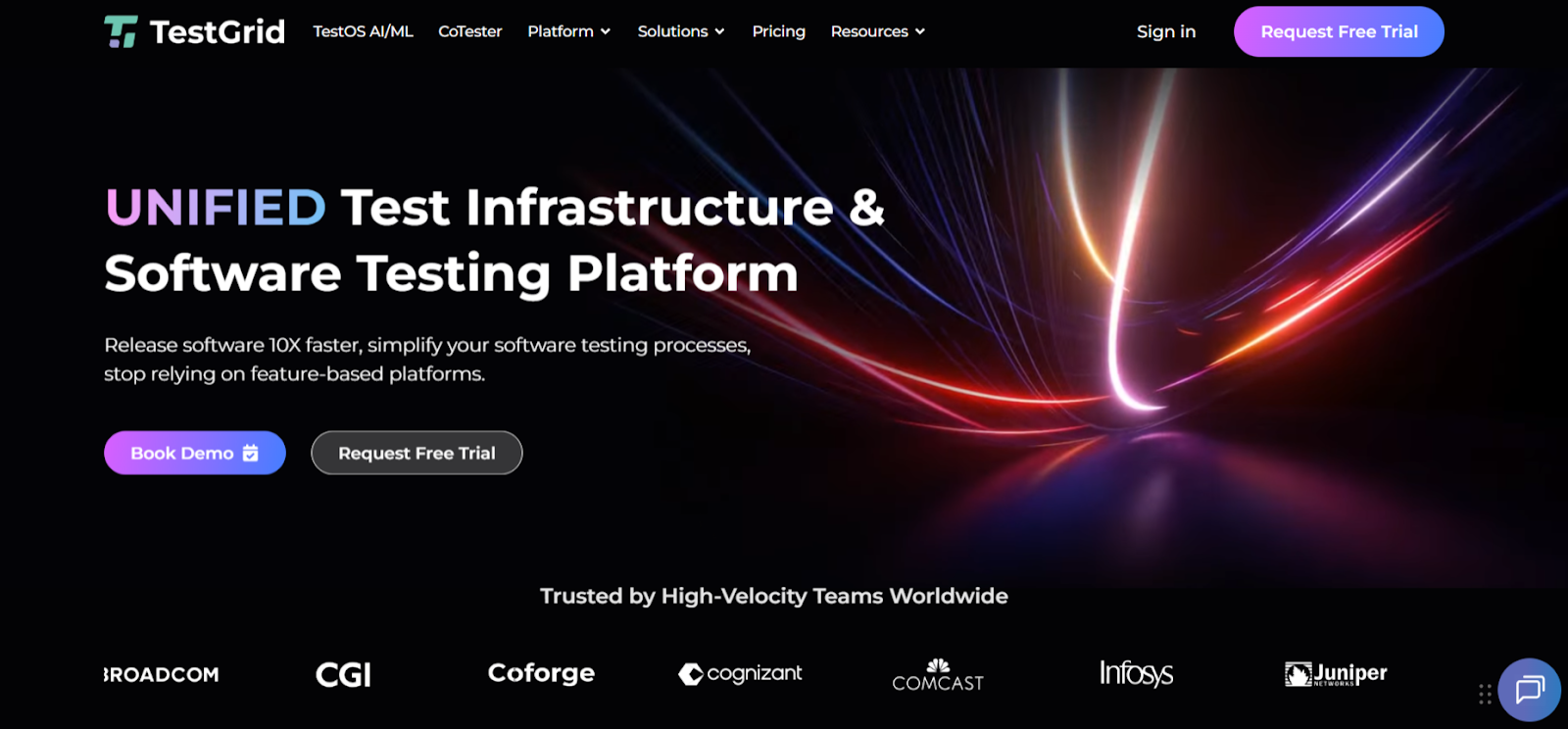
TestGrid unified testing platform providing an integrated test infrastructure to scale software testing efficiently.

TestGrid is a unified test infrastructure and software testing platform. It combines AI-powered automation with flexible deployment options. Its key feature is CoTester, the first AI agent built for software testing. It comes pre-trained on testing basics and tools. 

Key Features

  • CoTester AI Agent: CoTester is a pre-trained AI agent. It creates and runs test cases on its own. It brings smart test automation to teams without deep scripting skills.
  • Flexible Infrastructure Deployment: TestGrid offers on-premises, private dedicated, and hybrid deployment options. This makes it a good fit for enterprises with strict security needs or global teams.
  • Test Creation with Record and Play: The modern IDE supports record and play authoring. It also supports low-code and no-code automation. This makes testing easy for all users.

Who is it for?

Organizations that need a unified testing platform with flexible deployment options for mobile and web testing.
8. Applitools
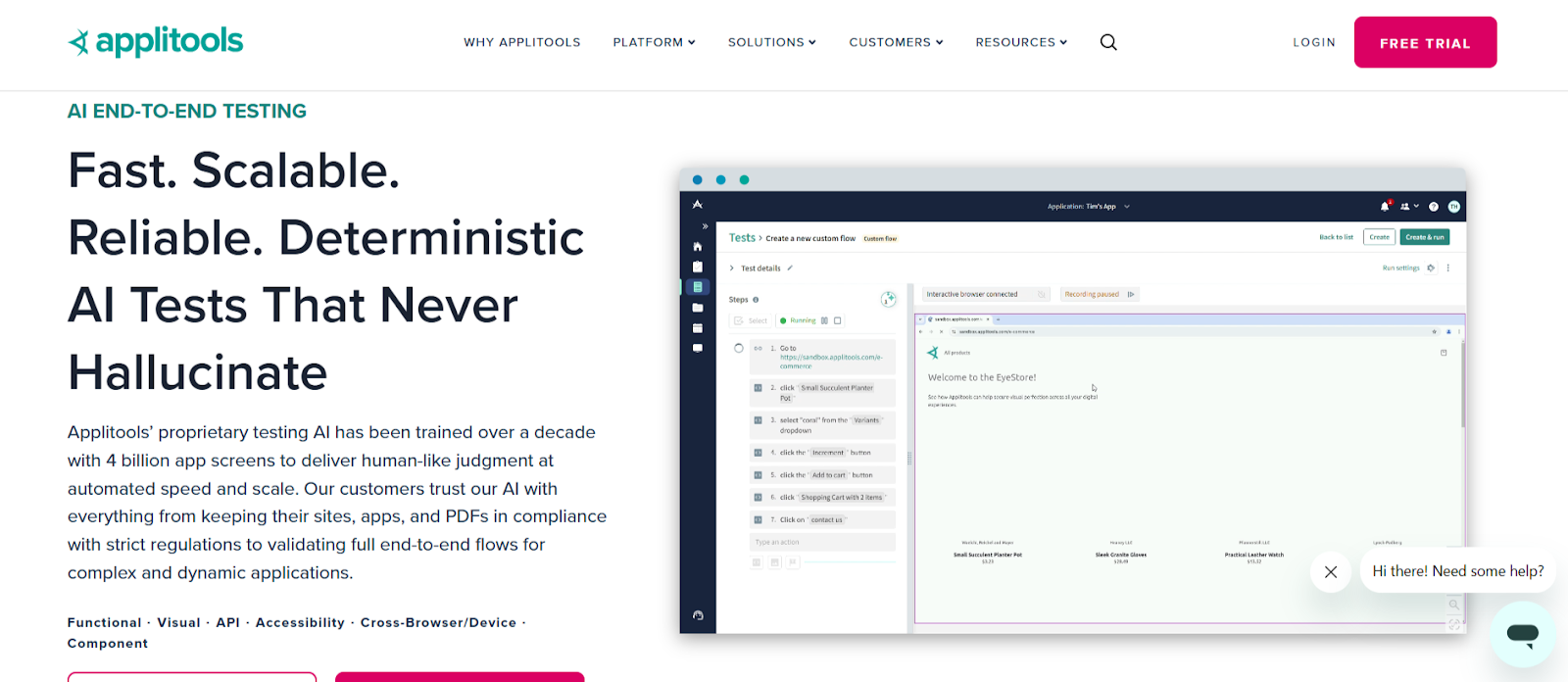
Applitools AI end-to-end testing platform delivering fast, scalable, and reliable visual tests

Applitools is a leading platform for visual AI testing. It uses a strong algorithm trained over many years on more than four billion app screens. 

Applitools delivers human-like visual judgment at scale. It covers functional, visual, accessibility, and cross-browser testing. Its strong security standards make it a trusted choice for regulated industries.

Key Features

  • Proprietary Visual AI: Applitools trains its model on UI rendering across billions of screens. It detects real visual issues and ignores minor pixel noise.
  • Faster Test Creation: Teams create tests much faster and spend less time on maintenance after UI changes.
  • Compliance Ready Deployment: Applitools supports deployment on-premises, in a dedicated cloud, or as SaaS. It meets ISO 27001 and SOC 2 Type II standards and supports secure access.

Who is it for?

Teams that want strong visual testing for web and mobile apps with full compliance and accessibility support.
9. Functionize
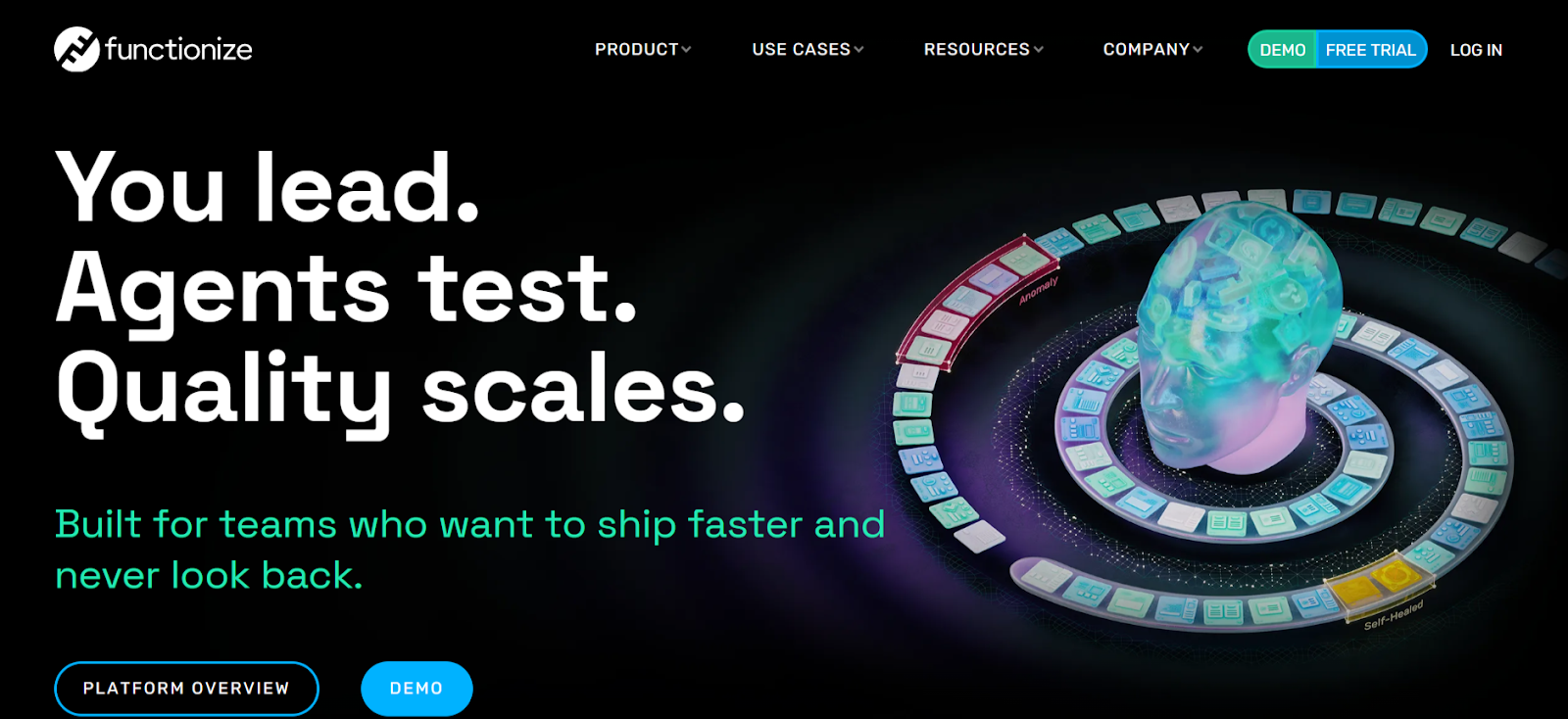
 Functionize AI testing platform where intelligent agents automate testing to help teams scale quality.

Functionize is an AI-driven testing platform. It replaces fragile scripts with smart agents. These agents build, run, check, and fix tests from start to end. Its AI trains on enterprise apps and processes large data points per page. This helps it reach very high accuracy. 

Key Features

  • High Accuracy: Functionize agents recognize UI elements with very high accuracy. They fix tests automatically when apps change. This reduces maintenance work.
  • Parallel Test Execution at Scale: Container-based agents run many tests at the same time across browsers, devices, and locations. This helps teams scale easily without slowing down.

Who is it for?

Enterprises that want to scale testing with minimal manual effort using smart and self-healing agents.

Conclusion

Is your team still dealing with long testing cycles and heavy manual effort? 

AI software testing tools now play a key role in modern development. They help you run tests faster and with better accuracy. 

Among many options, TestSpell from SoftSpell stands out as a strong choice for enterprise teams. It helps you create test cases automatically. It also connects smoothly with your development lifecycle and gives clear quality assurance.

Think about how much smoother your testing process could feel with the right tool in place.

Try SoftSpell today and see how it can improve your entire SDLC.

Table of Contents

    FAQs

    1. What is an AI tool used in software testing?
    AI tools in software testing use machine learning and AI to handle test case creation, execution, failure detection, and maintenance. They help you improve efficiency and overall quality.
    2. How do AI testing tools differ from traditional test automation?
    Traditional tools like Selenium need manual script writing and regular maintenance. In contrast, AI tools create tests automatically. They adjust to changes and fix issues on their own, which reduces manual effort.
    3. Do AI testing tools require coding knowledge?
    Not always. Many AI tools, like TestSpell, offer no-code or low-code options. This helps non-technical users create and manage tests with ease.
    4. Which AI testing tools are best for improving test coverage?
    AI tools like TestSpell help you expand test coverage automatically. They test more scenarios and reduce gaps in quality checks. Think about how much stronger your coverage can become with this approach.
    5. How can I evaluate which AI testing tool is right for my team?
    Focus on what your team needs. You can look at ease of use, tool integration, or automated test creation. Tools like TestSpell work well for enterprise teams that want to reduce manual work and move faster.
    Blog Author Image

    Market researcher at Codespell, uncovering insights at the intersection of product, users, and market trends. Sharing perspectives on research-driven strategy, SaaS growth, and what’s shaping the future of tech.

    Don’t Miss Out
    We share cool stuff about coding, AI, and making dev life easier.
    Hop on the list - we’ll keep it chill.